“Reader, I Gained Weight”: On Eating Disorders and Romance by Katherine J. Chen
I had forgotten the taste of bread. Of salmon and chicken. Of chocolate and figs. My tongue held the memory of these foods, of a cube of Kobe beef so tender that it felt a profanity to chew, of a spoonful of gelato, which seemed to carry a lesson of its own: how the initial shock of cold will give way to the warmth of sugar. For nearly half a year, I drank in large gulps water, tea, and cold brew. In the mornings, dry-mouthed and lightheaded, I would go to the bathroom, pee, and strip naked before stepping on the scale. I would try to ignore the sensation of feeling like a calf on display before its slaughter; I would ignore the paradox of both winning and losing, winning because the number on the scale had dipped since yesterday, losing because I sensed, in the way a runaway train barrels towards the precipice, that if this continued, as it must, absolutely must, I was probably going to die.
In one of those conversations, which if the contents were leaked would likely prove to be career-ending, I told someone that I believed that every woman, no matter how accomplished or intelligent or talented, desired to be called beautiful. In hindsight, I think I said this because, at the time, I equated beauty with simply existing. Wouldn’t it be nice, I suggested, to be congratulated for showing up: for sitting, then standing, then crossing the room and opening a window? Instead, one had to get degrees, to write and publish books, to hold one’s own on Derrida and Lacan and Marx, to listen to Bach and Shostakovich and be conversant about French New Wave. Not that I’m complaining, I said, complaining, and I quoted a favorite line from The Wings of the Dove, “…her easy injunction, tossed off that way as she turned her beautiful back, was like the crack of a great whip in the blue air…” Of course, James understood.
I’ve always wondered about the path by which we arrive at certain truths and how these truths are constructed. In 2016, I read an article about a four-year-old child, who told police officers that her name was “idiot.” This detail stayed with me longer than other features of the story, such as that the child was bruised and malnourished with marks on her wrists from where she had been zip-tied to a bed. I know about black eyes and bloody mouths, how the pain will not last but the sense of degradation will. I know that the body in such cases is merely a vessel, that it isn’t really the eye or the mouth or the tufts of hair like lambswool that is the true target but something else that takes more time to wear down until it won’t move, won’t even cry out. I thought about what it means for a child, particularly a girl, to believe her name is “idiot,” and to introduce herself as such to others in earnest. And because I am not above self-pity, I thought of myself, though I hadn’t endured the same horrors as this child, not even close. If police officers showed up, I would have used the words, “ugly” and “fat,” and uttered those words in two languages, because I had been called “ugly” and “fat” in more than just English. I didn’t know that these were “bad” words. I might even have said, “I’m ugly and fat,” with a good deal of pride. Often, the missives that are loosed from their strings in youth and adolescence don’t land until one has waded deep into the waters of adulthood. Children are hardier than we give them credit for; it’s possible I was stronger as a kid for the sole reason that I didn’t overthink what was happening to me. I rolled with the punches; I learned to raise a ruckus before others could, and if people spit poison at me, I learned to spit the same, or worse, back. Somewhere in my early thirties, I grew soft. I knew I wanted to be loved. I knew, too, I was ugly and fat. So, this was the truth I constructed for myself: Because I am ugly and fat, I am not loved.
Concerning my rapidly shrinking body, I made these observations. Sitting, I could not stand up again without experiencing momentary lightheadedness. Certain tasks, such as vacuuming, which required basic strength, became more difficult. To combat hunger, I would tuck a hot water bottle under my t-shirt, where the heat gave the illusion of making me feel sated. I was always hungry. As I pedaled away on my exercise bike, I watched videos of hot women give food reviews while taking huge bites of overstuffed burritos and slices of cheesecake. On more than one occasion, I escaped to the movie theatre, because the dark, the noise, and the large screen proved an effective distraction from the fact that I had consumed, in the span of 24 hours, a single hardboiled egg. I had only to glance at the mirror to be able to delineate the outline of my scalp, now visible because I’d lost so much hair, while what hair I had left turned soft and thin.
This was the truth I constructed for myself: Because I am ugly and fat, I am not loved.
These observations were true, as was the fact that a sales associate at Neiman Marcus had embraced me when I told her why buying a pair of Helmut Lang shorts in size zero meant so much. In my presence, an elderly neighbor gushed to my mother, “Your daughter is beautiful,” and these words alone carried for the rest of the day the heft of a three-course meal. My new body was so mind-boggling to a member of the maintenance staff in my apartment complex that he spread the word to all his colleagues before beginning his own weight loss journey, telling me whenever he got the chance, “You inspired me.” What I had accomplished did seem, on some level, Herculean. At my heaviest, standing five feet two inches, I weighed 227 pounds; at my lightest, I weighed under 100. I marveled at small moments: how people seemed more willing to sit next to me on the bus and subway; the ease with which I could glide past cars parked far too close to each other in the parking lot; how the gazes of men appeared more inclined to linger; how department stores seemed, at last, to yield up their treasures; how one by one, like the slow unearthing of some ancient landmark beneath my skin, I could count my ribs. I emailed a friend, aware of how silly I sounded, and informed her that recently, I had set foot in Nordstrom and could choose, actually choose, what I wanted to wear, and that among these choices were dresses. I joked that I no longer looked like a beer barrel wearing a skirt.
It is strange now to consider the logic by which I linked the “preparation” of my body with my “preparation” for love. I am thin; ergo, I am ready to date. In my new body, I had plenty of time to think about food and love. To eat is one of the most primitive forms of self-care, just as to feed another is to show care. There must be a reason why during long-distance phone calls with relatives, we always, subconsciously or otherwise, circle back to the same questions: Have you eaten yet? Are you eating well? I wonder what it is about food that conveys affection and concern, why, for instance, certain foods—macaroni and cheese, chocolate chip cookies, cinnamon rolls—are well known for imparting comfort and a sense of security, the edible equivalent of a baby blanket or child’s favorite stuffed toy. For many, particular dishes conjure an almost totemic power, as a tangible and sensory-laden substitute for actual people. I cannot eat or even look at a spring roll, for instance, without also remembering a scene from my early childhood, that is, of my mother standing on our ramshackle back-porch, painted the color of rust, frying spring rolls on a portable gas burner. The frying of spring rolls always felt less cooking than ritual, less food prep than sacred offering. No spring roll has ever come close to burning the inside of my mouth, of bringing happy tears to my eyes, as I cried, “Hot! Hot!” while choking down the first simmering bite. The filling of my mother’s spring rolls was alive and bubbling, not the stale, lifeless creations sold en masse in cardboard boxes at the supermarket, or the lukewarm appetizers tossed halfheartedly into cheap plastic bags at one’s local takeout. If I needed any physical proof of food’s connection with love, I had only to look at my mother’s hands and wrists, which have known as mine have not how it feels to be burned with hot oil, with steam, with boiling water. Her skin is a constellation of scars, as tough as tanned leather.
I think about food and the relief that comes with knowing someone you care for is well-fed and sated, that there exists, at least in this moment, no possibility that they will go hungry, that they will starve. I think about how when there is nothing more to be said, food becomes so easily, even naturally, the default subject of conversation. When big, existential topics are exhausted, when there is no more to be discussed on love or Sartre, on Jean-Pierre Melville and Big Pharma, one can still talk for hours about bread. Just bread. Shokupan. Sourdough. Babka. Ciabatta, focaccia, schiacciata. Brioche, baguettes, and boule. There has always seemed to me a direct connection between loving someone and watching them eat. When I was young, my mother watched me eat, and as a child, growing up in Shanghai, her mother watched her eat. There is comfort to be had in fending off starvation and malnutrition, in providing sustenance, in the observation, the mere witnessing, of the simple pleasure food gives to one who is near and dear to you.
I know all this. Just as I know what it means to live in a fat body. At some indistinguishable point, the chubbiness of a well-fed child becomes a fat child, a fat girl, then a fat woman. At some indistinguishable point, one begins to notice that though food gives pleasure, it’s still thinness that’s prized, and if you believe that anything has changed, really changed, if you start to believe in all the rhetoric around body diversity, inclusivity, and the ugliness of fat-shaming, then I feel sorry for you. You have been fooled. Somewhere in life, these lessons are learned, and the brain develops its own logic and twisted reasoning. My brain told me that food was the enemy of love, that the only obstacle to love and being loved were the pounds of myself that needed to disappear. One has essentially to unlearn everything that is taught in childhood and in school: It’s the inside that counts; don’t judge a book by its cover; intelligence matters more than appearances. Don’t believe any of it, for they are lies.
But believe in the growing number of likes on dating apps. Believe in the potential matches who tell you how beautiful you are, how well you photograph, and how they would be honored to know you better, if you only gave them the chance. Believe in the friends who, wide-eyed and mouth agape, tell you how great you look, how you seem like a different person, how you are a different person.
Better believe that there is a price to be paid for everything. Better believe that love must be earned.
As much as I despise giving credit to an algorithm where matters of the heart are concerned, Hinge delivered. Sebastian, or “Seb,” as he called himself, was an early match. For nearly two weeks, our only means of communication was via text. We didn’t talk on the phone. Nor did we make any concrete plans to meet in-person. He didn’t share his surname, and I didn’t share mine. But we sent each other texts that ran the length of the mobile screen, texts in full sentences and whole paragraphs that discussed what I was working on, creative ideas, and opinions on film and art and music. When I pressed him on what he did for a living, he replied that we would have plenty of time to get to know each other and that he preferred for details of our lives to emerge organically in the natural flow of conversation. He told me when he wouldn’t have his phone on him because he was playing basketball, one of his great passions. He mused on saṃsāra and the cyclical life of cell phone batteries. He liked lox, Woody Allen, and Truman Capote and asked me if I didn’t think “vestibular” was a strange word. His texts read like miniature essays; his sentence structure rivaled William Trevor’s, and he used multisyllabic terms that implied at least some familiarity with Latin. I fell for him. I fell for him well before I knew his last name, before we spoke on the phone, before we even met.
During my weight loss journey, I had stayed away from restaurants. Entering the dating scene, however, threw me back into a world I’d left behind. It wasn’t a surprise that the first snag I hit with Sebastian was over where we would meet for our first date.
“Balthazar?” I suggested, trying to think of restaurants in his neighborhood. “I have good memories of that place.”
“A tourist trap,” he replied. “For our first meeting, I prefer somewhere casual where we can sit outdoors.”
“What do you mean by casual?” I said, feeling testy. “And how casual is casual?”
“Casual means easygoing,” he said. “Casual means not a big production. Balthazar would be a production.”
“Would it? You make a reservation, you go in, you sit down, you have dinner. Is that a production?”
“What about Fanelli Café?” he asked.
Better believe that there is a price to be paid for everything. Better believe that love must be earned.
“What’s that?” I answered, furiously Googling. I scrolled the menu and made a face. Buffalo wings and chicken fingers? Are you serious?
“I’m not sure I’m a fan of pub food,” I said. “Or pubs, in general.”
This continued, until we circled back to my original suggestion. “I will go to Balthazar only because you want to go,” he said, giving in.
Online, I checked for reservations and came up with nothing. Calling the restaurant proved equally futile.
“They’re fully booked,” I informed him. “What do you want to do?”
By then, we had narrowed our choice of cuisine down to three possibilities: American, French, Japanese, or some cross-pollination hybrid of the above. We had excluded Italian because, as an Italian, he preferred not to eat at Italian restaurants. “I can make everything they can—and better,” was the explanation, which given his background as a restauranteur, seemed perfectly viable. I offered more possibilities, none of which passed muster. “We’ve officially landed in options territory,” he said.
“I don’t really care where we go,” I answered, losing patience. “But I’d prefer somewhere quiet with spacious seating, sufficient air to breathe, not congested. Clean restrooms. And, most important, I’d like to actually meet you.”
It seemed ironic, a trick of fate, that we ended up at an Italian restaurant, the space of which felt positively cavernous compared to other spots in Manhattan. The lighting was sufficiently dim to render most everyone in the space mildly attractive, and as the hour was still early for dinner, customers were few. “Spacious enough?” Sebastian asked, as soon as we settled into a large banquette.
“Spacious enough,” I said.
In going through life, it is hard to delineate ends and beginnings. All the times I’ve had toothache, which have been numerous, I thought the pain would never end. I would never know again what it would be like to live without the sensation of someone holding a blowtorch to my gums. On the occasions I had a fever, which was common when I was a child, it was the same, the whole world atilt; likewise, with grief over a dead dog; with bad colds and coughs; with hiccups; with writing a book. How does one chapter become thirty and counting? I still don’t quite know. When does a toothache or a cough give up the ghost, the world right itself again, a new dog appear on the scene? It always seems impossible, until it isn’t.
I mention this because I couldn’t, at the time, foresee how my struggle with anorexia would end. I did not want to return to my former self; I also did not want to die.
I couldn’t know that my healing would begin that evening of our first date, that if one chapter of my life ended with renouncing bread, a new one would commence with a bread basket, a plate of tagliolini and sea beans, and a lemon tart topped with toasted meringue. That it is commonplace, even mundane, for a relationship to start with an invitation to dinner suggests to me that there is latent within food the possibility of intimacy and romance, its very presence implying potential communion. In the restaurant, I studied the menu. I drank copious amounts of water because it was hot, the height of summer, and I was nervous about eating too much. Somewhere I had read that it was good to drink at least two glasses of water before a meal, that there is a delay in the signals the stomach sends to the brain. The brain is apparently slow in registering satiety, making it easy to overeat. Therefore, eat slowly. Therefore, I tell myself, eat smaller and smaller portions. Therefore, I tell myself, perhaps, better and safer for the body not to eat at all.
In the throes of my eating disorder, I often wondered what women are supposed to do with food. To be frank, there are still moments when I seriously ponder the question. What are women supposed to do with food? At the risk of stirring the reader’s ire, I promise I’m not being deliberately obtuse. Having no health insurance, I didn’t have access to a nutritionist or dietician; I had no concept of what it meant to eat well-rounded meals, to occasionally indulge but in moderation. My thinking was dangerously simple and reflected a lifelong tendency to take things to extremes. Dieting was deprivation. If for decades I’d enjoyed a surfeit, now I had to withhold, to punish myself, and to starve.
To this day, I don’t know how I came to order the dish of tagliolini and sea beans. Perhaps it was the cheapest item on the menu. Otherwise, it doesn’t make much sense. Pasta (a carb!) was strictly verboten. Likewise, I don’t know how a piece of bread from the bread basket ended up on my plate, the crust left to soak in a small puddle of olive oil garnished with pepper. I remember watching Sebastian, who casually remarked that he loved bread but preferred only to eat the crusts. I remember smiling when he said this, breaking off a very small piece of crust, and touching its toasted warmth to the tip of my tongue. I swallowed. Nothing happened. The roof didn’t cave in. The waiters didn’t trip over their feet and spill their platters or tumble headfirst into the banquettes. No one stopped to stare. But suddenly I remembered the taste of bread. I looked down at my plate as if a small miracle had enacted itself without my knowing. Sebastian took another piece of crust and dabbed it in olive oil, and I did the same.
I fell in love in stages: a lemon, a mint leaf.
The brain doesn’t register everything. Possibly, it doesn’t need to, and perhaps it’s better that it doesn’t. The body holds its own laws, its own yearning and awareness of the world. That evening of our first date, I ate slowly. I cut my sea beans into ridiculously small pieces and lined them up in neat rows, as if I were preparing to feed a fussy baby. I talked about my books, my work. I showed Sebastian the Henry James tattoo I got in Paris on my right forearm. “The best possible souvenir,” I said. “Beats a tattoo of a croissant, doesn’t it?”
We talked about French cinema and the bad acoustics of the restaurant. At one point, he looked over his shoulder at the chatty group of young women in the next banquette and said, “Someone turn the radio off,” and I laughed.
Somehow, I don’t know precisely how, the plate of tagliolini and sea beans disappeared. I tasted oil on my lips and forgot to wipe my mouth. I remarked to myself how good Sebastian looked in the ambient light, and with every such thought, another bit of pasta vanished from my plate. I stopped refilling my glass of water. It was the day before my birthday, so we ordered dessert.
“Una vela, sin cantar,” Sebastian said to the waiter, and some moments later, the lemon tart arrived with a single silver candle.
Under the table, we held hands, and I told him my wish was that I would have the chance to see him again. For the first time in months, I forgot about food. I forgot about food because I was full.
Falling in love isn’t a distraction. Rather, I think more and more that it is a guide. I see love as filling in those parts of the self that need care. Holes are patched over, rough edges whittled to smoothness, wounds aired and given the chance to heal. In Sebastian’s kitchen, I watched him squeeze a lemon between his hands over two plates of salad, and I wondered that such a sight could inspire so much awe and make my heart swell to the point of pain. “Do you know what you do with mint?” he asked over a dish of strawberry panna cotta before rubbing the sprig in his palms, inhaling, and offering the gap between his thumbs to my nose.
Reader, I gained weight. I fell in love in stages: a lemon, a mint leaf. I fell in love over butter-soft sashimi, over rainbow trout, clams, and yellowtail rolls, over margarita pizza and porcini mushrooms, over chocolate mousse, chocolate cake, and chocolate soufflé. The physical trail of my path to healing could be found in plates and bowls scraped clean, on paper and cotton napkins bearing lipstick stains, over bare and candlelit tables on which I left water rings, scattered breadcrumbs, and the stray piece of arugula. Is it possible in life and in love for food not to serve as some point of reference? Particular dishes conjure precise memories. Cod and matchstick vegetables remind me of New Year’s Eve, where a live bossa nova performance made up for the fact that my fish was over-salted. In a parking lot outside a Greek restaurant, the honey of baklava still on my tongue, I remember being pulled into the combined shade of an SUV and pickup truck and kissed. The music of Chaka Khan brings to mind a cup of sencha, sipped in a hotel bar not far from Carnegie Hall, where Sebastian and I had just watched a concert. The concert had been awful, reminding us both of the kind of grating, nostalgic entertainment performed on cruise ships and in senior homes with pastel wallpaper; the young woman singing “Through the Fire,” on the other hand, possessed a voice that could fill Stern Auditorium—and then some. Over a plate of linguine frutti di mare, he said for the first time, “I am in love with you,” and if I did not swoon, it was only because we were waiting for the tartufo. Manhattan, in especial, the Lower East Side, has become a landscape scattered with small monuments, significant only for how personal they are to me. Washington Square Arch can’t compare with any of the wooden benches outside of La Colombe in NoHo, where on a starlit evening, the autumn chill settling around us, we drank hot cocoa and talked of the past. Later, on the same bench, Sebastian would hold my hand, as he worked patiently to remove a splinter, his nail gently scraping at my skin.
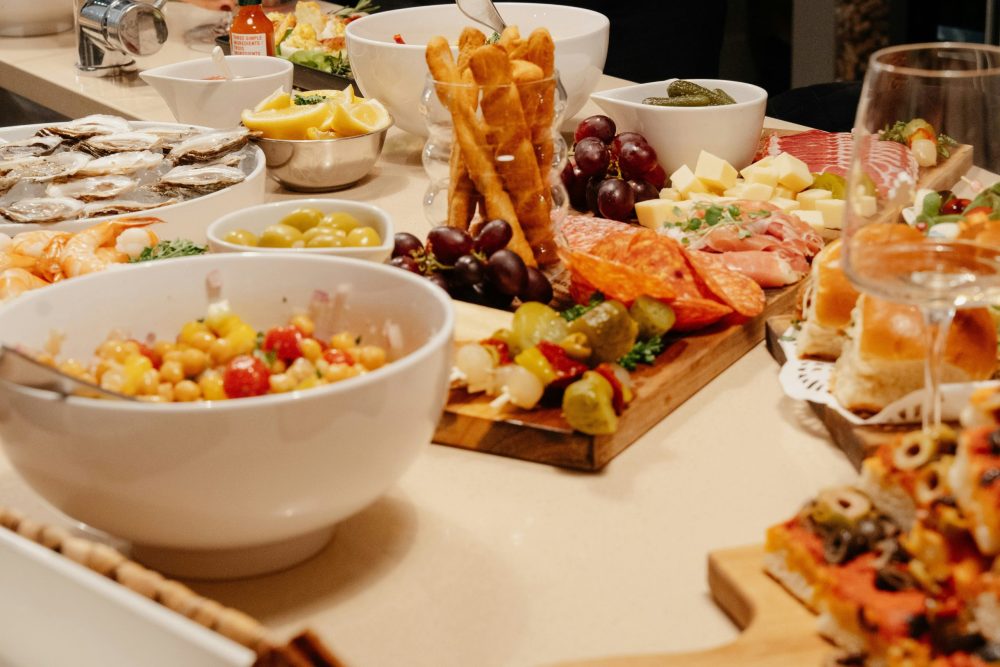
If I fell in love in stages, then my healing also comprised individual moments and lessons internalized by my body. I learned that food wasn’t to be feared. To indulge was not to let myself down. I could control what I ate. I possessed the intelligence to determine what was good—and less good—for my health. I learned, too, that many things in life existed beyond the reach of mere nutrition labels, that you cannot hope to measure the value of a memory in grams of protein and fiber. If there is nutrition for the body, then there is almost certainly nutrition for the soul. This is wisdom that is acquired bite by bite, dish by dish; the kind of lesson one absorbs watching the remnants of a previous night’s charcuterie board turn into an omelet as if by magic. Jambon de Paris. Gruyère. A sprig of rosemary pilfered from a Japanese restaurant’s window box. Three organic eggs and a splash of olive oil. “It’s more a frittata,” Sebastian said, bending over the skillet and sprinkling in a pinch of sea salt. When the omelet arrived, I did a little dance of happiness. I broke my own rules around taking pictures of food (the remit of influencers) and snapped photos of the omelet from different angles. I kissed Sebastian on the cheek. If this is all life had to offer, I thought, just an omelet on a glass plate with two parsley leaves for garnish, then it would be enough. I could die happy.
Perhaps there is some degree of mimicry in love that manifests itself in habits and in convictions about food. I discovered I liked smoked salmon, Balocco’s Buongiorno biscuits, Manchego cheese, and split pea soup. I became highly opinionated about bagels: Plain was the way to go; a bagel with the dough scooped was always better than an unscooped bagel; a bagel was not a real bagel that did not also have a hole in it (not a squished hole, a proper hole); a plain bagel without lox hadn’t achieved its full destiny as a bagel. Neither of us could understand the copious amounts of cream cheese that seemed to accompany every bagel; certainly, neither of us would ever stand in line outside Apollo Bagels. No food in the world was worth waiting for, we agreed, if it took more than five minutes to place an order. I began to dip cookies in tea and coffee and to drink a mug of peppermint tea before bed. I bought a cheap French press, which until it broke, played as vital a role in my morning routine as the chalice during Mass. I think of a moment in Jane Austen’s Pride and Prejudice when Mr. Darcy says, “I have been used to consider poetry as the food of love,” and now I wonder if the food of love is, in fact, simply food.
In saying this, I do not mean to be reductive about how an eating disorder is managed, much less conquered. Often, far more complex issues are at work, and the journey to healing can be long, full of reversals, false starts, and regressions to harmful habits. What I had to face was that my broken relationship with food ultimately mirrored a broken relationship with myself. This isn’t about receiving permission from someone else to eat. Rather, it’s about the realization that to eat and to be loved are not mutually exclusive. If this should strike others as being self-evident, then consider yourself fortunate. It wasn’t long ago that I recorded on small slips of paper every item of food ingested; if I consumed 200 calories for breakfast, I would work off at least 400 calories at the gym. Once, having eaten out for a celebratory dinner, I proceeded from the restaurant to the elliptical and exercised for three straight hours, terrified of sodium levels and what my weight would be the following morning. Body-checking and laxative abuse became second nature. The most insidious aspect was my own self-awareness. I knew I was slowly killing myself, and still I jotted down every hardboiled egg, every banana and apple slice, every dozen blueberries and half-serving of nonfat Greek yogurt. My period stopped. My right knee, likely from over-exercise, started to appear misshapen, bending outwards and making me look partially bowlegged.
The physical trail of my path to healing could be found in plates and bowls scraped clean.
If I was aware of being caught in a destructive cycle, I also knew what I needed to heal: someone, who wasn’t myself, to encourage me to eat, to show, by gesture, by words, by simple kindness, that to feel sated was not to engage in an act of self-harm, far from it. In the end, I became the only person who didn’t want to celebrate my new body. Instead of receiving congratulatory remarks, I wished people who’d known me from before I lost weight would tell me I had always been beautiful. No one did. Instead, they were curious. “Did you use any GLP-1 drugs?” they asked. When I told them no, I had no insurance, and I couldn’t afford the medication out of pocket, they expressed amazement. “I can’t believe you lost that much weight on your own!” they enthused. It isn’t fair, but it would be naïve to ignore that, in any society, there doesn’t exist some correlation between aesthetics and attraction. The standards may vary; the desire for beauty, however that may appear to the individual person, does not.
Many friends and acquaintances have drawn a direct line between my weight loss journey and the love I now have in my life, a cause-and-effect story that I reject with some vehemence. They say that if I didn’t lose half my weight, I could forget about having a partner. Who would even look at you? In other words, my willingness to starve was also a sign to the universe that I was ready to love and be loved. I will never attribute to bullying, abuse, and harm the credit of enlightenment or happiness. But I will draw a connection between the act of sharing a whole branzino and the act of sex, between snacking on pane carasau with a sharp cheddar and kissing with tongues. In both instances, the mouth has achieved its telos. To taste my lover’s cum, I have found, brings the same warmth and satisfaction as the first bite of a cinnamon sugar donut.
It seems a natural progression to move from food to sex, for one form of hunger to replace another. The salt of the omelet still in my mouth, I returned to the bedroom and watched Sebastian take off his clothes. A soccer game was on. Neither of us bothered to turn it off. I lay on the bed and sucked him. Later, after we had finished, I took his hand and tasted the tips of his fingers. I thought of a time when we had gone to a bakery, and because my hands were full, Sebastian held the cookie he had bought to my cheek so that I could feel its warmth. The boy behind the counter had told him a new batch had just come out of the oven, wasn’t he lucky? “Cookie kiss,” I said. You could have offered me the Hope Diamond in exchange, and it wouldn’t have swayed me. As we left the bakery, I cupped the cookie as if it were the Holy Grail. I licked the mixture of dark chocolate batter and melted peanut butter chips from the wax paper bag and felt like a teenager about to write a bad poem.
Another discovery is this: The body wants to heal. If I had starved myself for love, then it was love that also saved me, that anchored me to the earth by giving me weight and heat and substance, and, therefore, strength. If men were at one time in my life both the enemy and the goal, it was, I confess, a man who steered me back to the path of nutrition, of consistent but not copious exercise, of the occasional indulgent sweet treat. For the dream of having a date, I had forgotten the taste of bread; it was on a date that I remembered it. I now know what Anna Karenina meant when she says to Count Vronsky, “I am like a hungry man who has been given food. He may be cold, and dressed in rags, and ashamed, but he is not unhappy. I unhappy?”
In an Italian restaurant, faced with a serving of tagliolini and sea beans, I had felt a rising panic. I recall inching the dish towards Sebastian, and when he didn’t respond, trying to fork as much of the pasta as I could on to his plate. He shook his head, refusing. “That’s all yours,” he said. Then, looking at me, he added gently, “Eat.”
I ate. I have been eating ever since.
Read the original article here