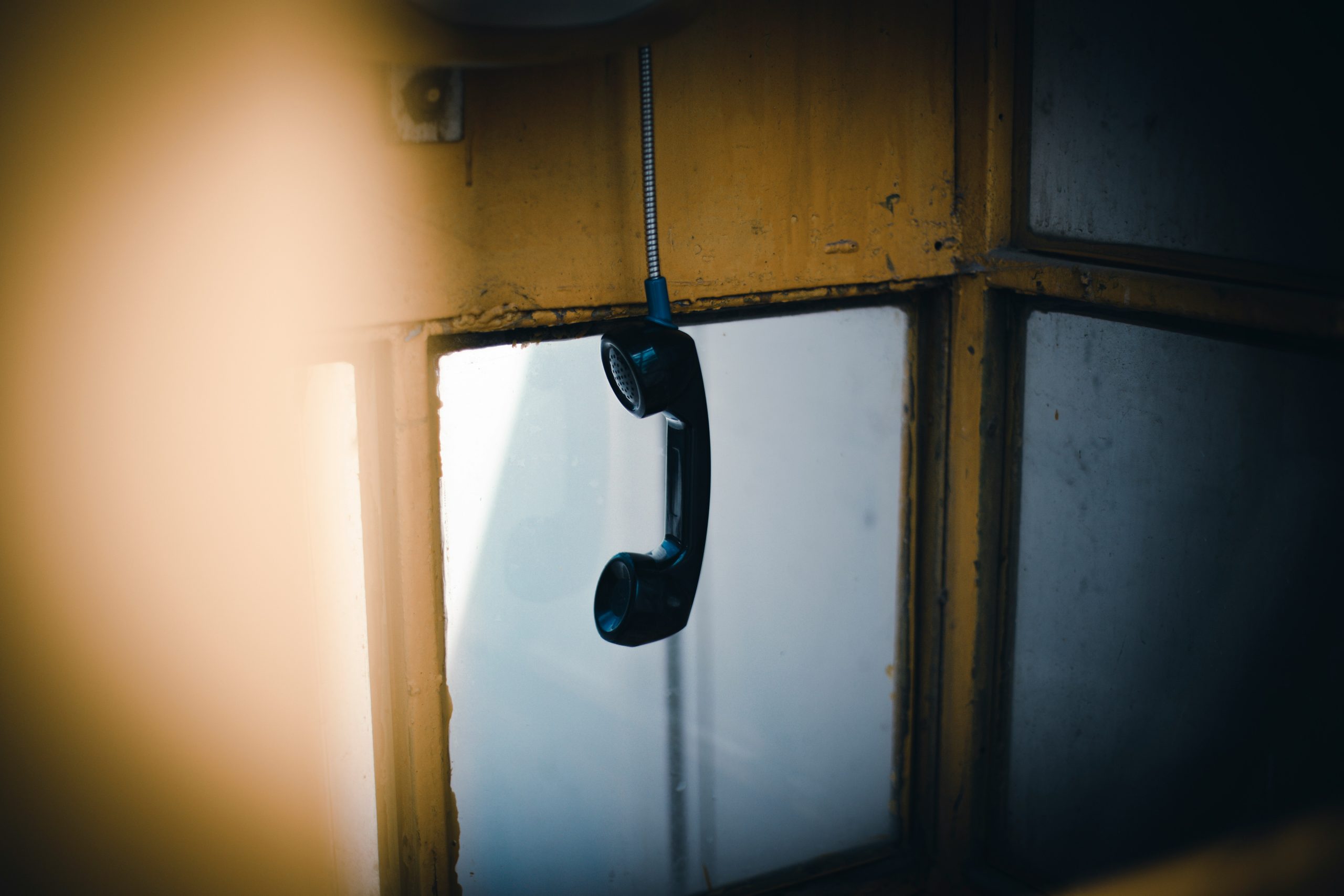
This Anonymous Caller Is Not a Metaphor for Her Despair
“Going Up” by Chris Vanjonack
It’s the middle of the night when the Speaker first calls, and the timing is awful.
It’s nearly 2:00 a.m., for one thing, and Kate teaches first thing in the morning, but what’s worse is that Tom’s neighbor—her neighbor, now, she keeps reminding herself—didn’t wear himself out from all the screaming until like half an hour ago, and so when Kate’s phone rings, she was just, finally, maybe, starting to lose consciousness. The neighbor shouts like this every few days or so. Last week he wouldn’t stop moaning about how there’s no such thing as the self, and earlier tonight he was inconsolable about his own mortality. “Oh God!” he began shouting through the too-thin drywall, just a few minutes after midnight. “I’m gonna die! Everybody I know is gonna die! What the fuck.”
They figure that whatever’s going on with him is some sort of night terrors situation, but in, like, “an existential way,” is how Tom puts it. Kate doesn’t understand how her boyfriend has put up with this for so long, although, to his credit, he really did try to warn her about it before she moved in. She dismissed his concerns, though, figuring the screaming would be like living near a busy road: annoying, sure, but you get used to it. And while the pang of anxiety in her stomach about their relationship has mostly subsided ever since Tom finally agreed that she should move in, she didn’t think it would be this way, living here. She thought it would feel like the start of something.
Whatever their neighbor’s deal is, his whole vibe is starting to mess with Kate. She’s been a little short with her middle schoolers, lately, a little short with Tom. It doesn’t help that he usually sleeps right through it. Some nights, Kate puts headphones in, some nights she bangs on the wall, and some nights, like tonight, she scrolls endlessly through Instagram while the neighbor narrates his terror, until eventually and inevitably she finds herself lingering on a post from her ex-girlfriend, Naomi.
Naomi’s pictures are always West Coast cool: rooftop parties, neon lights, gallery openings, installations, out of context glimpses of the surf rolling up against sand and rock. And on the rare occasion that Naomi makes an appearance in these photos, she of course looks invariably glamorous even with her face underneath a mask. When Naomi first moved out to Los Angeles, she told Kate that one way or another she was going to be a cliché—the artist who moves out to LA and makes it, or the artist who moves out and doesn’t—and, wouldn’t you know it, she really seems to be making it. Tonight’s post was characteristically in vogue: Naomi standing on a balcony with her arms against the railing, a cigarette burning between her fingers, her pierced naval just barely visible underneath her crop top. Kate’s thumb hovered over the heart reaction before she thought better of it, reminding herself that she had chosen this—Tom instead of Naomi, Denver instead of Los Angeles, relative stability as a schoolteacher instead of the whole starving artist thing—and so she continued on, scrolling toward the bottomless abyss.
And now at nearly 2:00 a.m., their neighbor a half hour into a silence she hopes will last the night, Kate’s loosening thoughts are trickling from Naomi toward sleep, when her ringtone chirps in the dark.
From the carpet, her screen casts a blue hue over her corner of the room, and next to her, Tom groans and rolls to his other side. As the phone rings again, Kate’s first disoriented idea is that someone has died—her father, her older brother, some aunt. Maybe it’s a drunk dial, she thinks, a wrong number. The thought crosses her mind that it might be the Speaker, but she reassures herself that this is unlikely, especially now that she’s all moved in with Tom and her rent has been practically cut in half and they’re together in the unmarried but very much settled-feeling way that defines so many of the relationships in their respective orbits. It’s not the Speaker, she tells herself. It can’t be. Instead, Kate steels herself for bad news, fumbling her arm over the bed for her phone. From still under the covers, she squints at the words UNKNOWN CALLER displayed across the cracked screen. She knows right away that she shouldn’t answer, but she accepts the call anyway.
The person on the other end of the line is crying.
Which is to say: The Speaker has called. The Speaker is crying.
“Hello?” says Kate, and next to her, Tom mumbles something incoherent.
“Hey, man,” the Speaker manages, between sobs. “You don’t know me.”
“No I don’t,” Kate hastens to say. “You’ve got the wrong number.”
“Wait,” the Speaker says, and he takes an exaggerated sniffle. “You’ve gotta take it.”
“Take what?” Kate asks, because even though she’s been hearing clips on the news for however many years now, it’s still unnerving to have this entity’s voice actually speaking to her, to hear how upset he actually sounds. His voice is pained, desperate in a way she can’t name. Like pretty much everyone, she’s known a few people, tangentially, who’ve gotten the calls, but deep down she never really believed it could happen to her. Especially not right now, when things are good. She knows it’s a reductive way of thinking about it, but she’s internalized the idea that only struggling people, lonely people—fundamentally unhappy people—are supposed to hear from the Speaker.
Tom’s awake now. “Kate?” he says.
“You’ve gotta take this fucking heart,” the Speaker continues, louder. He’s not crying anymore. In the background she can hear the patter of something dripping, the muffled beat of soaring traffic. “I’ve got this fucking heart right here,” he says, and now his voice is sober, crisp. “You have to take it. It’s so bloody. Oh, Jesus. It’s leaking, Kate. Leaking all over my nice pants. You’ve gotta help me. The ventricles are waggling like crazy, Kate, flapping all over—”
She hangs up. She pitches her phone to the carpet.
“Was that—” Tom asks, clicking the light on his bedside table, and his voice is shaky with adrenaline. “Kate, shit, really?” He leans in to diagnose her expression.
“No,” she says. “Well. Yeah. But. It—it’s gotta be a fluke.”
From the carpet, afloat atop the lumpy bulk of discarded clothing, Kate’s phone rings once again, the words UNKNOWN CALLER lighting up the screen.
Kate buries her face in her hands, already visualizing the next few weeks, months, maybe even years of this sprawled out ahead of her, all the complications, the inconveniences, the explaining. “Fuck me,” she says. “This is gonna blow.”
“It doesn’t make sense,” Kate says. She and Tom are standing outside their building in the wake of the call, Kate smoking and looking out at the McDonald’s with the broken arches across the street, Tom’s nose only a few inches from his phone. Kate has given up on sleeping. She’ll call out in the morning, send along some half-baked sub-plans—watercolors for sixth grade, maybe a figure drawing activity for eighth. She believes, really, that this shouldn’t be happening to her, and for a moment she wonders, absurdly, if there’s a lever she can pull to put a stop to all this. Who do you report to? she imagines asking the Speaker. Let me talk with him. Kate takes a drag of her cigarette and cranes her neck to spy on Tom’s findings as he finishes typing getting speaker phone calls even though happy into his search bar. “What’s it say?” she asks, blowing smoke into the night. Absently, she wonders if their neighbor also gets the calls, if they’ve driven him to screaming, or if his nightly, delirious panic has summoned the Speaker to him. If Kate’s getting them, then surely their neighbor must be, too.
“Hold on,” Tom says, scrolling. And then: “You know what it’s going to say.”
“I know, but,” Kate says, and she doesn’t finish the thought. “Come on.” Her phone is upstairs—turned off, of course—and she feels irritated that she needs to rely on Tom for this, especially given that looking stuff up online is pretty much his whole deal. The compulsive googling was cute at first, back when he would ask the internet things like, Denver date ideas, or Best Netflix documentaries, but over the course of their three years together, his searches have taken on an outsized authority in their relationship.
moving in with partner first time, he’s googled.
signs of healthy relationship
anxiety couple
When he’s not looking up urban legends or demonic rituals, Tom’s always googling shit like this about their relationship, and his recent searches are like a sad little window into everything he’s unable to vocalize. Tom doesn’t know that Kate’s seen most of these, of course, but he’s careless about leaving tabs open, and it’s become clear that Google is his doctor and his therapist. His mother. “Did you know,” she remembers him asking, a few months before her lease was up, “that more long-term millennial couples are choosing to live apart? Listen to this: Experts say that younger people are realizing that they don’t have to do what older generations felt they had to do,” he recited, holding his phone to his face. “They’re forging their own model for successful relationships, often rejecting cohabitation altogether.” And then he looked at her, expectant, like she owed a 2014 Cosmo article a rebuttal or a concession. As though it knew more about their relationship than she did.
Shivering, Tom looks up at her now and grimaces. “I’m looking on the CDC website,” he announces, and Kate can see his breath. Spring has finally started to emerge from the dry winter, but the nights are still cold and the sidewalks are still lined with dirtied snow. “I don’t know what to tell you, Kate.” He passes her the phone, and, hand shaking, she scans the page:
The Center for Disease Control continues to monitor the proliferation of bizarre phone calls from an unidentified entity popularly referred to as “the Speaker” . . . Although difficult to quantify, anecdotal data suggests that individuals experiencing personal crises may be particularly susceptible to the Speaker’s calls, with some even going so far as to argue that the Speaker’s phone calls represent a manifestation of the recipient’s internal state . . . Risk factors may include recent terminal medical diagnosis, bereavement, complicated grief, relocation, depression, anxiety, post-traumatic stress disorder, obsessive-compulsive disorder, job loss, relationship loss, or loss of financial security . . . Although an exact cause is unknown, recipients are encouraged to seek mental health resources at their earliest convenience.
Kate hates that he is right. “Fuck,” she mutters, and Tom puts his hands in his jacket pockets and looks up at the hazy sky. She shakes her head and types, speaker calls why reddit into Google, sifts through the pinned thread on r/speakersupport.
I started getting the calls like a week after the floods.
The night Brad left and then pretty much every night since, lmao.
Right at the start of quarantine, like the very first day. Back when we all thought we were gonna die.
“You okay?” Tom asks.
Kate pulls hard on her American Spirit, hitches the smoke deep into her chest, jets it out fast between pursed lips. More than anything she wants to call Naomi. To hear her voice and to tell her what has begun. And it’s not like her ex-girlfriend would have any real answers, obviously; it’s just that the initial reports of the Speaker kicked off during the early days of her and Naomi’s relationship, junior year of college, early on in the relationship. Kate remembers the first stray mentions on Twitter, then TikTok, then all at once a front-page spread across the New York Times, a nervous Colbert monologue. She remembers watching news reports from underneath hanging string lights in Naomi’s bedroom, her girlfriend running a hand up and down her thigh and saying, “What if this is real?” She remembers burrowing into Naomi’s embrace across nearly every night of those unstable first few months. And so now she craves, guiltily, to speak with her ex-girlfriend the way she sometimes longs to crawl inside a photograph or a memory. A dream.
“I don’t understand,” Kate says into the wind. And she doesn’t. Because even though, sure, she’s been feeling pretty checked out in the classroom lately, and she’s fallen a little behind on her student loan payments, and the check engine light on her dashboard is a loaded gun that she can’t afford to deal with just yet, and of course the fucking guy next door just keeps screaming all through the night, she still means it when she waves her hand through the air, the lit tip of her cigarette an arcing star, and insists, “I’m happy.”
“So, seriously,” Tom says the next night, squeezing the steering wheel even though they’re pulled over onto the shoulder. He always avoids eye contact when he’s frustrated, and rather than looking at Kate, he stares instead out the windshield toward the chipped RIVERDALE ROAD sign planted a few feet ahead on the side of the highway. “Why do you think you’re getting the calls?”
“I don’t know,” Kate says, tersely. “Nothing is wrong.”
A pair of bur oaks rustle uneasily across the street, but otherwise there’s nothing out here but pitch-black countryside. Kate’s annoyed that Tom’s annoyed, and that once again, he’s willing to take the internet’s word over her own. She doesn’t understand why he can’t just believe her that the Speaker’s phone calls are a fluke. It’s like the CDC said—an exact cause is unknown, so there’s really no use worrying about it. She’s fine. Really.
Already Kate regrets driving out here to Thornton with him—forty minutes north of their apartment—just to sit here, waiting, with Tom occasionally jotting down observations into his notebook about Riverdale Road, which he read online is supposedly the most haunted highway in America. On the drive up from Denver, he’d given her a rundown of what to be on the lookout for: an ethereal jogger, bloody handprints, a hitchhiker. The last thing they’ll do before they leave is walk out to a set of coordinates he’d found on some paranormal investigation website, where, according to several prominent posters, a gateway to Hell sometimes manifests.
It’s all a little embarrassing. It’s all pretty fucking ridiculous.
Kate considered the ghost-hunter schtick to be charmingly absurd at first, but Tom’s been putting more and more stock into it lately. He’s convinced himself that if the Speaker exists, then so too must other paranormal entities—“We don’t know that he’s supernatural,” Kate remembers telling him once, and he just cocked his head like, seriously?—and now Tom spends most nights getting stoned and googling urban legends. He works, barely these days, as a freelance reporter for Denver Westword, and he’s hoping that if he can prove the existence of other supernatural entities, he can leverage it into a column at a bigger paper.
She’s caught him doodling about it in notebooks. She doesn’t have a lot of faith.
“It’s just that there’s usually a reason,” Tom says. “There’s no use hiding from it.” He glances at his phone resting on the dashboard, and Kate can already formulate his searches:
partner sad speaker calling
girlfriend depressed
how make gf happy again
Every well-intentioned possibility annoys her. “Was moving in not what you thought it’d be?” Tom asks. He clicks his pencil against the steering wheel. “I know it took me longer than it should have to—”
“Tom,” Kate says. “Stop.”
“It’s just okay,” he says, quiet, “if the calls are, you know, symbolic of something going on with you.” A red Camaro speeds by going south, and Kate clenches and holds her tongue. She’s willing to indulge the ghost-hunter cosplay, but she doesn’t want to talk about metaphysical Speaker theory, or metaphorical science, or even the Speaker. “Please don’t be mad,” Tom says.
“I’m not mad,” Kate says. “It’s just not worth talking about.”
“Listen,” he tells her, and he’s got his phone out before she can even object. “This is from The Atlantic. Chuck Klosterman wrote this.” Tom clears his throat. “When one factors in the sheer impossibility of a single, untraceable being contacting and directly addressing thousands of individuals over a single day, it becomes clear that the Speaker is not capital R “Real” in the way that we have come to understand the term. That the Speaker appears to primarily target individuals undergoing crisis only adds to the surreal nature of the calls, a factor I had not considered until, mere days after my wife walked out on me, an UNKNOWN CALLER suddenly began blowing up my phone, sobbing and shouting and begging me to accept a presumably disembodied heart. I should have been frightened by this, but instead, I felt strangely moved. The Speaker was articulating a desperate, angry, and sorrowful desire that I felt but did not know how to express: That my heart be held by another, that my pain be given over to someone else, that I be relieved. I don’t think the Speaker is literal in the way that I am, or the way that you are. No, I think the Speaker is a literalization of the recipients’ internal state. I think it’s a symbolic manifestation, of, as they say, the shit.”
That last turn of phrase rings a bell with Kate, and she remembers scrolling through the article in bed with Naomi back in college. This was long before they knew the Speaker was something they would have to learn to live with, and in retrospect, it feels almost silly how afraid they were. “Metaphorical science,” she remembers Naomi reading out loud in her bedroom, orbiting her hand around a bruise on Kate’s thigh, “is a school of thought advancing the notion that all natural phenomena exist as a literalization of the abstract. If the Speaker is a symbolic representation of our internal states, who’s to say a hurricane is not a manifestation of collective despair? That an earthquake is not a metaphor for division? That pandemics do not merely represent the frailty of our soft bodies?” Kate remembers Naomi putting her phone down and looking out at her with those big blue eyes, dazed. “What the absolute fuck,” she’d said.
“I read that article,” Kate tells Tom, in the car. “Years ago. That’s all been discredited.”
“Lots of people still believe in it,” Tom says, defensive. “It’s gaining traction, even.”
“The Speaker isn’t symbolic of anything,” Kate says. “And certainly not of my depression.” Tom’s face twists, and, suddenly conscious of her tone, she adds, “I don’t know if you’ve heard, but there’s this guy I’ve been kind of shacking up with recently? Cuts rent practically in half, so, you know, can’t complain. Other than all the screaming, I mean.”
“What’s his name?” Tom asks, deadpanning. “I’m gonna murder him.” He smiles apologetically. “I’m just worried,” he says. “And I don’t think it would hurt to engage with it a little more, the calls. Maybe it’ll give you a better sense of what they’re all about.” She hates when Tom tries to solve her problems like this, but there’s something about the way he fakes a smile, puts his hand on the console, opens his palm, and says, “We’ll get through this,” that makes her want to fake a smile, too.
She accepts his gesture. “Okay,” she says. “I’ll consider it.”
“Now remember,” says Tom. “If you see a ghost before I do, make sure your eyes bulge out of your head just like we practiced.” He squeezes her hand, and they watch in silence as branches shake across the way until the sound of Kate’s ringtone startles them both.
Kate resists it at first—engaging. Rather than answering the phone or pondering the calls’ significance as Tom has repeatedly suggested, she instead tries the opposite, attempting to affirm her contentment to herself and to the Speaker. “I love you,” she says, cupping Tom’s barely conscious face at the crack of dawn before work each morning. “I fucking love you.” The calls don’t relent, though, and for the next week, Kate keeps her phone off as much as possible, only turning it on to briefly check text messages or when it’s truly necessary—when she needs directions, for instance, or proof of her vaccination status. Kate misses an invitation to karaoke night this way, a few calls from her mom, but overall, it doesn’t bother her much to be cut off from this appendage. More than anything it’s just a huge pain in the ass.
She gives in after ten days, when the Speaker calls during her lunch period. It’s just after third hour—a section of eighth-grade visual art that’s easily her biggest daily headache—and by the time her twenty-two students have filed out for lunch, Kate’s voice is hoarse from projecting through her mask for fifty straight minutes and from breaking up a long-simmering altercation between two pungent fourteen-year-olds. Splashes of red and blue have been splattered carelessly over desks and countertops, with broken paintbrushes discarded on the tile floor like they’re nothing. It doesn’t matter how many times Kate tells her students that she pays for these materials out-of-pocket; like so many of the trust-fund kids she studied with back in college, money just doesn’t seem to mean anything to most of them. At least her students have the excuse of being literal children.
Exhausted and pissed and already dreading fourth period, Kate checks Instagram on her laptop, and the first thing she sees is a photo of Naomi with her hands in her blazer pockets amid the backdrop of a cosmopolitan gallery. Her mask is off, lipstick shining tastefully, elegantly, against the white wall behind her, a sea of patrons in the periphery sipping wine and rubbing elbows.
It all seems so dazzling. So fucking cool.
Kate looks around her cluttered teaching space.
For the first time, she wonders if the calls really are symbolic of something.
Kate turns her phone on.
She feigns lesson planning for a moment, and then, when it rings, she answers it.
“You’ve gotta take this fucking heart,” the Speaker gasps. It’s the first time Kate’s answered since the night this all started, and his voice still sounds so frightening, at once vulnerable and assured. She listens in silence, and he sounds angrier than last time, the dull roar of traffic still speeding by in the distance. “You’ve gotta come take it from me,” he implores her. “If you can’t come to me, I’ll come to you. What’s your address?”
Kate’s chest seizes. She grips her phone against her ear.
“Give me your fucking address and I’ll hail a cab,” the Speaker says. “I’ll take it right to your fucking door, Kate, and you can see what it’s like to have these cut-up ventricles spitting blood all over your kitchen. Let me bring it to you. Let yourself take it. Take it from me.”
I’ll take it right to your fucking door, Kate, and you can see what it’s like to have these cut-up ventricles spitting blood all over your kitchen.
“I don’t want it,” Kate says.
“Listen, fucker,” the Speaker says. “You’re going to want this.”
Kate hangs up. She turns off her phone, and, with fifteen minutes left in her lunch break, finds herself swallowing her pride and googling
speaker phone calls why
metaphorical science reputable
speaker phone calls symbolism
It’s all been widely debunked—very, very little has been published on the matter in the last few years—but still she digs up everything she can. By asserting that he knows the listener, but that the listener does not know him, the Speaker readily invokes the recipient’s presumed fear of The Other, Michael Chabon had written for Vanity Fair, maybe four months after the start of this. Of course, the Speaker is simply a literalized extension of the listener’s internal state—to fear the Speaker is, in essence, to fear the self.
In the couple minutes remaining before her next group of students stomp in, Kate makes a list of everything she’s afraid of on a ragged slab of newsprint:
school shootings
merging onto highways
cramped spaces
gelatin
flooding
being alone
being with Tom forever
not being with Tom forever
fucked up not pursuing art
should have applied for residencies
should have moved to LA with Naomi
should have moved to LA even without Naomi
Chicago? NYC? Seattle?
resent my students
life will never get better than this
life will get worse than this
something might change
nothing will change
The bell rings and Kate looks over the list. Her fears start off pretty boilerplate, she thinks, until they start to become the story of everything she’s done wrong. Everything she’s doing wrong. When they were together, Naomi used to deadpan that “life is about living with regret,” but Kate’s not sure if regret is even the right word for what she’s feeling. Her story is too mundane, she thinks, to be worth fussing over. Too benign to manifest specters.
The chatter of students rises through the hallway.
Dreams slip away, people slip away, and Kate is where she is.
On Friday evening, Tom lights a joint in the living room and says, “Let me pitch you on a story.”
This is what they do most nights: get stoned and watch television, Kate sometimes plucking absentmindedly at her acoustic guitar while Tom rambles about his latest paranormal lead. When he first started with Denver Westword a couple of years ago, he was interested in writing about police violence, homeless sweeps, the fires up north, the alt-right militias in Monument and Colorado Springs. All shit that mattered, shit that somehow affirmed Kate’s decision to stay in Colorado and settle down with Tom instead of moving away with Naomi like she’d suggested after graduation. It’s not that Kate didn’t want to go—of course she did—it was more that she had no idea how Naomi was able to afford doing it in the first place, and the apparent ease with which she uprooted her life raised all sorts of questions about their relationship that Kate hadn’t even thought to ask. She and Tom started dating not long after. “My boyfriend’s a journalist,” Kate used to enjoy saying, to her family, to strangers, to her old friends and classmates still bullshitting along through the art world. “His work is important.”
In the living room, Tom waves his hand, laying down a thick ribbon of smoke. “It’s called the elevator ritual,” he tells her.
Kate’s pretty sure she’s heard this one before, but she still listens as Tom explains that it supposedly originated in Korea before going stateside. The ritual has no connection whatsoever to Colorado, but Tom still thinks his editor might go for it, so long as he can find a geographic-specific angle, like if he can try and conduct the ritual himself at the Cash Register Building or the Tabor Center or something. “The Stanley Hotel would be too obvious, probably,” he muses. “But anyway: the ritual is based around the idea that elevators are a kind of inter-dimensional threshold—you know, to like parallel realities?” Tom explains. “You’ve gotta do it in a building with at least ten stories.”
He laughs, takes a hit, and Kate reaches to open the window. “Oh yeah?” she asks. More than Riverdale Road or Cheesman Park or anything to do with the Speaker, something about this notion immediately captures her interest.
“So, you get onto the elevator—alone—from the first floor, then you take it up to the fourth.” Tom shapes his hand like a crane to imitate an elevator lift and raises it to eye level. “Then you go down to the second floor.” He drops his hand a little. “Then back up to the sixth. Then to the second again. All the way up to the tenth. Then down to the fifth. You with me?”
Kate leans forward for the joint. “With you,” she says.
“Word, okay, so the fifth floor is the moment of truth,” Tom says. “Once you’re there, you press for the ground level, and then one of two things happens: If you’ve been rejected from entering the alternate reality, the elevator takes you back to the first floor, and you’re supposed to exit right away. Like, as fast as you can. Like, don’t even turn around to look behind you.”
“Or else what?” Kate asks, taking a hit. She tries to imagine herself in that scenario, and she cannot imagine resisting the urge to look back. Not if it’s forbidden.
Tom nods, a slow and stoned and self-satisfied grin forming across his lips. “Nobody knows,” he says, mysteriously. “But! If you’ve been granted access into the other world, instead of going down like it’s supposed to, the elevator will take you up to the tenth level. And when the gate opens, there you are, but it’s not the tenth floor of that building in your original reality; it’s the tenth floor of that same building in a whole other universe.”
Kate’s eyebrows raise as smoke escapes her throat. “What’s so different about it?”
Tom pauses, and in the hanging, open expression on his face, Kate feels the swelling, impossible weight of what she’s asked him to answer, of what’s possible to know or learn that isn’t yet understood. She wonders if there’s a universe where the Speaker never called her in the first place, where Tom never fell down the paranormal rabbit hole, where she has enough to live comfortably, where she moved to Southern California, where she’s a successful artist instead of a middle school teacher. Or not even a successful artist—if there’s a universe out there where she still identifies as any kind of artist at all, where she still produces anything for fun or joy or the sheer verve of creativity. Where she lives the way Naomi seems to.
“Supposedly things are just a little . . . off,” Tom says. “And things are just a little different. You know. In one universe you’re an art teacher, in another you’re a mechanical engineer, or a politician, or everybody still uses pagers, or the sky’s all fucked up. Multiverse shit.”
“And what do you do,” Kate asks, “if the elevator takes you up?”
Tom looks down at his legal pad of notes and diagrams. “Well, two options. You can get out and explore the alternate dimension, or, I guess, you can just go right back down the elevator and return to your original reality.”
Kate imagines this, stepping up to the precipice of an entirely different universe—a different life—and then rejecting it completely. She’s not sure what she would do in that situation, not sure what scares her more, the idea of staying or of leaving. “And then you’re back?” she asks.
“Supposedly,” Tom says. “Although apparently when the elevator opens on the ground level, you’re supposed to look around real carefully before you get off. If anything looks even a little different than normal, that means the elevator is trying to trap you in the parallel reality, and you have to start the whole ritual over again so you don’t get stuck there.”
“Huh,” Kate says, slowly. She can’t find the language to ask how anybody could be sure whether or not the elevator spit them out in the same place they started. And what if you thought you were back but you weren’t? What if you failed to recognize home? “Imagine if something felt even just a little off,” she says. “You’d spend the rest of your life wondering.”
Their neighbor starts screaming that night until around 3:00 a.m. “Holy fucking shit!” he shouts. “My ancestors fought saber-tooths! They slept in the cold! And here I am! Born inside the precious window between electricity and collapse! Squandering this miracle!”
Kate lays awake through it, Tom snoring beside her. When she can’t sleep like this, she sometimes turns to cataloging anything she can think of: apartment numbers, favorite movies, friends she’s fallen out of touch with. Tonight, her brain rattles off the names of old partners—Emy, Samuel, Summers, Naomi, Alex—and she tries to remember the how and the why of her first I love you with each person. She’s not sure why she lists names like this, over and over, like a metronome. They’re windows into the past, maybe. Or alternate timelines. Entire branches of her life shut off forever. She can’t help comparing Tom to these lost figures: He’s less in shape than Emy, less passionate than Samuel, more caring than Summers, less vibrant than Naomi, and more dependable than Alex.
Vibrant. Kate keeps coming back to that word. Naomi was vibrant.
She can hardly remember the first time she and Tom said I love you—they were drunk, probably, or else he said it while thrusting clumsily inside of her, and so she thinks back to the first time with Naomi. They were in bed together, six or seven months in, having already broken up and gotten back together a couple of times already. They were naked, chatty, neither of them on their phones. For whatever reason, Naomi made a joke about tongues, or at least some stray reference to them, and then Kate remembers saying, “Have I ever shown you how long mine really is?” and then stuck it out as far as it would go, two or three whole inches, flexing it to touch the tip of her nose. “You’re just full of surprises,” Naomi had said, and Kate replied, “You don’t know the half of it,” and then, loose and comfortable and wholly inexplicable, “For my next trick, I’ll pull a rabbit out of my ass.” Somehow possessed by this idea, Kate then pantomimed the act of pulling a bunny out of her anus, before pretending to hold it up by the ears in front of Naomi. “His name is Mr. Carrot,” Kate said, realizing what she was saying as she said it, wholly incapable of stopping herself, “and he loves you.”
Naomi’s eyes widened as she processed the gesture. “I’m going to start naming all my pieces after the weirdo shit you say in bed,” she told her. And then: “I love you too. You and your rabbit.”
Tom’s neighbor goes on screaming, and Kate wonders how many universes there are out there where they kept saying it to each other. Hoping to distract herself, she turns on her phone and checks her messages, finding a severe air pollution alert, a biweekly Please donate we are so, so close to turning this thing around text from the Colorado Democratic Party, and, finally, a group chat with old friends from undergrad who stuck around the metro area trying to organize a pregame for a former peer’s upcoming art show. She vaguely remembers this classmate, Andrea, as being annoying, insufferably twee, and beloved by the faculty. Kate barely gets a sentence or two into the description of the installation—What Are You Going to Say / When You Pick Up the Phone?—and she could not be more exasperated with its affectation and its smugness and its overuse of the word liminal. Rolling her eyes, Kate types I don’t think I can make it ☹.
Just after she hits send, her phone jolts. It vibrates in her hands as an alert slides down from the top of the screen: UNKNOWN CALLER.
The attendant icons hover beside it—the prone red handset, the eager green one.
She stabs at the phone, denying the call.
She curls her body next to Tom’s.
The neighbor screams and screams beyond the drywall.
During her planning periods, Kate researches the multiverse. At night, she runs hypotheticals by Tom. “Okay hear me out,” she says, and she can tell he’s surprised by her sudden interest, a little aroused. “If you were to infiltrate an alternate reality, do you think you could ever get back home? Or do you think it’s a one-way trip? And if you did stay, what would you do about the version of you who was already living there? You’d be the same person, right? But also not?”
Later on, she answers the phone and listens for longer than normal. “. . . And do you know what I’ll do if I lose it?” the Speaker continues. “If I drop the heart in a puddle on my way out of here? Or if somebody takes it before I can get it to you?” Kate wonders what he means by here. Even as the dull roar of revving engines accelerates in the background, she cannot imagine the Speaker calling from a concrete location. He could be phoning in from the ether, she figures, or the afterlife. Someplace outside of tangible space. She wonders if it is even coming from inside this branch of reality. “If we lose it, I’ll tear you apart as I did the universe at conception,” threatens the Speaker. “I’ll rip you apart like the cosmos.”
“Are you omnipotent?” Kate asks. “Do you exist across the multiverse? Do I?”
A few nights later, she and Tom attend a dinner party at Delia’s, an old friend from undergrad, one of the few that Kate still holds any real respect for. She knows that Delia has no student debt, but she admires her work as an art therapist, admires that she’s done something real with it, that she’s still doing it. Kate is always telling her this, complimenting her by way of projection. Inevitably, there’s a lot of talk about Andrea’s upcoming art show, and whenever Kate’s pressed about attending, she manages to vaguely demur. “I don’t know,” she says. “Don’t you think that going to something like that, seeing everybody—that it’ll feel too much like living in the past?”
Later, and both a little wine drunk, she and Tom tag team a rambling explanation of the Elevator Ritual after someone asks Tom what he does for work. Kate can tell that the other dinner guests are kind of humoring him at first, but the premise ends up stirring a few minutes of lively discussion. Even after the subject’s been exhausted, though, Kate can’t help returning to it. “What would you do if you got stuck in another dimension?” she asks the table, slurring. “Because odds are, even if you performed the Elevator Ritual every five minutes for the rest of your life, you’d never make it back to your original reality. So, if you were stuck, would you track down the alternate version of you that lived there? What if their life was better than yours back home? What if they had everything you wanted? Would you start over, or would you try to take over the alternate you’s life somehow? Would you hurt them? So that you could slip into their life? Your life?”
Delia brings Kate a glass of water and preemptively thanks Tom for getting her back safe. “I’ll see you Friday?” Delia asks, as Kate struggles to button her coat. “At the installation?”
“Fuck no,” Kate says, sharply whipping the first vowel.
Tom drives them home, and their neighbor is already screaming as they step through the door, shouting out a monologue in clusters sandwiched between almost audibly drawn breaths: “It’s just going to keep happening!” he screams. “I’m just going to keep leaving a place of comfort because I want something! And then entering an unfamiliar situation! And adapting to it! And then sort of getting what I want! But sort of not! And then consequently suffering a deep and surprising loss! Only to return to the familiar! Having changed! It never stops!” he screams. “We are in a cage!”
Tom’s maybe a little drunker than he should be for having driven. He bangs on the wall yelling for the guy to shut up as Kate turns on her phone to check her messages.
A text is waiting for her from a number she doesn’t recognize.
Hey, it says. It’s Naomi. You going to Andrea’s show? The message is punctuated with an upside-down smiley face.
Kate reads and rereads it, the name Naomi, over and over again. She shuts her phone off and tucks it under her thigh.
“Shut the fuck up!” Tom shouts, still banging. “You gotta shut up!”
“Tom,” Kate says, and he stops his fist midair. “I think I know what the calls are about.” He steps away from the wall, sits next to her on the bed. Tom puts his hand on her knee. Kate can tell that he’s trying to be present, but even still, he can’t help glancing wild-eyed at the wall as their neighbor starts up again. “I think I made a mistake,” she tells him. She says that she shouldn’t have given up on graphic design. That she misses it. That she hopes it isn’t too late.
“And I think I should go to that show next weekend,” she says.
Tom insists on coming with her.
They park a few blocks away from the event space, hoping to let the gallery fill in a little more before they make their entrance. The previous night, at Tom’s request, Kate had briefed him on what to expect, how to pretend like he’s appreciating a piece of art by cocking his head and nodding and looking thoughtful but never smug. How to note the focal point, the line work, the composition. It occurred to her, explaining this, that even before the most recent pandemic, they’d somehow never visited a gallery together, not even the Denver Art Museum, not even on free days. “This whole scene is a little stuffier than we’re used to,” she had told him, explaining that pretty much everybody there would be on fellowship or living off their parents or nebulously employed. “We’ll be a novelty act to them. Just talk about Westword. Talk about being a reporter. Take a shot whenever someone thanks me for the work I do.” At Tom’s request, she’d mapped out her entire undergraduate social circle on the whiteboard hanging over his desk, drawing connecting webs as she talked him through the glut of interpersonal backstory.
Seat belt still strapped around his chest, Tom says, “Why don’t you quiz me.”
“We’ll start easy,” Kate says in the car. “We were at her party last weekend.”
Tom feigns uncertainty. “Carla?” he asks, and then: “Kidding. Delia.”
“Bingo. The guy who used to date, like, so many poetry girls.”
“Eli?”
“No. I’ve talked about him a lot. We partied at his house all the time.”
“Right. Uh, Topher?”
“There you go. Okay: The girl I had the sort of rivalry with. That I had the crush on.”
“Lina.”
“Yup. She’s real cute, please don’t fall in love with her.”
Tom laughs, and Kate feels a little guilty that her good mood has so little to do with him. “Oh hey,” Tom says, “what about, uh—shit, who was it? The one you dated for a while. She did, like, ceramics or something, right?” He furrows his brow as if searching for the name. “Natalie?”
She knows he knows her name.
“Naomi,” Kate says, not bothering to try and sound like she hasn’t thought of her in years. “I don’t think she’ll be here. Last anybody heard from her, she was still living out in SoCal.” She flaps her hand dismissively. “Or somewhere out west.” She remembers vividly the last time she heard Naomi’s voice. It was years ago, shortly after she and Tom had just started dating. Kate had been the one to call, drunk, late at night, alone. “I miss you,” she had said, slurring. “Are you by the ocean?”
‘I miss you too,’ Naomi had replied. ‘Just not enough to drunk dial you.’
“I miss you too,” Naomi had replied. “Just not enough to drunk dial you.”
Kate’s given that phone call more thought than it probably deserved over the last few years. And she can never seem to resist the speculative impulse to filter the memory through Naomi’s perspective. Kate imagines her out at an installation opening or an immersive theater production or, God forbid—on a date with some pretentious motherfucker—and then looking down at her buzzing phone to see this specter of the past summoning her attention and interrupting this fresh, wide-open start with a reminder of what had been. Kate hopes that Naomi has forgotten this even as Kate herself has never forgotten anything. She’s not sure what to expect tonight.
She double-checks that her phone is off, and then she pulls two shooters out of her bag and passes one to Tom. “Ready when you are,” Kate says, unscrewing the lid.
Right away she’s glad they took the tequila shot. It’s the first Friday of the month, the art walk, and the sidewalks are claustrophobic in a way they haven’t experienced since before the last variant. A bunch of paper DIY signs reading WHAT ARE YOU GOING TO SAY / WHEN YOU PICK UP THE PHONE are plastered across the front window of Railyard Arts. Inside, the gallery is emptier than Kate anticipated, the lights ambiguously dimmed, as if the show were occupying an uneasy space between a nightclub and a business conference. The mood is a little stiff, formal, classical music easing in from the speakers. The sight of so many familiar faces overwhelms Kate—some she knew well, some she hardly remembers—all hanging around in loose clusters, shaking hands and flashing exaggerated smiles. She’s relieved they dressed for the occasion, Tom in the one and only button-down that still fits him, Kate in a pantsuit and jacket. There are lots of nods of acknowledgment as they make their way to the bar. Tom orders two gin and tonics, and Andrea—the belle of the ball tonight—nearly shouts Kate’s name, steps up, and embraces her. It is so good to see you, Andrea says, and Kate replies, Yes! Good! and that’s about the extent of their interaction. There’s no sign yet of Naomi, but Kate and Tom link up with a circle of her old friends drinking near the back of the gallery, each a self-identifying artist, and each at once a little embarrassed and a little proud. “Really admirable, teaching,” Topher tells her. “Fuck it, use my tab tonight.” It’s condescending, of course, but Kate is pleased with how she and Tom must look together: settled but not fully domesticated, young. Serious people working serious jobs. She likes listening to Tom’s old—non-paranormal!—work stories about doing battle with his editor and getting arrested during a homeless sweep. Someone finds a way to dim the lights a little more, and Kate cranes her neck at every available opportunity. “Not looking out for old flames, are you?” Tom asks, and Kate can’t read his tone. She suggests they take another shot. They dance a little. They embrace. Tom steps away to get another, and suddenly Naomi is standing right there in front of her, grinning. “Holy shit, Kate Cowell,” she says, and Kate’s heart skips. “We’ll catch up later,” Naomi promises, and Kate nods a little too enthusiastically. “Definitely!” she says, Naomi already taken in by another mess of conversation. Tom returns and hands Kate a drink and asks, “Who was that?” and then frowns when she answers, “No one.” Kate isn’t sure why she lied. She didn’t mean to. She didn’t think about it. She wishes Tom wasn’t here. She can tell he’s a little anxious, a little suspicious, but he’s still a hit with everyone, just the right mix of magnetic and self-effacing as he drops tossed-off asides about his time in Chicago and his work with the paper. “I’m actually waiting on a call from my editor,” he tells a circle of strangers. “It’s for this story about a haunted road in Thornton. Have you read anything about metaphorical science lately?” Kate tugs at his belt loop, hoping to cut him off, but this guy Julian who she used to see at parties swoops in and traps her. “No, no,” he says. “I haven’t given up on being an actor. I’m just waiting on the big one to wipe out the West Coast, you know? They’re going to need new A-listers once that happens. There’s going be a movie star vacuum.” She shoos him off and rejoins Tom’s conversation, feeling anxious and annoyed as he pitches strangers on his metaphorical science theories—thunderstorms as metaphor for pent-up feelings of isolation; birth as metaphor for inevitability of death, time as metaphor for time. A few people are clearly rolling their eyes at him, but a few others, impossibly, seem pretty into it. She hopes Naomi doesn’t overhear any of this. Even so, she stays glued to Tom in the center of the now crowded gallery. One conversation away, she overhears Andrea explaining how even though she’s never gotten a phone call from the Speaker herself, she still thinks it’s important for her work to reflect the experience. “It’s like, if we don’t demonstrate what’s really happening, who will?” Kate rolls her eyes and flits them wildly across the event space. She kisses Tom on the mouth. “What was that for?” he asks, and she answers, “No reason.”
Naomi rarely ventures past the periphery. She is better dressed than Kate remembers. Refined. Elegant, almost. You can tell she lives in a big city. She only seems to speak to a single person at a time, keeping one hand wrapped around a wineglass and the other at her side. She smiles like in movies, and her newly cut bangs are so fucking hot. Occasionally, Naomi flashes a glance across the room. Occasionally, they seem to be looking right at each other.
They keep drinking. Kate poses for pictures. She gossips. She brags about Tom, about the local journalism award he won a few years back, about their relationship, about having moved in with him. Eli and Topher are way too into the paranormal investigator schtick, and Kate watches as Eli lifts their shirt to reveal a minimalist stick and poke of a ghost hovering over their belly button. “It must be so nice having summers off,” Andrea says, cornering her. “Do you travel much with all that time? We’re going to Paris again in a few months.” Later Kate and Delia stand together gazing at one of Andrea’s pieces—this ringing landline with the word SLEEP painted across it in black, a prerecorded, monotone voice reciting obituaries from a tape recorder planted behind it—and share a smirk. A drink or so later, Kate corners Lina and drunkenly tells her about the Elevator Ritual. “The scenario that I keep thinking about,” Kate says, “is what would you do if an ex-partner from another reality performed the ritual, and then they got stuck in your dimension, and then they came to you looking for help because in their dimension, you’re happily married to each other and you have kids and a dog and a house and everything? Would you help them get home? Imagine how complicated that would be.” She doesn’t let Lina get so much as a word in. “Imagine how fucked.” Lina feigns an excuse to exit the conversation, and Kate finishes her beer as Tom walks up beside her.
“Why don’t you have some water, champ,” he says.
Kate takes the glass from him. “Stop—” she says, hiccupping, “Telling everyone—about ghosts and shit.” She downs the water. “I’m sorry, I’m—” she hiccups once more. “I’m drunk. I’m sorry. You’re okay. Are you—having a good time?”
“Did you know there’d be this many people from college here?” Tom asks, projecting over the din of conversation.
“I didn’t know—Andrea—had this many friends,” Kate says, louder than she intends.
Kate puts her hand on his waist, thinking she’ll lean forward to kiss him, but before she can, Tom says, “I met Naomi.” He nods to Kate’s ex, mingling at the other end of the gallery. “Shitty way to handle that.”
“Tom, I—”
He shakes his head. “Whatever,” he says, whipping out his phone.
“I didn’t know she’d be here,” Kate protests, stupidly.
Tom starts typing something into his phone, and Kate imagines what he must be googling:
Girlfriend lied
How to talk to gf about still loving ex
How to maintain sense of self in the face of uncertainty and despair
Kate cranes her neck and sees that Tom hasn’t written any of that. He doesn’t even have Google up on his phone. Instead, he’s in the Uber app, typing in his address.
“Not my scene,” Tom says. “I’ll see you back home.”
Kate’s planning to go after him, really, but first she gets another gin and tonic, nurses it until Naomi appears beside her.
“Really milking that tab, huh?” Naomi asks, low, nudging her.
Kate laughs too hard, and she wishes she were a little less drunk or a little more. She can’t help wondering if Naomi had been waiting for Tom to step away before approaching. “Have a drink with me,” she says, and they grab a seat at an empty high top near the entrance, jackets spread out on the seats surrounding them.
“Where’s the boyfriend?” Naomi asks.
Kate leans forward to hear better. “He left,” she says.
“Well. Those ghosts aren’t going to interview themselves.”
“Tom’s not a serious person,” Kate says, and she hiccups again, feeling bad about everything. “We live together now, though,” she announces. “It’s all very domestic.” A song comes on that she recognizes but cannot place. “Did you come all the way out here just for this?”
“I’m moving back,” Naomi says, abruptly, and a faint wave of giddy vertigo wobbles Kate on her seat. She’s quick to clarify that she loved LA. The sunlight. The clawing energy. The feeling of perpetual motion. All the fucking shit there is to do out there. She looks thoughtfully at a sculpture of a home phone line for so long and so apparently sadly that Kate begins and fails to say a half dozen different things. And then Naomi turns to her, eyes flashing, and says, “When you said no—to coming with me, I mean—I thought for a while that you knew something I didn’t. About Los Angeles. Or here. Or, you know, life. It seemed like you had it all figured out.” She reaches for Kate’s hand. Her fingers are cold. Strong. “But then I got out there, and no, it’s awesome,” she says, and she laughs, and Kate does, too, and then Naomi lets her go and explains that it was all just too exhausting. Too expensive. That her parents are getting old out here. That she got tired of all the traffic, the flooding, the fires. There were more pieces to Naomi’s existence out west than Kate’s imagination had allowed for: three jobs, mounting credit card debt, the fickle whims of donors. “Did you know I spent most of last year subbing in middle schools a few days a week?” she asks. “What a fucking shit show. I don’t know how you did it full time.”
Kate picks at the label on her beer bottle. It’s like she’s meeting Naomi again as a stranger, like the stories she’s long told herself are being overwritten in real time. “When are you back?” she asks.
“Soon,” Naomi says. “I’m out here looking for apartments—just happened to time out right that I could make it to this. I’ve got a hotel room just down the street though,” Naomi says, and for a second it feels like a suggestion. “Hence,” she says, gesturing at her drink.
It’s not clear if Naomi was being euphemistic or not, but Kate doesn’t care. She’s drunk, she wants this, and she thinks, really, that Naomi could fix everything. That Naomi is her symbolic absence. “Hey, I should have come with you,” Kate says. “I fucked up.”
A pause.
“You couldn’t afford it,” Naomi says, coldly. “I barely could.”
Kate shrugs. “What’s a few extra grand of debt,” she asks, “if we’re all just going to burn to death anyway?” She hiccups. “If we’re all just going to drown.” She laughs without meaning to.
“So, what then,” Naomi asks, her expression indecipherable. “Am I like, the one that got away?” She makes spooky hands when she says it, and Kate gets chills. It’s a little hot, she thinks, how mean Naomi can be, how real. She shakes her head and takes a drink. “Don’t you fucking put me in that corner.”
“You’re not the one that got away,” says Kate. “No, not if you’re sitting right here in front of me.” In the clarity of the interstitial silence, she puts her hand on Naomi’s knee and guides it ever so slightly between her own. “We should fuck off somewhere,” she says. “If you wanted.”
Naomi glances down, back up again. “I feel like I should ask about your boyfriend.”
Kate looks around at this sterile gallery, at these pretentious people, this shitty art. Tom is still not here. She doesn’t want to go back to where he lives tonight. She doesn’t want to go to work on Monday, doesn’t want to go anywhere but Naomi’s hotel room. She shakes her head. “There’s probably tons of universes out there where Tom is with me right now,” Kate says. “And then there’s this one, right here, that we’re living in.”
Naomi leans forward, kisses her, and Kate is aghast and enamored, bursting.
They sneak out back, laughing, giddy, and Naomi takes her hand as they cut across Spear and onto Colfax, over into the parking lot, and then the lobby of the Hilton. “Race you,” Naomi says, and they stumble up the echoing stairwell, where Kate kisses her against exposed brick outside the fourth floor. It takes Naomi three tries to work the key card, and before the door has even shut behind them, they’ve already got their hands on the other’s hips. They collapse onto the bed, yank the clothing off each other’s bodies. Kate’s back is against the bed. Naomi straddles her. Kate feels her lips become an O.
“What?” Naomi asks, already out of breath.
Kate wants to tell her that ever since the Speaker’s calls first started, that she—Naomi—is all Kate’s thought about, all she’s desired. She wants to tell her that she knows now what the calls were symbolic of, knows how to get them to stop, knows what she needs to do. That this is what she’s been missing.
Instead, all Kate says is, “I can’t believe this.”
“I don’t know what to tell you,” Naomi says, beaming. She bends forward and kisses Kate’s neck, then her breast, her navel. Kate closes her eyes, lifts and spreads her knees, and Naomi begins to settle her face between Kate’s legs, her breath and Kate’s heat pooling and stirring as all the space between them closes, and then a phone rings. Harsh and sudden. Sobering. They jolt and freeze and it rings again, the landline on the bedside table, and Kate squeezes out from around Naomi and rolls onto her side.
Even here, even in this moment, the Speaker has found her.
After Kate calms down, and after they’ve talked, after she’s told Naomi everything she thought would happen and everything that didn’t, they sit at the edge of the bed and drink frigid bottled water from the mini fridge, their feet touching the speckled carpet.
“So,” Naomi ventures. “You thought—you thought this would stop it?”
“I don’t know what I thought,” Kate says. She feels so stupid. She doesn’t want to explain that she really believed their relationship might have been a negative space, a lack. “I’m so scared that there’s nothing else beyond this,” Kate says. “I’m so scared that nobody else is ever going to feel like home.”
“Oh,” Naomi says, and her voice is soft, gentle. “Kate. I think this might mean something different to you than it does to me.”
“What if this isn’t a metaphor for anything?” she asks.
“Lots of things aren’t,” Naomi says, and she touches Kate’s face. “Come here.” She guides her horizontal onto the spotless bed, and Kate warps into the familiar heat of Naomi’s embrace. She runs her hand across Kate’s back, tells her kind things, stories about her cat, bruising critiques of terrible art, dark little comedies about life in LA. Kate feels herself slipping out of consciousness, strains to keep her eyes open for as long as she can, and when she awakes, hours later, to the hotel room landline ringing once again, Naomi is gone, her things are gone, and Kate is left with the horrible possibility that none of this means anything at all.
It’s 4:32 a.m. Kate gets dressed and looks out the window at darkened storefronts. Somewhere out there back at the apartment, Tom will be worried sick. Or maybe he’s not worried. Maybe he’s just angry. Or sad. Or incurious. Every possibility is awful. Kate considers turning her phone back on but doesn’t. She considers calling him from the landline but doesn’t. She wonders what the record must be for getting your heart broken by a single person. She wonders what her and Naomi’s batting average looks like across the multiverse. Kate pulls the hotel room door closed softly behind her, and heads for the elevator.
The down button is cracked, but it still lights up when Kate presses it. She waits a moment, nods politely at a man in a suit fumbling for the key card outside his room. Then the elevator dings open and she steps inside. She presses for the first floor, remembering the steps that Tom had recounted as the elevator door closes around her.
It descends.
Opens.
Kate exits into the nearly empty lobby, and then stops. She hears the hum of a vacuum in the distance, the uncomfortable shuffling of the woman sitting behind the front desk. She glances behind her to see that the elevator gate has lingered open.
She steps back inside, she presses the call button for the fourth floor, and for a moment, she feels weightless.
The sun is just starting to emerge out of the Denver skyline when Kate finally steps through the sliding glass doors of the Hilton. She’s woozy, a little uneven. She probably still has a buzz going. The air is dewy and wet; it’s got that feeling of newness that Kate recognizes only when she’s out early enough, that she craves the most when it’s all around her.
There’s a hint of pink to the sunrise that Kate’s not sure she’s ever noticed. She wonders if she really has entered another universe, and, if she has, if this alteration to the skyline is the only difference—minute and nearly imperceptible—but then of course you’d notice all kinds of things you’d never noticed before if you went looking for them. She considers other possible deviations: that bald eagles might be as abundant as pigeons or that the Speaker might not exist or that Kate might have left for LA or that Naomi might have stayed. She supposes she will find out soon enough, and, as a string of cars speed by her, it occurs to her that she should plan for what she will say.
Songbirds chirp in the distance.
Police sirens howl down Broadway.
A shrill pay phone jangles across the street, and Kate sobers up just a little on the long walk home.
Read the original article here