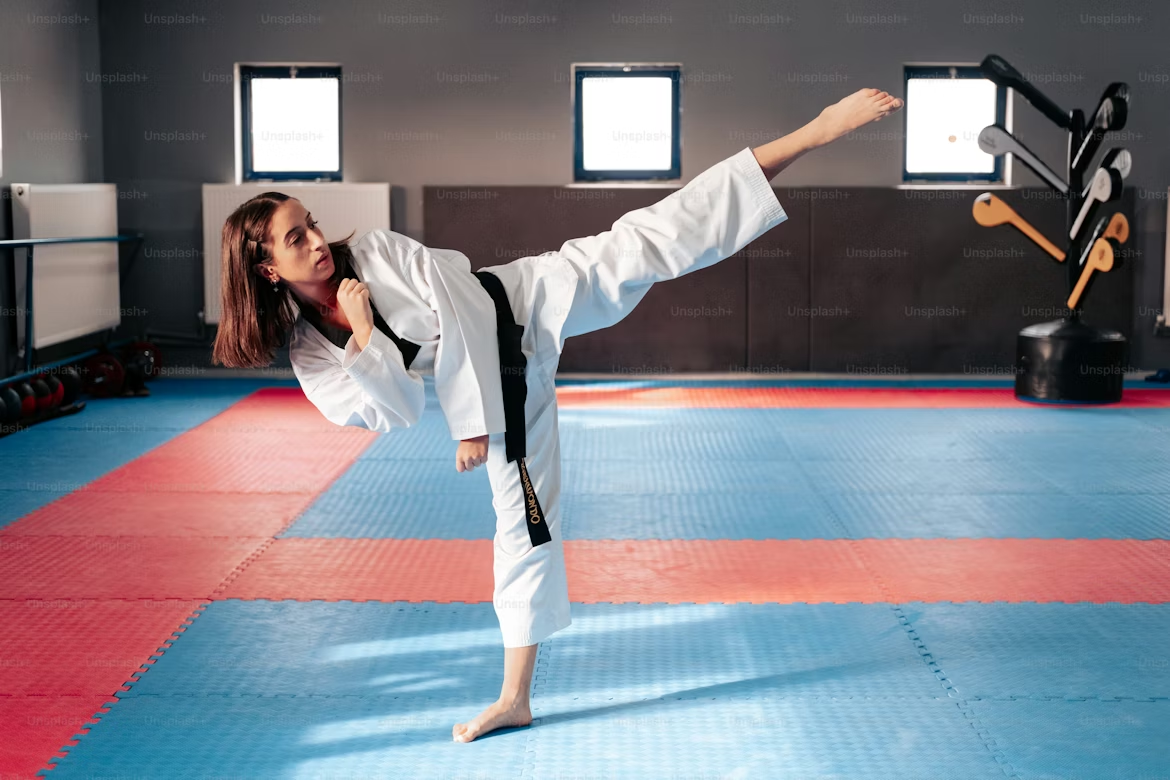
When our taekwondo master spars with us, it’s slow, instructive. He’s demonstrating a drill we’re about to do in pairs or walking through possible attacks or counters with a student to show them their own tendencies.
I hadn’t seen him spar for real until a former student, a heavyweight finance bro who used to spar in college, came back one day. Anu is 25, bulky, and flexible. Our master is a 31-year-old featherweight. “What level do you want?” our master asks Anu before they begin, which is both a flex and a real question. Even though our master could destroy Anu right away, it would be easy for either of them to get hurt. Anu because he rolls his ankles just from walking across the room. Our master because he’s fighting someone heavier with less control over where his kicks land.
They begin warming up with no gear, light contact. Our master wears a white uniform, black collar, black belt, black stripes down the shoulders. Anu wears a green muscle shirt and rolled-up white pants. Anu struts around before holding his fist out to make contact and begin. Our master bounces a little, relaxed, baiting. He holds his leg out, tapping Anu several times. That was the old style, he says, like sword fighting. Now it’s all cut kicks. Anu tries headshots for more points. He’s flexible. But our master slides 45 degrees or steps forward to clinch. Anu punches, which is fewer points. But it’s good for him. His arms are imposing and can psych his opponent out. After some time, they decide without speaking to put on their chest guards and helmets. Another student and I lace and tie their chest guards. Anu likes his tight; our master likes his loose.
Anu is blocking well, but our master’s foot finds its way under, over, and through his arms.
Our master jumps once and kicks Anu three times, each one higher than the last, before landing. “What the hell was that?” Anu says.
“It’s just this one,” our master says and demonstrates the three kicks on the dummy to show Anu.
Anu, almost 100lbs heavier than our master, goes up for a headshot. Our master ducks and stands back up in time to gently lift Anu’s leg and send him rolling across the floor.
“If you weren’t staring at yourself in the mirror, you could have killed me,” our master says.
They spar and rest and argue. Accidentally hurt each other, rest, spar.
I sit unmoving like suddenly the Olympics has commenced in front of me. Like I’m a kid up past my bedtime and if I move my parents will remember I exist.
After a while Anu looks over at me and asks, “Do you like watching us dick around?”
“Yes,” I say, and realize everyone else has left.
I couldn’t sleep after the first time I saw them fight. I stared at the ceiling, buzzing and glowing like I had a secret. I just learned people could fly, and I was a person, too.
The taekwondo studio, I’ve found, is the only place where I can be completely focused on something outside of myself. For a long time, I have found this experience to be rare. After puberty, I understood my value was tied to my ability to be attractive, both pretty and cool, and that awareness accompanied me in every context. I saw myself from the outside the way I saw actresses in movies romanticized. Could I fall in love with me from this angle or that? If ever I was fully inside myself, focused on something out in the world, that awareness of my role would snap me back out of myself and point my gaze at me. After becoming a mother, I perceived expectations on me to grow exponentially in impossible and conflicting ways. The demands of motherhood require you to exist above reproach as you care flawlessly and tirelessly for your perfect children. But the things you need to do to fulfill those duties (when they’re young: not sleep, not shower, not talk to any other adults, not be frustrated or resentful) are in direct conflict with being pretty or cool.
But at taekwondo, there are no societal expectations for how a middle-aged woman is supposed to be as a student. It’s already unusual that I’m there. In class we only consider taekwondo and the other people in front of us. Are we attacking or defending, sore or tired, warmed up or stiff or strong, laughing, frustrated, amazed. We, teens and adults of all genders, wear the same uniform. We’re not pretty. We’re not parents. There’s no one present I’m supposed to take care of and, notably, no particular way I’m supposed to feel.
My other middle-aged, married friends and I have a list of books and films we avoid because we’re afraid if we consume the wrong one, it’ll be impossible for us to stay married. Miranda July’s novel All Fours is one of them. But I risked it because one of my middle-aged, married friends recommended it after he saw me struggling to write about ideas of home and safety.
July’s narrator is 45, a semi-famous multimedia artist married to a man, Harris, and mother to one nonbinary child, Sam. She has birth trauma. She has a best friend, Jordi, the only person in her life with whom she’s always honest. I, too, have an admirable and capable husband. I have kids, birth trauma, and a very limited number of people with whom I am honest.
The narrator describes the self-governing system of shame so many mothers experience, even in private, even in their own homes. She says before she and Harris had kids she could easily “dance across the sexism of my era, whereas becoming a mother shoved my face right down into it.” When she describes how Harris was “openly rewarded” for every parenting task he did while she was “quietly shamed” for the same things, a deep recognition stirred in me. But, as July writes, “There was no way to fight back against this, no one to point a finger at, because it came from everywhere. Even walking around my own house I felt haunted, fluish with guilt about every single thing I did or didn’t do.”
It’s amazing how efficient a system of shame can be when the shamer and the shamed share one body. Years ago, I had a student in a fiction workshop who was my age, an outstanding writer working on a novel about political revolutionaries in Pakistan. There was a line in her novel I think about all the time. The narrator’s grandfather, a radical poet, says something like, “Yes, make a woman’s body shameful. Then where will she live?”
After becoming a mother, I perceived expectations on me to grow exponentially in impossible and conflicting ways.
No one told me to feel guilty every time my husband does the dishes (most days!) or makes our son’s lunch or supervises our kids’ baths and showers (half of the time). He signs them up for summer camp. He cleans the humidifiers. I keep track of the things I don’t do, subtracting from the calculation of my moral performance.
When I drop the kids off at school and pick them up and manage each of their opposing whims and snacks and fights and questions until evening, I don’t know exactly what I’m “doing” and don’t feel like my husband should be doing it. When I brush their hair and donate the clothes they’ve grown out of and go through months of homework and crafts to decide what to keep or recycle and look up their symptoms and maintain friendships with their friends’ parents, I don’t think my husband should be doing it. But when he does bedtime so that I can go to taekwondo, I’m sent down an emotional flight of stairs, landing, shivering at the bottom, imagining the kids as adults, still troublingly blond, on the phone with each other, never being able to remember a time when I was there while they fell asleep (I do bedtime three nights a week).
When I was a new mom my friend who’d been a mom slightly longer than I had came to visit. What a relief to have someone witness your baby and show them things you didn’t know about yet (Duplo blocks)! My friend was talking about how much her husband does for the kids, how she felt like he was better at taking them places, managing their bodies in their various carriers, and not becoming overwhelmed by their constant talking and demands. She said of course she does things, too, like clip their nails. She couldn’t think of anything else. “I do other stuff,” she said. To herself. To everyone.
Sometimes after taekwondo I pull into the garage and sit there for an hour or more. Sometimes I drink nips like a 90s dad, sometimes I don’t. I answer texts, read horrifying headlines my dad has sent throughout the day, scroll TikTok. I’m tired for one thing. Let’s say it’s 10:30pm. Taekwondo ends at 8:30, but sometimes we stretch and talk for a while. Sometimes we keep practicing. Or video each other spinning-roundhouse-kicking a ball out of the air. Or see how far we can jump or high we can jump. Sometimes we show each other pictures from our weekends or of our dogs. Sometimes we make plans for one of our birthdays, or play would you rather or read out horoscopes or riddles. We want to be in one third of a run-down cinderblock strip mall and we want to be there for a long time. It’s not a rose garden or a spa. There are no nature sounds, real or piped in, unless you count the screams of someone seeing a spider. In the garage after, getting out of the car: It’s hard to move when you’re tired and have been sweaty and then still. It’s hard to turn back into a wife and mom when you have been just a person. My tombstone will read: “Devoted wife and mother. It took her forever to get out of the car.”
When I do come in, I do it quietly in case the kids are still awake. If they know I’m home, they’ll want me to crack their toes and take turns lying in their beds. They’ll get wound up again and I can’t tell them no, even if what’s best for them is to get a healthy amount of sleep. “I came into the house my usual way, like a thief,” July writes. “I turned the lock slowly and shut the door with the handle all the way to the left to avoid the click of the lock. I was often two or three hours late because I had trouble admitting that I was planning to talk to Jordi for five hours. But how could it be any shorter, given that it was my one chance a week to be myself?”
Is it leaving the house that lets the narrator be herself? Or is it talking to her friend who doesn’t need anything from her? Conversely, “When Harris comes in late he slams the door cheerfully behind him. He’s trying to be quiet, but not that hard. His mind is on other things, and why not? This is his house.” Yes, if we’re not comfortable in our bodies or in our houses, where will we live?
July’s narrator sets out on what is supposed to be a cross-country road trip from L.A. to New York. But she does not drive across the country. She’s nervous about driving all that way alone and makes excuses to stop. She has an intense interaction with a young man at a gas station. She stops for lunch and runs into him, Davey, again. Then she gets a room at a cheap motel by the Hertz where Davey works, twenty minutes outside L.A. She doesn’t know how long she’ll stay but slowly extends the reservation to encompass the whole two-and-a-half weeks she’d planned to be away. She lies to Harris and Sam, reporting her stops in different states headed east, and to the friends she’s supposed to visit in New York, saying something came up with a crisis or project and she’d see them next time. She hires Davey’s wife to help redecorate the motel room. She goes for walks with Davey every day, and they slowly reveal to each other they feel the same mutual desire and obsession. They spend the rest of the narrator’s vacation in the room in creative and intensely intimate ways.
July spends a lot of time describing the redecoration of the room, and in fact, the redecoration of the room was more uncomfortable for me to read about than any of the other ideas in the book, menopause, infidelity, desire, suicide, the deathfield, sex, lying, motherhood, divorce. All those things make sense. But redecorating a temporary place, a room that doesn’t belong to you, seemed random, indulgent, outside the logic of the narrative. I wasn’t sure if my reaction was a critique of the book, or a critique of the importance of a place. I felt afraid while they decorated, and afraid in the scenes when the characters were in the room. Were they going to reveal to me something I wanted or needed but couldn’t have?
In an interview with The Yale Review, July says, “Gradually, over years, I came to realize that the narrator’s desire to decorate was the tip of a very large iceberg. What makes a home? Can you make it up? Will it be ‘real’? Is real just a construction held together by fear? And if a home is a place for love and intimacy and honesty, then maybe it is not one thing, different for everyone, always changing—and political. Since there is no pure form of love and intimacy and honesty, they are always made of long histories of unsafety. Everyone in a home feels a different kind of unsafety, depending on who they are. Cozy! Ha. But coziness is the goal. A safe, relaxed feeling that is possible for the narrator in the motel room and eventually (spoiler alert) everywhere else too.”
One of the guided meditations a therapist thought might help after my own birth trauma was to imagine a place where I felt safe. I couldn’t imagine one. There were, as July describes, long histories of unsafety attached to every place I could imagine, even if that unsafety was the fear of losing it, or of it not being mine.
Even before I had any experiences where I was afraid I was going to die or my child was going to die, I’d do a thought experiment about where I might want to have my ashes scattered, which is really a question of where feels the most like home. Where would I not feel like a stranger or an imposter at all for eternity?
It’s hard to turn back into a wife and mom when you have been just a person.
My family used to rent one side of a tiny duplex for two weeks every summer on a lake in Michigan. It’s where I learned to swim and to drive. It’s where I had all my first crushes. That seemed like a perfect contender, but the duplex went up for sale and the new owners tore it down to build what my parents derisively called “a mansion.” I can still feel the soles of my feet on the knotted wood slanting steeply over the bed. I’d lie on my back and put my feet on the ceiling until my legs went to sleep and so did I. My childhood home, maybe, though more complicated, less filled with concentrated joy than the summer duplex. I drove by it when I was back home visiting a friend and the new owners had cut down the tree so grand in the front yard it took a chain of four kids, me, my brother, and our friends, eight little fleshy arms, to encircle it all the way around, fingertips touching. And in the tree’s place, almost laughably: a Trump sign. The arboretum in Ann Arbor, where I walked for hundreds of hours in undergrad, belongs to other students now. If my ashes were there, I would feel like an eternal college student, and that’s not how I feel. Moore State Park, where I live now, has fields and water and trails lined with azaleas, but I still feel like a transplant in New England. Our first apartment here burned down. Our own house now, where both our kids were babies, perhaps. It’s in New England, where I don’t belong, but my body is here in this house, my blood soaked into the grooves between the bathroom tiles where I hemorrhaged after my daughter was born. I could be scattered in the backyard. But how strange to be there when the kids won’t be. The hope is they’ll be grown up and living new places filled with their own dangers. And this house isn’t mine. It belongs to me as a wife and mother. If I were neither of those things, I couldn’t live here.
One’s mind naturally goes to where they were happiest.
The taekwondo studio is our master’s, not mine, and so there is danger there, too. If I were to disappoint or betray him somehow, or less likely, if he were to disappoint or betray me, it would feel different. I think he thinks about this, on some level, almost all the time. The sameness of the place, day-to-day, is remarkable. If you forget something, it is likely unmoved from where you left it when you come back. His voice is the same, his intonation, his phrasing, his teasing. We do the same routines at the start of class before we break off into whatever we’re individually working on.
He is also very, very slow to let people actually know him. Perhaps there was danger for him in his own studio when his friends from real life joined our adult class. Now there were opportunities for them to mention things about him his students didn’t know, opportunities for his students to become friends with his friends. One of his friends wanted to practice talking to girls. “He can practice on us!” I told our master, but he seemed hesitant. “Let’s say he gets weird,” he said. “Who cares if he’s weird,” I said. I’ve always prided myself on being unflappable, not judging anyone or protecting myself. “And then you guys feel weird,” he continued. “Then it’s weird here. It’s bad for business.”
It seemed cold and frankly inaccurate to think about this magical place as a business, even if it is one. But then I realized it was entirely up to him to maintain the magic for us. And that’s lonely. When you’re the only one with the ultimate responsibility, it’s as lonely as being a parent.
Maybe that’s the key. I get to be a kid there. I get to be taken care of.
My son and daughter also take taekwondo, but I insist on us each attending our separate classes. My son wants to come to the adult class. His friend, he reminds me, goes with her mom sometimes. “Unfortunately, it’s too late for you,” I lie. The truth is, if my son is there, I will take care of him, and I don’t want to.
I liked Harris, the narrator’s husband in All Fours. He reminded me a lot of my own husband. They’re both, oddly, sound engineers. Both equal coparents. Both sensible, thoughtful, steady. Even when they fight, Harris and my husband speak “very slowly” and calmly. Harris and my husband both keep track of fairness and equal distribution of tasks, logistics, scheduling. They’re polite or passive aggressive, asking if something is right when they believe or know it is.
My body is here in this house, my blood soaked into the grooves between the bathroom tiles where I hemorrhaged after my daughter was born.
My husband and I have been together for a greater portion of our lives than we have not. And because we work on this shared project of being married and raising kids, we need each other likely in more ways than we realize. I think because of this element of need, part of me needs to be kept a secret from him. Having a secret part of myself feels like a form of safety, something to catch me if my husband should suddenly disappear.
When the narrator sets out for what she and Harris believe is her multi-day drive, they say goodbye in the driveway. Harris takes a picture of her hugging their child. “‘Call us from Utah tonight,’ he said, hugging me. I gave him a look that said: If I survive, if I come back to you, let us finally give up this farce and be as one. He gave me a look that said: We could be as one right now, if you really wanted that. To which my eyes said nothing.”
My best friend from high school, Sarah, and I talk on the phone every morning for 20 minutes (if our children, morning routines, and latenesses to work allow). She’s also married to a man who makes more money than she does. She also has kids. She, too, feels the strain of need and dependence on what would otherwise be a connection to her husband that’s free to be as intimate as possible. One day she’d learned she’d be receiving a small inheritance from the death of a family member. “Secret account,” we both whispered. Our husbands don’t need to protect themselves in this way, which makes us feel bad that we feel that we do. But our health insurance is their health insurance. Our houses their houses.
Sarah has a gift this summer. Her kids’ camp ends at 4pm each day instead of the usual 3pm school pickup. “What should I do?” she asked me. Should she work longer hours to make more money and so her company doesn’t have to hire a parttime person? Should she go home and organize and clean so logistics at home are smoother? “Secret weights,” I said. “Of course,” she said. “Tell work you’re at home and tell home you’re at work and lift weights for an hour every day.” We need to be strong. It doesn’t have to be a secret, but it’s better if it is. Ta da! I can lift this air conditioner. Ta da! I can live on my own at age 90.
When I watch people who are better than me fight (everyone), I can usually tell what they’re doing and appreciate how good they are. It’s similar to reading better writers than me. What a thrill to see what they do and to wish I could do it. But there are some writers who seem to be operating on a different plane. I can’t identify what they’re doing; I can only experience it. When I watch our master fight, it’s like this. He’s physically and mentally on a level where I can’t recognize the decisions he makes or what happens after he leaves the ground and before he lands again.
One night in a small class, just me and two others, our master breaks down one of his kicks for us. First, he shows us a cut kick.
“But the cut kick is a fake,” he says.
You lean back on your standing leg and lift your cutting knee and foot between 90 and 45 degrees. Instead of cutting when you leave the ground, you turn your cutting knee toward the ceiling, so your opponent, who is watching the angles of your knees and feet to predict your next move, reacts as though you may be switching from a cut to a push kick. But you’re not doing a push kick either. Instead of extending your leg then, you turn your standing foot, which is no longer standing, 90 degrees, twist your waist, and land a roundhouse kick. You leave the ground once. These shifts in position take place in the air, and they happen in about one second.
“This is level one,” he says.
When my mom was my age and I was my kids’ ages, she suddenly made us all go to church. My brother and I were old enough to feel the injustice. We had not previously had to put on uncomfortable clothes and sit quietly on hard benches, bored, hot, and dying of thirst. She gave us word searches and gum, which, if we were living our emotional truths, we would have slapped out of her hands. But she had had an experience. She’d seen a leaf, bright green and bursting out of its bud, and heard a voice say, “yippee!” So now we had to go to church while she investigated her new spirituality, a belief in a form of a god. The Bible as a text was fascinating to her, and she loved to intellectually spar with the others at Bible Study.
She didn’t need this place forever. She felt satisfied or lost interest after a year or two. Simultaneously we grew and entered new and different stages of needing her and being able to intellectually spar with her. But even without church, she can access the feeling she had with the leaf. She has a similar experience when she’s alone with the moon, she says. She has this secret, glowing feeling, like safety and extasy and oneness.
I’ve had this feeling, too. When I pause a movie I’m watching by myself to smoke a cigarette at night in the dark. When I ride my bicycle or sleep in my car or remember my journal, where I really exist, is with me in my bag. When I’m reading a book that blows my mind. When I watch our master spar. When I was nursing my kids, I could scurry them away to a quiet bedroom, encircle them with my arms, and feel them latch. Secret. Safe.
There are some writers who seem to be operating on a different plane. I can’t identify what they’re doing; I can only experience it.
Why are secrecy, independence, and safety twinned together in these cases? If the knowledge that our master can fly is only mine, if I’m secretly getting stronger or smarter, the world cannot do its work on it and take away my awe, make a thing dutiful or shameful, make my attention shift to myself and my value at this angle or that.
Whenever my kids are trying to convince me of something or make a deal, they say, “If you let me do this thing, while I’m doing it, you can read by yourself or play cards by yourself or take a nap so you can stay up late by yourself…” They say it in a listing tone, drawing out the e sound in “self” to make it sound irresistible. And it is! They know me so well!
The narrator of All Fours uses the motel room to, among many things, interview her women friends about menopause, marriage, lust. One of the women she interviews is a historical biologist and says that the ecosystem around marriage is the problem, not marriage itself.
“‘For example, dances. They once fulfilled an important function in society—court dances, barn dances, ballroom dances—they allowed people to legally touch someone who wasn’t their husband or wife.’
‘That’s . . . healthy?’
‘Yes, biologically it’s important to feel different arms and hands . . . smell strange bodies. A diverse human biosphere makes for a healthy marriage.’
She said this last part with exhaustion, as if she’d made this argument a hundred times.”
The narrator makes a note: “Some customs have remained—monogamy—but not all the microtendrils that actually made it possible: the community, the dances, and God knows what else.”
What else? For me, artful, measured fighting.
Natalia and I are facing each other, our faces squished in our foam helmets. She’s 33 with a long thick braid of curly brown hair and bright blue eyes. We’re in the same weight class even though I’m taller, because she’s solid muscle and my body is held together with hopes.
“Jane, your job is just to try to bother her,” our master says.
Natalia is supposed to focus on distance.
My legs, though inexperienced, are long, which is good for me. Everything about Natalia’s body, ability, experience, and attitude are good for her. She’s strong, fast, smart, and loves to fight.
We’re not kicking hard, and getting tapped in the chest guard, though that’s the opposite of the goal, feels good.
My footwork is bad. I can’t close distance. I’m self-conscious under the gaze of our teacher.
Over and over, he tells me to move with instead of against the kick when I’m blocking so there’s less impact, but I can’t make the change in real time.
One thing works once, to lift my front leg and tap her when she fakes, so I try doing that all the time.
When our teacher calls time, Natalia says, huge smile, flushed face, “Want to go again?”
I fight Natalia again. I fight Anu. Anu fights Natalia. Natalia fights our master. Our master fights Anu.
Anu and our master argue between rounds. If I had done this, then this would have happened, one of them says. No, says the other, because I would have done this.
Everything about Natalia’s body, ability, experience, and attitude are good for her.
“I love listening to you guys argue,” I say.
“I do it to buy myself more time to rest,” Anu says.
“I know you’re doing that,” our master says.
When I fall asleep that night, I think about how the second time I fought Natalia she was so far away. “She’s changed her strategy,” our teacher had said. “What do you have to do to adapt?” She was always out of range unless she was coming in to attack. Even lying calmly outside the moment, I can’t figure out what I should have done. I think about how I look at my opponent’s chest guard to try to anticipate their moves. Does their weight shift forward or back? But Natalia and Anu both look straight into their opponents’ eyes.
If the roles of wife and mother come with constant questioning, shame, conditions, fear of loss, it’s hard to remember what it’s like without all that. There is so much sex and lust in All Fours I didn’t even mention. The book is largely sex and lust. That seems to be the narrator’s path back to understanding herself as a person, and the motel room is the place she can have that feeling. My mom’s motel room was a church for a year or so, and then she could have that feeling of awe and oneness, with the moon. At the dojang, right now, I get to be a person. Once I’m confident enough that I exist outside of other people’s survival and pleasure, I can forget myself. Forget shame, forget the constant struggle for recognition. My secret safety is myself, dissolving, wide open to awe. Sprinkle my ashes on the way my mom feels when she looks at the moon. Sprinkle my ashes on the way I feel when I watch our master spar, (and then, maybe someday, everywhere else, too).
Read the original article here