Do Not Think About Death or Blowjobs
“Sixteen Hours in Iceland” by Laurie Marhoefer
It was just after midnight on the fourth of October, 2016, a Tuesday, when Ben Sullivan stepped off the flight from Berlin and became the happiest person in Keflavik Airport. It was the start of his sixteen-hour vacation from the impending death of his wife.
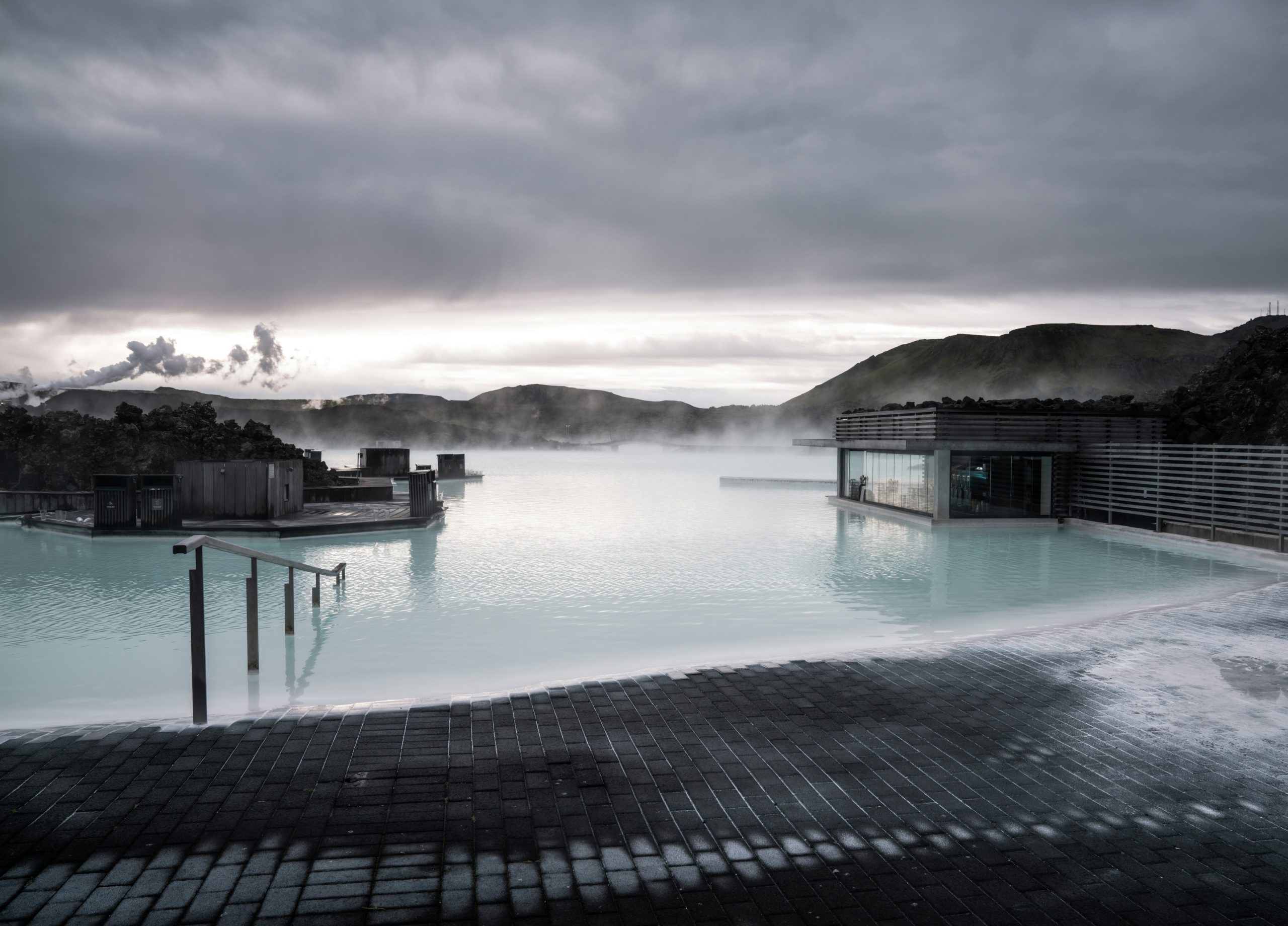
In the first minutes, on the walk from the gate, Ben looked about himself, enchanted, bewildered: Iceland. A huge banner advertising volcanic hot springs. The eerie turquoise, the white steam. In the middle of the concourse, a life-sized grass-roofed hut, made of fake rocks. It sold plush trolls, wearing adorable hand-knitted sweaters. Trolls!
He turned a corner, and the glaciers and moss gave way to dirty orange plastic tarps over scaffolding and a creaking double escalator, and suddenly it did not look as much like Iceland, but Ben didn’t mind. At the bottom of the escalator, a vast duty-free liquor sprawled, seemingly makeshift, nothing more substantial than metal shelves penned in by plastic yellow emergency barriers. It had the look of a road construction site, or a minor refugee camp, and within it, many exhausted people were loading little carts with bottles. The Icelanders behind him on the escalator pushed past and veered into the duty free, faces all bleak determination. This might have been a sign that Iceland was not what he was expecting, that in Iceland, one drank one’s way through the darkness, but Ben felt no misgivings. Rather, he felt a swell of love for the people of the duty-free. None of them saw him, a tall, pale, paunchy American with an old backpack and a messy red beard, who had been wearing the same Sonic Youth sweatshirt for five days. He had told no one that he was going to Iceland, a place that had absolutely nothing to do with anything in his real life. He had not told Tamara, his wife. He had not slept properly for a long time. He was muttering to himself, taking a childish joy in saying the name again and again: “Iceland, Iceland.”
Heading towards the lone baggage carousel, he passed another banner image of a hot spring, which made him think of the short film “Iceland 101,” which had flashed onto the plane’s monitors just as they descended towards Keflavik Airport. The two major lessons from “Iceland 101” were, first, that if you rented a car, and you accidentally drove off the road, you should not expect to be rescued by Icelanders, or by anyone: you would die alone in the cold and the fog. Second, if you visited a hot spring, before you got into the water, in the locker room, you were to remove all of your clothing. Then, you should shower naked, with soap. Also, use a rag to scrub vigorously at your genitals. Scrub for a meaningful amount of time. To underscore this message, the video had shown a hipster guy scrubbing himself in a shower, with his genitals fuzzed out, but only just, while an Icelander, fully clothed, stood next to him and pointed.
Ben only had sixteen hours in Reykjavik, a layover, and he did not plan to rent a car. However, in his earnest way, as the plane landed in the misty dark, he had resolved that he would scrub his genitals vigorously. It was important to the people of Iceland that he do so. He could tell it was important by how much effort they had put into the video. And with this small act, perhaps he could redeem the United States in their eyes. Though he did not think the United States was all good, it did have some good aspects, such as President Obama, who surely next year would be succeeded by President Clinton. Ben had not slept much in the five days in Berlin, or before that, in the year and a half that Tamara had had cancer. That was why this thought of President Obama, and of Ben’s own small resolve to do the right thing here in Iceland, brought a film of tears to his eyes. Then his phone buzzed.
It must be Tamara. For days, Tamara had not been answering his texts. She was furious at him for going to Europe. But she might text, if something was wrong. What if the results of the bone marrow biopsy had come back early? It was still Monday afternoon at the hospital in Eugene. This text might say that the cancer was back. Ben froze, the baggage carousel behind him creaking, the automatic doors before him whining as they open and closed on a view of an empty parking lot under a pitch-black sky. He knew it, he felt it, as if in his own bones: these biopsy results would not be good. He took a breath, swung the bag down, fumbled the phone out. The text read, “Are you in Iceland?”
No one in the world knew he was in Iceland. He had not told Tamara. He had not told anyone. The number was not saved in his phone. A 310 area code. It wasn’t Tamara. But who?
Two weeks before, Tamara went back to the hospital for tests, one a blood draw, the other a biopsy of her new bone marrow. The blood test results would come in three days, the biopsy would take two weeks. These tests would tell if she was in remission. She had to pass them both.
Like all of her cancer treatment, the tests were at the hospital where Tamara was employed, where she had risen from resident to attending. If she survived, she could never work at the hospital again, because what they called treatment for this disease was no different from long-form torture, and just the sight of the hospital building made her shake with nausea. But the biopsy was easy by comparison. By afternoon, it was done, and when they were about to leave, Penny the oncologist came out to the waiting room to see them off. Ben was gingerly doing up the snaps on Tamara’s jacket; her fingers were too weak for it. Tamara vaguely knew Penny from some hospital committee, and had always disliked her. Tamara loathed optimism. That afternoon, chipper as ever, Penny put a hand on Tamara’s shoulder and said, “Now Tamara, remember, the results will say you’re in remission, but if they don’t, all it means is more chemo.” Tamara had responded in an even voice, “I’m not a fucking idiot, Penny.”
If Ben was being honest about the layover, the truth was that he had not thought it through. Sixteen hours was not enough time to see Reykjavik. Yet sixteen hours was a magic number of hours, the perfect number of hours. Long enough to step out of the life where Tamara had leukemia, and into another. Tamara was alright by herself for a few days. The neighbor kid would walk the dogs.
There was just one problem. Ever since she had gotten sick, he had not missed anything. He had seen every doctor with her, he had waited during her infusions and driven her home, he had missed nothing. He had been the best husband he could be.
He bought the layover the day after the biopsy, a Wednesday, that evening when he came home from teaching. The front door of the house was ajar. Tamara sometimes did that so that the dogs could go in and out. But the dogs didn’t come to greet him. Tamara must be asleep with them in the bed.
He had left her alone for too long. He ought to have come right home after class. Instead he had lingered in his office, dazed, the second lecture of the day having been the one about Poland in 1943, that village. A particularly dark lecture, a negative verdict on all of humanity, that lecture—and though he taught it every year, it had left him, as always, hollow.
But Tamara slept most of the day now.
Ben paused at the open door to the bedroom he no longer shared with his wife. The dogs were curled under the comforter with her. With the blackout curtains drawn, he couldn’t properly make out which nodes of blankets were dogs and which were Tamara. Because of the lecture he had just given, he thought of the humps of earth over shallow graves, then, disgusted at himself, turned and went to the couch. He ought to cook, but she never ate and he wasn’t hungry.
These pasts months, Ben slept in the basement, on a mattress. Before the transplant, Tamara had had a lot of pain at night. The meds they gave for it did shit. Finally, he had decided it was better that he slept. “You can sleep,” she had said at the time. “You take it for granted. You’re not dying.” Tamara’s main response to her own cancer was anger. Which, Ben thought, was a useful response. But it made for some depressing moments. Though, what was the alternative, really. Terror would have been much harder to watch.
If the test results came back shitty, he would get a sleeping bag, sleep on the floor of her hospital room, quit his job, never leave her. Though in its sixth year the marriage had not aged well, though cancer had not made the marriage work any better. But you couldn’t blame someone who was about to die at thirty-six for not loving you anymore.
He went in the living room and slumped into the couch, too tired to turn on any lights. He put his laptop beside him, thinking that he should open it, buy the flight to that conference in Berlin. He’d asked Charlie, his department chair, to get out of it because Tamara was so sick. But Charlie had said, better not to, if at all possible, Ben had missed a lot of things over the last year and a half and this was a really important conference in Holocaust history, a conference that only happened once every two years. At least he could fly back from Berlin in time for Tamara’s biopsy results, thank God. But how to leave her. And he was so tired.
In the living room the darkness buzzed at him. He knew this feeling, sadness so heavy it did not deserve that anodyne name. Ben tried, generally, to think about death only in the abstract, but now he saw, again, in his mind’s eye: the photograph of the market square of that village in central Poland, a snapshot taken by a soldier. It had survived the war, made its way into a museum collection, and he had shown it to his class that afternoon. Ben saw the woman again. She must have been thirty-five, thirty-six. No one from that village had survived to remember her name. There were a variety of possible deaths, some far more violent than others. But the result was the same; the person gone, and in their place, lumps, cinders, gristle. This fate awaited Tamara, too, and of course, it awaited himself. The dark in the room worked its way into his nose, his ears, like black earth.
Yet the room was not completely dark. Out the window were the rust brown oak leaves, now gray in the streetlight. He had always liked this room. They had painted it yellow when they bought the house. Their first house. Lemon yellow and a white mantel piece. (Though a few months later she decided she hated the yellow.) He had painted it. Tamara had cooked, something very complicated, trout, probably. She set the plates on a tablecloth on the floor because they had not bought furniture yet, just the mattress in the bedroom. She laid out all the food. But then she kissed him. He shoved the hyper, yipping teenager dogs, into the kitchen to keep them away from the food. He and Tamara went into the bedroom and shut the door and fucked. “Just quickly,” she had said. “The fish will get cold.” Ben had expected adult life would be mostly about love and sex. But it had turned out to be mostly about death.
For lack of anything else, he reached for his laptop. The screen opened to a white glow. The browser showed the flight search from that morning. He hit refresh, and there it was. Iceland Air. A flight to Berlin, the same price as transferring through Amsterdam. With a sixteen-hour layover in Reykjavik. And a free night in a Reykjavik hotel. Suddenly the darkness evaporated and all Ben saw were the images on the airline website—a very shaggy pony, a hillock of lizard-green grass—fascinating simply because they were so very much alive.
Ben had always wanted to go to Iceland. In high school, in a suburb, he had jacked off a lot to Björk. He wanted to see molten lava through a crack in the earth. He wanted to sit in a thermal hot spring. In high school in Tel Aviv, Tamara had not had any idea who Björk was, but she had always wanted to go to Iceland, too. They had talked about it.
But the return flight was the day Tamara would get the biopsy results. If he flew directly home to Eugene from Berlin, he would be home in time. If he went to Reykjavik for sixteen hours, he would be on a plane thirty thousand feet over the tundra of northern Canada when Tamara found out if she was going to die.
Tamara padded into the living room draped in a blanket.
“Do you want something to eat?” Ben asked.
“You eat,” she said. She went down the hall. The bathroom door clicked shut. He looked again at the flight, the hotel. He had never missed anything for her cancer before. He would not buy a crazy sixteen-hour layover in Iceland.
He heard the toilet flush, the sink running. Then Tamara crossed the living room in the old white comforter. She hesitated in the door of the bedroom, leaned on the door frame. She said, “I got the CBC results.” That was the first test, the blood test.
“What?” He got up, followed her into the bedroom, where she crawled into the bed, amidst the dogs. The blood test results were not supposed to come back till tomorrow. “When?” he said.
“While you were at work,” she said.
Why hadn’t she called him. She propped herself up in the bed with some pillows, pulled her computer from the bedside table to her lap. Then she said, “It was clear.”
He took a step towards her but she put up her hand. “No,” she said. “Don’t. It was clear, but I did something stupid. I googled.”
The entire time she had been sick, Tamara had forbidden him to look things up on the internet, that is, things about her illness. Half the time all the internet did was cough up outdated research she had said, and being a doctor, though a rheumatologist, she would know. But Ben suspected that was not the real reason. The real reason was that the odds of survival were so bleak, he and Tamara were better off not knowing. But now, at the end, she had googled. She must have had hope.
“Everybody gets a clean CBC at this point,” she said. “Here I was terrified about the CBC. But with my genes the odds of a clean biopsy are awful.”
“Sweetie,” he said, an old name for her, it had been months since he had used it.
“Oh, shut up, Ben,” she said. “Don’t try to tell me it’s not true.” She opened the laptop. She was on leave from the hospital, but she still spent hours reading through the resident’s notes; she did not trust residents. Ben stood in the doorway for a long time, watching her click through files. Finally, he decided there was nothing he could say. So he began to explain about the flight, the conference, Berlin. Just as he was about to assure her that he would fly back in time, he would be here when she got the biopsy results, that whatever happened, he would be here, she cut him off. She said, “Yes, fine. Go and talk about the Holocaust in Berlin. You’re into dead Jews. That’s your favorite kind, isn’t it.”
He was gripped, suddenly, by the memory of that summer ten years ago, she came to Berlin, when he was in grad school researching his dissertation and living over a Turkish grocery. He rode her around on the back of his bike, her arms around his waist as they crossed the canal bridge, and he laughed at her black-hearted Israeli Holocaust jokes. Every time they saw the u-Bahn go by she would make a very dark joke about German trains. How he loved her. Maybe she was teasing him again, now. But no, he could tell—the set of her jaw, the clipped, furious way she pronounced the “d” in “dead”—this wasn’t kidding.
A wish came to him, a strong wish, rising up in his chest: that they would divorce. She could move back to Tel Aviv. Apparently—and this he would never understand—she wanted to go back, she had come full circle. When Ben had first met her, she had talked so much about how she would never, ever go back. He had no right to have any opinion about Tel Aviv, beyond admiring the beaches. She would be the first to say so. Never mind that. The wish was that they would get divorced. The biopsy would show no cancer. People got divorced at 36. They didn’t die at 36.
He said, “I’ll get back from Berlin Tuesday night. After you get the biopsy results.”
“I don’t care,” she said.
Years ago, he had broken down about all of the murdered, because there were so many, crowding around. He told her he couldn’t finish the book, ever, because what was a book, why did a book matter. He stopped writing. That Berlin couple in their eighties, the lawyer and his wife who had been a music teacher. After they got the notice to come to the police station the next morning, he had reminded her to bring stamps so when they got to the labor camp they could write their son in England.
He told her he couldn’t finish the book, ever, because what was a book, why did a book matter.
And Tamara had said, but you are writing it down, that means something, you are making it so the murderers cannot hide.
Tamara went on, “It really is. Your favorite kind of Jew. You wrote two books about dead Jews. And lucky you, you don’t have to be one.” She went back to typing, the screen’s glow sharpening the shadows of her spectrally gaunt face.
Ben went back into the living room and bought the flight to Iceland. Because it might be too late for her. But at least he would have those sixteen hours.
On the transatlantic flight, guilt should have eaten him: he was abandoning his wife. Instead, he felt elation: he was abandoning his wife. He did not sleep. He drank coffee and read, a new book about Lichtefelde, the fancy Berlin suburb, the upper-middle-class elite and the years of Nazi rule, filling in the gaps in his knowledge on the middle-class reaction to fascism—understanding it better did not make it better, but it gave him some hope. His was the only light on in the whole plane. He got up and walked the aisle, his feet floating as if gravity had slackened its grip, and he pictured the dark Atlantic, so far below.
At the conference, it was more of the minutia of German history in the 1930s, panel presentation after panel presentation in a lecture hall at the university, fascinating—even after all this time, they were still getting better at understanding why it had happened. He forgot about Tamara for long stretches. He texted but she never texted back. He kept his phone out, face up on the empty chair next to him, or on his knee, in case she texted, in case something happened and she needed him, but she did not. At night, back at the hotel, he called her. She didn’t pick up.
On Monday, the conference’s last day, he sat on a folding chair near a slight man with olive skin and dark hair swept in a wave above his forehead. He wore an expensive coat, a beautiful maroon boiled-wool, with a sharp collar folded up past his ears. Ben recalled that this guy was not a historian. He was the artist-in-residence of the conference, a radio producer researching a podcast, or something. At the podium, one of the senior historians from the Freie Üniversität gave a paper on the Berlin deportations. The radio producer took notes by hand in a palm-sized paperback journal and chewed the end of his pencil. Then his pencil broke, and he asked Ben if he had an extra. Ben only had a pen.
“I’m going to chew it,” he whispered. “Is that OK?”
Ben nodded.
They went back to listening to the paper as the radio producer demolished the end of the pen. When the session ended he handed it back with a long, sheepish look and a little grin. What was it about this guy, Ben wondered. It was as if he had met him somewhere before.
The conference ended with one of those staged conversations, the conference director interviewing the radio producer, his name was Elliott Rosen, about his podcast. He was making a series about the life of a German Jew named Charlotte Charlaque, who was transgender. She survived, got out before the deportations, and lived in Brooklyn for decades. Ben had written two books about Berlin Jews and the Holocaust, but he had never heard of Charlotte Charlaque. Elliott Rosen said how her story had been hidden for so many years, and at times his voice shook ever so slightly in anger. It was one of the most compelling research talks Ben had ever heard.
At the reception afterwards, Ben had three beers and two sausages, standing in a corner with his friends from grad school, Helene and that crowd, who were going on and on about tenure, or, alternatively, about the new book on Operation Reinhardt—“a whisp of a book, three slipshod chapters and a meaningless conclusion,” Helene called it. He was only half listening. Elliott was by the buffet, surrounded by admirers. He reminded Ben of someone, but who? Ben did not often think about what people were wearing, but it was hard not to notice that Elliott was dressed like someone who had money, someone in the movie business, and the historians flocking around him were dressed like historians, that is, as if they had borrowed their parents’ business casual in the 1990s and not returned it.
Ben had been with guys—a fair number of them, in fact. But not since college. He had not been with anyone but Tamara in six years. He realized why Elliott seemed familiar. He reminded Ben of those college bars, those guys, before Tamara. Was Elliott gay? he wondered. Was he trans? He must be. Could a trans guy be gay? Ben had never been with a trans guy. He was not sure he had ever met one.
“Ben,” said Helene, “Go talk to the radio producer.”
“What?” Ben said.
“The, ah, person he’s writing about, it’s just like your second book,” she said. “Minus the transgender part.” She laughed. “That’s a first, isn’t it?”
“Uh,” Ben said.
Helene dragged him through the crowd, elbowing the octogenarian historian bending Elliott’s ear, and introduced Ben as an expert on the Berlin deportations.
“Oh, that’s amazing,” said Elliott. “And I ate your pen! But you’re exactly the person I—”
Two of the conference organizers—nervous junior faculty at the FU—cut in. Elliott had to come for a picture, right now; so-and-so, some very senior person, was leaving. Elliott promised to come back. “You’ll wait, won’t you?” Elliott smiled, a half-smile, and cocked his head. He had dark eyes, and he was looking at Ben so intently that a shiver ran up the back of Ben’s neck, this was not a usual look, not just a friendly look, it was something more, Ben knew that look. He’s gay, he thought. He thinks I’m gay.
“Uh, sure,” said Ben. “I have a flight but—”
“See you in a second.” Elliott squeezed Ben’s forearm. Then the two organizers whisked him off through the crowd.
Helene hissed, “Tell him to put you in the podcast!”
“I have to go,” said Ben, flushing. He had a flight to Reykjavik at 10 pm. And he was married, to someone who was dying. He had to go. Helene walked him out. She asked after Tamara, in that meaningful way that people do when they think someone’s number has come up. Ben lied and said Tamara was doing much better.
At the airport, at the gate, he texted Tamara. She did not text back. He walked up and down the empty concourse, giant, echoing, ominous blond wood and black metal, wondering if Elliott would notice that he had left the reception, wondering if he should email Elliott and determining not to, because he was married, to a dying person. Tomorrow, as he was flying over Canada, the biopsy results would come back, and then, he would get a taxi home, it would be late at night, she would be asleep but the nightmare would begin. If the biopsy was bad, the nightmare would begin. Until then, he had his sixteen hours.
His seat was in the very last row of the plane, snug up by the bathroom. Ben took out the Iceland guidebook. He would get to the hotel, sleep a few hours, wake up at 6 am, and he only had to be back at the airport at 2 pm, he’d have virtually the entire day in Reykjavik. But he should make a plan. That bright blue hot spring in the guidebook photograph, or the hike up the mountain. They got held at the gate for a while, a scrum of commotion way up the aisle toward the front, last-minute passengers boarding late, and a flight attendant got on the PA to announce how everyone was being held up by these late-comers. This was northern Europe, after all, no sympathy at all for the failings of others, a trait Tamara appreciated, he recalled. He put the guidebook into the seat back pocket and gave in, thought about Elliott. Elliott had the look of a bird, somehow. Like if a bird went to the gym a lot and got jacked. Was Elliott trans? He never would have thought so. Did it matter?
Ben had a feeling that he would get to the hotel in Reykjavik and have a wank about this Elliott, even if he got to the hotel at two in the morning. He had not thought about sex since Tamara got sick. He rubbed at his beard, disgusted by himself. It was dumb to get a boner on a plane about an (admittedly good looking, very square-jawed) guy, when your wife was dying. But it didn’t matter. He would be in Iceland soon. A thousand miles away from Elliott the hot radio producer. He should read the guidebook and make a plan, because he only had sixteen hours, and the only way this was going to work is if he made a careful plan. Instead he closed his eyes and thought about Elliott whispering in his ear and giving him a hand job.
Who had a 310 area code? Ben stood there, baffled, between the baggage carousel and the automatic doors and whatever lay ahead, Iceland itself. Then another text from the same number came in, “Are you in the airport in Iceland right now looking at your phone?”
He looked up. “Oh my god.”
Elliott was ten feet away. “I wasn’t sure it was you!” he said. “You look like a Viking but so does every other guy in this airport, but that sweatshirt—that’s your only sweatshirt? Your friend gave me your number!”
Elliott had been on his plane. He had not been able to find Ben at the reception, where had Ben got to? And then Elliott had almost missed the flight. The starstruck historians had not wanted to let him go; he had had to take a cab. “Then I sprinted! They were just about to close the door, the gate agent wasn’t going to let me on the plane, but I smiled at him like this—” Elliott smiled at Ben, eyes narrowed, as if he was smiling at Ben over a nearly empty glass of wine in a Parisian hotel elevator, ascending to a bedroom on the eleventh floor—“And then he did let me on the plane.” Months ago, Elliott had seen the same affordable flight, with the same free hotel. He, however, was wisely staying longer than sixteen hours. Elliott lived in Los Angeles and had a lot of friends, none of whom had cancer, and they had planned a multi-day hiking trip. The friends were renting a car and weren’t getting in till tomorrow.
Out in the drizzle and the dark by the curb, where the only shuttle bus into the city arrived and departed, they learned that there was only one person who sold the bus tickets, loaded all the luggage, and presumably would drive the bus, and that he was unhappy. The shuttle bus line was long, it was 1 am, and so they looked for a taxi, and learned that there was only one cab, for the whole airport, and that it had left already. Elliott huddled into his beautiful coat. They could see their breath in the air. The Icelanders waiting for the bus smoked, their faces clenched, grim. Keflavik, Iceland’s major airport, hunched behind them. It was about the size and look of an art museum in a small city that was surprised and lucky to have an art museum, such as Utica, New York—a small, poorly kept up concrete building, its windows clouded by the grime that had built up over the decades.
When they got on the bus there was no way not to sit next to Elliott. It was much, much farther to the city than Ben expected. They passed through an uninhabited, desolate country.
“I’m so glad I ran into you,” Elliott said. “You wrote a book about the deportations from Berlin, Helene said.”
Ben agreed and decided not to mention that in fact, it was two books, because that might sound excessive, as if he had a thing for dead Jews.
“You must know so much about history!” Elliott said. “You’re married, aren’t you?”
“Not—,” said Ben. “Uh, yes.”
“And you have children,” Elliott said, “and you live in a suburb, and you are happy?”
“I have two dogs,” Ben said. His heart was pounding. “I mean, we have two dogs. They’re old now.” Then he added, and immediately regretted it, “I’m not straight, I mean, I used to date guys. In college.” He flushed, why had he said such a stupid thing?
“And you only have the one sweatshirt?”
“Uh, I don’t have many sweatshirts, no.”
Elliott smiled, reached over, and squeezed Ben’s knee. Then he withdrew his slender hand and launched, too quickly, into what was ostensibly a historical question about Charlotte Charlaque, what she might have had to do to get a visa to the United States, how she had escaped the Holocaust, but was really a long story about her life, resplendent with detail, told in a way that made it plain to Ben how much Elliott loved the subject of his documentary, though she had died before he was born, though she was no gender revolutionary, Elliott allowed, though she was prone to personal drama and kept spending her meager funds on clothing instead of food, though she ignored lots of practical advice from the doctor Harry Benjamin and instead had long cocktail evenings with his wife, Gretchen.
It was dark on the bus. The other passengers slept. Elliott was so close that Ben could smell his hair product. It had a faint, reassuring, manly scent to it, perhaps sage; Ben did not know the names of things that smelled. Elliott’s pants were brown, of that checkered fabric—was it called houndstooth? Ben had an urge to brush the back of his hand against Elliott’s leg. His hand was so close to Elliott’s thigh. It would take almost no more effort to reach out and do it than to simply imagine doing it.
Just then the bus pulled into what looked like an abandoned gas station in the middle of a desolate moor but turned out not to be abandoned at all, and in fact, to be Reykjavik’s major bus terminal. They got out and stamped their feet in the cold and after a while, the tired and defeated bus driver led them to a fleet of sad-looking mini vans. He and Elliott had a van to themselves, the lonely van bound for Íslandshótel Grand Centrum. Now there were one-story houses here and there, and a few streetlights. It was 2 am. Ben had a moment to think.
He had not had sex with anyone but Tamara in six years. But he doubted he had the power of mind not to end up in bed with this guy when they got to the hotel. They were at the same damn hotel! He couldn’t. He couldn’t be in bed with someone on the day she got the biopsy results. He couldn’t be in bed with someone who made podcasts. Tamara hated podcasts.
They were passing a lake. Modest white houses, dark windows. No people, and no trees. Just the dark moor. Ben resolved to look out the window and to think only about leukemia and about what a moral garbage fire he was until his boner receded. He took a deep breath of the fetid van air.
Ben resolved to think only about leukemia and about what a moral garbage fire he was until his boner receded.
“I wanted to ask you something,” Elliott said.
Fuck, thought Ben, but thank god, it was not about sex. Elliott said, “My mom’s mom’s parents, they were from Berlin, but they didn’t get out in time.” His manner had changed. His voice was slow. As if it was an effort to speak. “We don’t really know what happened to them. I was wondering if you could tell me where I could go. To look something like that up. If there are books. I mean, to know how they died.”
Oh no, thought Ben. He had wanted this guy to blow him. He had sat and pictured that, on and off, for an hour, with the guy right next to him. And the whole time, the guy was being friendly because he was working up the nerve to find out how his great-grandparents had died in the Holocaust. I am truly a moral garbage fire, he thought.
Elliott went on, “I know it’s probably not possible. I guess they could have been deported to any number of places—”
“No,” Ben said. “No, it’s easy to find out. I can help you. I just, I just. I mean. I’m sorry.” He was sorry. He would never think of a blowjob again, ever.
Elliott went on, “I thought maybe I could look them up at the Jewish Museum in Berlin but they don’t do that. This guy I’m dating—well, was dating, anyway—he said, did I really want to know, wouldn’t it make it worse? I guess that’s what my mom thinks. But I feel like I owe it to them.”
If you were a historian of the Holocaust, over time, you realized, that part of the job was, people wanted to know things like this, but they didn’t know how to find out. You ran into people, occasionally, who had lost relatives but didn’t know what had become of them. When the war finally ended, there had been no neighbors to write to the relatives who had managed to flee abroad. The whole city had been wiped out, all together, in an afternoon. Now, all these years later, the family members still wanted to know, and they had an old document, and they asked if Ben could translate it, perhaps it was a clue. Or, they had the name of an obscure camp, outside a tiny town in the Ukraine, did he know what kind of camp it was?
The news was never good. Elliott was going to be sad.
The van stopped outside of a two-story building, corrugated steel, and the driver announced: Íslandshótel Grand Centrum. It appeared closed for the night. As they pulled their bags out of the back of the van, the driver recommended that they look behind them, to see the Parliament of Iceland. Then he drove off, the van’s exhaust leaving dragon swirls in the night air. They turned and saw, across a small, grass city square, an elegant but unassuming two-story concrete building, about the size of Ben’s high school: the Parliament of Iceland. Bisecting the grassy square was a footpath, and along it was a single statue and a single bench. On the bench, people in sleeping bags were drinking peacefully.
“That’s the parliament,” said Elliott. “Look at it, Ben Sullivan. Think about it. How many people can live here, if that’s the parliament? Do you know what that means? We actually stand a chance of running into Björk! Is the hotel open?”
They peered in the window of the hotel. No one was at the desk. Ben banged on the door. After a while, a teenager in a hoody came. He checked them in, first Elliott, then Ben. As he did, Ben explained to Elliott about the various databases: one was public, he could send Elliott the link, but the largest was ITS, set up by the Red Cross after the war, and 90% of it wasn’t public. If Elliott could send him his grandparents’ names and birth dates, Ben would look, he had access for work. Now that everything was digital, it was so easy to run names through ITS. The quickness of it still stunned him, every time. Years ago, it took months, an exchange of letters with the office in Bad Arlosen, Germany, it took someone there actually walking to a giant warehouse, pulling paper cards from files. Now it was the work of fifteen minutes, the work of small muscles, fingers only. So quick now, the little path to the abyss.
Their rooms were up a curving staircase set with wall niches. The niches held statues of Vikings battling serpentine monsters, tentacles wrapping around bulky necks and bare legs. Despite their dire circumstances, the Vikings did not seem entirely unhappy. Awkwardly, Ben followed Elliott. His room was right across the hall, of course.
“Maybe I’ll see you tomorrow,” Elliott said. Ben had explained that he had to go back to the airport at 2 pm. “Maybe I won’t, though. You’ll leave early in the morning to climb the volcano, and to sit in the hot spring.” Elliott looked directly into his eyes, as if he knew exactly what Ben felt just then.
What Ben felt was so much lust that for a second, he though his knees would give out. They did not. His face turned that stupid pink again, he could tell, but he nevertheless held it utterly rigid. “I’ll email you,” he said. Then he turned, robot-like, unlocked his hotel door, went inside, and pulled it shut, click.
It was 2:50 am. He got into the shower. He stood for a long time with his head pressed against the tiles, every now and then turning the water temperature down, until it got so cold he began to shake. Then he got out. He wrote Elliott the email about the database. Then he took two Benadryl and four melatonin, set his alarm for 5:55 am, and went to sleep.
His phone woke him. It was 4:18 am. The text was from Elliott. It read, “Are you still awake?”
Fuck, thought Ben. Oh fuck. He couldn’t get one of his eyes to open. How many Benadryl had he taken? He rolled out of the bed and landed on the floor on all fours. Why would a person text from across the hall at 4:18 am? Oh, he knew why, he did. It made him intensely happy, a happy he was not supposed to feel, and really, really was not supposed to feel, because: Tamara’s biopsy results. When, tomorrow? He looked again at the phone. The little dots blinked. “Can I come over,” Elliott wrote.
The glowing words seemed alive, creatures crouching in the Benadryl fog. But why hadn’t he thought before. About how, if the biopsy was bad, the next year of his life was going to be a horror movie, and he would never recover. Just one blowjob. In Iceland. Where sea monsters haunted the freezing black currents. Where the horns were sounding in the forest of life.
“Yes,” Ben typed.
“It’s not about sex,” Elliott wrote.
Ben was crushed. He shook himself. Death, then. The database. Of course. It was always that. Ben got up and began to dress, for death. His boner wilted.
Elliott knocked. He hadn’t even gone to bed. The houndstooth pants remained. “I couldn’t find my great-grandparents in the database,” he said. “I woke you up, didn’t I. I’m sorry.” He was troubled, his wry grin gone. “I couldn’t sleep. I wasn’t sure what time you would leave, if I would miss you in the morning. I wanted to know.”
Ben went to the desk by the bed, to his laptop. “What were their names?”
“Thank you,” said Elliott. After a while, as Ben scrolled through the list of names, looking for people from Berlin, Elliott said, “I guess I didn’t want to be alone with it.”
Ben didn’t know what to say.
He found them. It took longer than fifteen minutes, but not longer than thirty. Then he had a date, the date of their transport from Berlin. December 15, 1941, in the early morning. You could tell so much if you had the date. He could tell where they were sent, how they died. But you could go in the other direction, too, to the before. They must have lived in the western part of the city. In one of those leafy suburbs. Yes, here was an address. Elliott sat on the bed and took notes in his little journal.
“Lichterfelde. They probably had a good life there, before ’33,” said Ben. He told Elliott about life in the suburb. He had read about it on the plane. All the trees, the little shops, the choral societies and the Zionist lectures and the B’nai B’rith lodge. Maybe they were proud of their daughter. She had been a journalist and a communist, had gotten arrested early and then fled the country, had tried to bring them but couldn’t get the visas, Elliott had said. What Ben meant to say was, the end of their lives was not the whole story of their lives. Probably the end was not the only thing they would have wanted their great-grandson to know about them. He tried to say that, in stumbling words. He was OK at dates but so bad at words. Elliott looked down at his journal. Ben felt then that he had said the wrong thing, that he should have said nothing, or that he should say something more. But he could not think of what.
After a while, Elliott said, “To be completely honest, I don’t think you have time to get to a thermal spring without a rental car. There’s a public pool with hot pots in the west town. It’s ten Kroná and it opens at 5:30.”
They walked across the city in the dark and waited outside the public pool, with a cluster of very old people. Ben tried to think of something else to say, something better, about Elliott’s great-grandparents. What he had said had been stupid, but he couldn’t think of anything else. In the face of death, what was there to say. After a few minutes, an older woman unlocked the doors and sold them tickets from behind a Plexiglas shield. She begrudgingly rented them towels. Then she frowned and jabbed her finger towards a large sign. It explained in English how to shower before getting in the pool, how to scrub one’s genitals. There was also a diagram.
As they hung their coats in the wooden lockers and sat on a bench to take off their shoes, Ben said, “You have to really scrub. Scrub so they can see you’re scrubbing, you know, because they hate Americans. And it’s important to them as a nation. The scrubbing is.”
Elliott scowled. “Oh, fuck that.”
“What?” In the midst of stepping out of his underwear, Ben jolted, tripped, jumped on one leg, and saved himself from toppling over.
Elliott, who was still fully dressed, said, “Has it occurred to you, a trans guy might not want to scrub his dick in public?”
It had not.
“Seriously.” Elliott smiled sweetly as he unbuttoned his shirt, but he was pissed, Ben could tell. “This is a plot to see my dick. All the posters, that angry lady, the movie on the plane, all of it. You think that’s paranoia but listen, cisgender people always want to know what transgender people have going on.”
Ben had himself wanted to know that—very intensely, he realized, to his mortification. He began to stammer, but then Elliott said, “Don’t worry, buddy. I bet you will scrub your dick good enough for both of us.”
Ben had no idea how to respond, so instead he kicked off his underwear. Now, he was naked, and it was time. He would do right by the people of Iceland. He could not figure out how to talk to Elliott, and Tamara hated his guts, and he could not fix the whole horrible human world. But he could scrub the hell out of his nuts, perhaps thereby sparking a tiny, fragile hope in the heart of a stranger.
He turned his back on Elliott. He crossed the locker room, hulking past bent, naked old men, into the shower area, where more wrinkled men were scrubbing their genitals raw. Ben turned on a shower, right in the middle where all could see, squared his shoulders, and scrubbed with a towel. He scrubbed his genitals for far longer than he ever had before. Also, he scrubbed his ass. After a while, he glanced up. There was Elliott under the shower in the corner, his back to him, his head up, the water striking the middle of his chest. He was not scrubbing. But his ass and his dark hair were so beautiful that Ben did not care.
Dripping, Ben put on his suit, and he was aware that in his peripheral vision, Elliott was doing the same, though Ben tried not to look. Then they went out barefoot to the pool deck. The sun had not risen, but there were weak electric lights above the big pool, which was empty, save for one very old woman swimming a slow breaststroke. The concrete was cold under his feet. The hot pots were small round pools and the hottest of them made Elliott screech. They settled into one that according to signage, Icelanders considered to be medium-temperature, so hot that just putting his calves in was excruciating. He had to wait a full minute to go to his knees. The walls of the hot pot were painted pale green. The water was absolutely still. Elliott’s shoulders were slight, like the crook of a bird’s wing. Ben set his phone on the deck, a little black stone on the gray, wet concrete. She was asleep now, but in case something happened in the night, in case she texted.
The air smelled like rain and chlorine. There was no wind. Through the chain link fence the streetlights cast soft shadows into the water. It was 6:15 am.
His phone, the little stone, buzzed. But it was midnight in Eugene. Something was wrong. He slid the texting ap open. It was Tamara. He read the words. She was sorry. The biopsy results had come back, they had come back a day early, she had not called, that was why she was sorry. The results were clear. No cancer.
It was as if he had been kicked in the stomach. Ben read the words again. The biopsy was clear, no cancer. The pain in his stomach built into a great black spike. He clenched his jaw but a groan escaped.
“What is it,” Elliott said, his voice coming as if through a mile of cotton.
Then, suddenly, the agony in his gut evaporated. He took a breath. He had to call her. He had to go call her. Why hadn’t she told him? She had known for hours. Hours! He switched off his phone. Through the chain link fence, the sky had gone a faint pink. There was rain coming, he could smell it. It washed over him, then: Tamara would not die of cancer this year. A good thing had happened. She was spared. He had come to this remote land, where beautiful men stood beside him in the shower, and he had gotten away from death.
And he had left her. Could this be the end, then? The end of the marriage?
Elliott was watching him from the opposite bench, the hot pot was so small that their knees almost touched. Elliott said, “Are you OK?”
“Yes,” said Ben.
“What happened?”
“I have to call my wife. But I wanted to, uh, say something to you. I’m sorry about your family. I never know what to say, but I’m sorry.”
“Oh, the Holocaust, you mean?” Elliott laughed. “It’s thoughtful of you to apologize for the Holocaust. You’ve really been very considerate about the Shoah, getting up in the middle of the night with me and all that. But let’s be done with it. It happened before we were born.” He paused, then said, in a quieter voice, “you can go call your wife. I’ll probably be here when you come back.”
Yes, that was right, Ben would call her. Maybe Tamara would feel different now, maybe she would say she loved him. Though he could never truly be there for her, he had tried. Maybe she would see that now, now that she wasn’t going to die. But if she did, if she said as much, would he have to stay married to her? All those hours, she hadn’t called him. She had gone to bed, probably, been unable to sleep.
Ben looked up. Elliott was still watching him. Ben said, “And I’m sorry I was insensitive about your dick.”
“You are apologizing a lot.” Elliott said. Then he leaned across the pool and put his palm against Ben’s cheek. His hand was wet, hot from the pool. “Ugh,” he said. “You’re married. But you’re so, so sad, about the Holocaust. Why do I find that sexy? You’re a bear, a sad bear, sad about the Holocaust. It should creep me out but it’s hot. What is wrong with me.”
Under the water, Ben slid his hand onto Elliott’s thigh.
Read the original article here