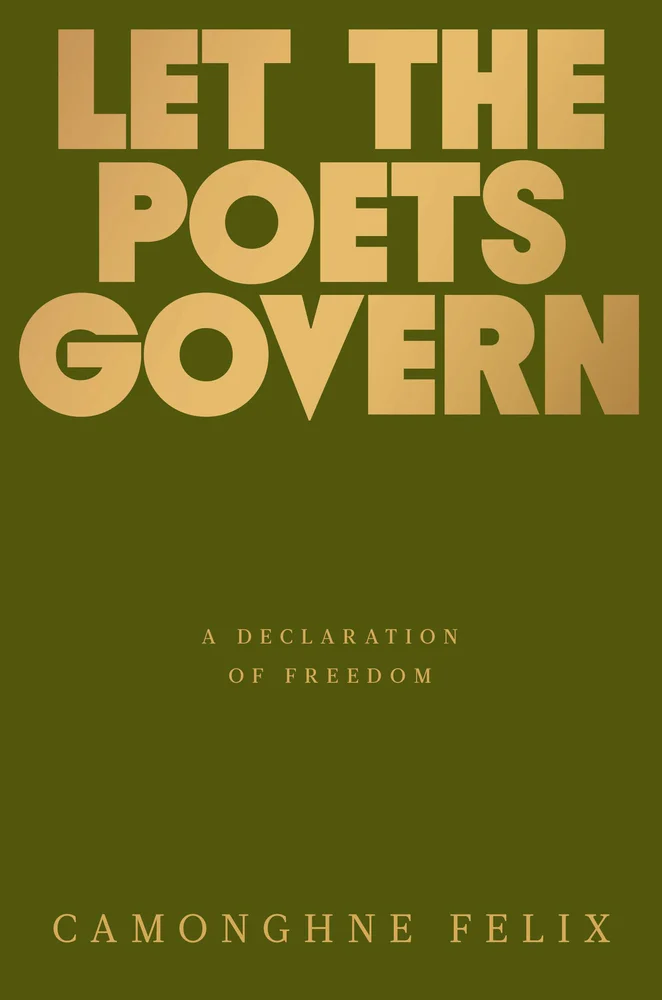
Everyone agrees we need a revolution but no one can agree on how it is to start. In her new book, Let the Poets Govern: A Declaration of Freedom, writer Camonghne Felix argues it should begin with poetry. “Poetry facilitates the imaginative work that becomes what Chris Dixon calls ‘another politics,’” she writes. Dixon’s framework offered a name for an emerging 21st century anti-authoritarian political current consisting of the cumulative efforts of activists and organizers to transform the world with radical thinking and action. As her contribution to this radical thinking, Bronx-born Felix offers a lyrical manifesto that blends memoir and nonfiction to avow poetry’s transformative promise. Let the Poets Govern declares poetry a requisite teacher for both imagining and ensuring a brighter future.
Felix is currently a professor of creative writing at The New School. Her debut poetry collection, Build Yourself a Boat, which explored multiple layers of trauma—sexual, cultural, generational—was long-listed for the 2019 National Book Award in Poetry. It was lauded for being formally inventive, with one poem that unfolds across Google search queries and others experimenting with footnotes. In Let the Poets Govern, Felix again challenges the parameters of the poetic form, this time playing with expurgation. In the book, five poems spawn from historic legal documents and remarks—among them a June 1922 British White Paper on Palestine and an excerpt from The South Carolina Slave Code of 1740—that Felix transforms via deliberate redactions to create new works. In revising these documents, Felix upsets their grammar and offers erasure poems that are responsive, corrective, palliative. In addition, Felix considers the poetic lineage and properties of Negro folk songs, American ballads, children’s nursery rhymes, political cartoons, poems from the West Indies where her ancestors are from, and the writing and thinking of other Black poets. Among them, Nikki Giovanni and former death row prisoner Marcellus “Khalifah” Williams who wrote a poem for Palestine prior to his execution in 2024. To learn the language of poetry, her book affirms, is to learn the language of liberation.
I caught up with Felix over the phone recently to talk about how her book reflects on a life of not only writing poetry but engaging poetically with the world, and how these experiences became catalysts for a personal revolution.
Naomi Elias: A throughline of this book is the elemental power of words. When was the first time you realized language was reality-shaping?
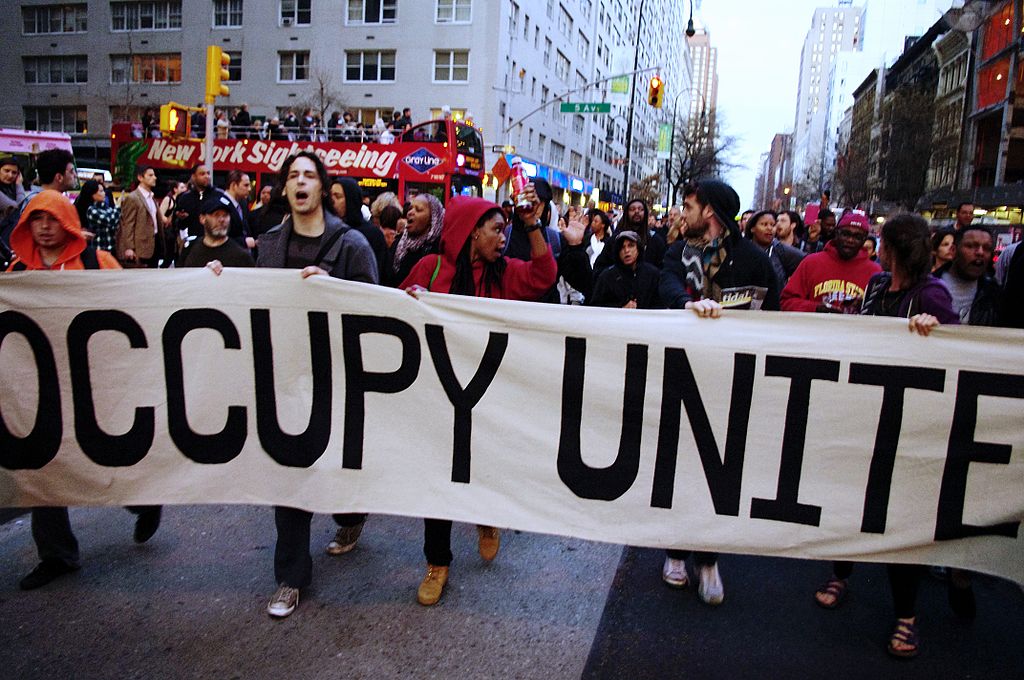
Camonghne Felix: When I was a young protestor, I think that’s when I realized the power of words. I remember after Trayvon Martin had been killed and people were marching through New York City, just listening to the chants, “Whose streets? Our streets.” That was so moving for me and activating. I remember feeling like I was picking up steam, like I was moving faster because I was so moved and guided by that language. It shaped my understanding of what power looks and sounds like and how repetition and call and response become opportunities for power building.
NE: You cite Audre Lorde’s 1977 essay “Poetry is Not a Luxury” as a guide post that helped you see poetry as an act instead of a tool. What does that distinction mean for you? How have you put that into practice?
CF: When people try to define poetry, they often get stuck in trying to describe the practice of writing poetry. I guess it depends on who you are. Either you approach that in a really romantic way or a really technical way. But we never really ask ourselves whether or not we’re doing poetry versus just writing it or trying to understand it. To me, doing poetry is walking through the world and trying to earn a perspective that is gathered and claimed through the lens of poetry. There’s a difference between saying, “I’m going to sit down and write a poem about flowers,” versus being in the world and sitting with a flower and touching a flower and recognizing its poetic and metaphorical possibilities.
When I was a young protestor, that’s when I realized the power of words.
When we use poetry, we use the idea of the poetics as a way to move people, and some might call that manipulation. We use language as a way to get people to do things. Sometimes, those things are good and sometimes those things are bad and sometimes they’re neither. But that’s the difference, right? It’s like treating poetry as a utility versus an experience of the world and of life.
NE: I generally find people are resistant to poetry nowadays. Reading of it has declined and there are frequent accusations that contemporary poetry is formless and the great works have already been written. As a poet yourself and as an educator, how do you approach people who are unreceptive to poetry?
CF: When I meet people who are frustrated with poetry, I try to explain to them that there’s a difference between a poem and the idea of poetics and of poetics. If you are studying poetry, you’re not just studying the words on the page, you’re studying the conditions and environment that created the poem. I try to just explain to people those conditions. For example, one class I’m teaching right now is a class about poetics. It takes work from a bunch of different genres, subgenres, and tries to explain and analyze them through the lens of poetry and how a poem works. We’re talking about surrealist film, post-modern painting, contemporary painting, sculpture. We’re even talking about landmarks and architecture. This week, we’re going to visit The Triangle Shirtwaist Factory as an opportunity to connect that to this book by Courtney Faye Taylor about Latasha Harlins who was murdered in L.A., which was the beginning of the L.A. riots. I try to introduce people to poetry, not as a thing that you do, but a thing that you engage with and observe.
NE: You intersperse erasure poems—poems you formulate by redacting legal documents— throughout this book. What was the impetus for that format?
CF: As I was writing this book, it felt important to provide examples of how specific documents have shaped the way that we see the world and shaped the world as it is. There’s a lot of hope in this book. Sometimes it’s hard to see, but in these redactions I’m trying to show people that even in the ugliest use of language, language still has the ability to preserve and to recreate. Text and those redactions represent the idea that we can take what is old, deconstruct it, and then approach it with new eyes that allow us to see new potential.
NE: I’m curious about the document selection process. There’s 18th century slave code, No Child Left Behind, remarks on Central America. Could you talk about that and, overall, how the process of crafting the erasure poems was different from how you’d normally write poetry?
When people try to define poetry, they often get stuck in trying to describe the practice of writing poetry.
CF: The erasure poems are really there as a way to tell us something new about history. These are documents that I have paid a lot of attention to because the language has always been really interesting to me. I selected this legislation based on where my fixation was because those fixations allowed me to be the most clear with this idea. Erasure poetry is a form. It’s most famously used in a book called Zong! by M. NourbeSe Philip. The book takes these documents from a case where a bunch of slaves were thrown overboard and the owners of the ship and the people who had purchased the enslaved people basically wanted insurance money as a way to compensate for “loss.” So, that process of making erasures is not new. It’s a different kind of poetic work. Even though I’m not physically writing, I am trying to source new narratives from material that already exists in order to say something else, which is different from the way that I would write a poem on a regular basis. On a regular basis, the poem would have its own motivation, its own vehicle, whereas these poems have to come from somewhere, some prior material. The process of writing is more like a curational process where I’m looking for language and trying to reshape narrative around it.
NE: How many times would you say you read a document before erasing it?
CF: I don’t know. I read, redact, go back, read what I’ve redacted. It’s a process of going over and over again, reading some parts more times than I read other parts, just going by gut, and then reading and rereading where I feel confused or unsure.
NE: While reflecting on your political career as a speechwriter for Governor Cuomo, you mention the person who vetted you for the position told you, “Cuomo wanted his own Maya Angelou.” That made me squirm while reading. What did that look like? How did you see your poetry being used or misused in the political space?
CF: Well, first of all, I think it looked like just having a name. In order to fulfill the whole, “I want my own Maya Angelou” idea, whoever they select has to have some sort of public reputation. So first and foremost, it was a performance for show. [It] was not about having any kind of respect or reverence for poetry, but rather just wanting to be able to say that there was a Black poet in the administration. I knew that I was being flaunted around and that no one cared what I had to say. I would write speeches that I thought were progressive and generous. And like I say in the book, you write speeches with the hope that you can push your principle and that in pushing your principle that pushes the campaign or government’s narrative and changes the way that laws are working, et cetera. But in this case, it was very clear that no one was interested in listening to me about anything. In some cases that is useful. You’re young and you’re trying to pursue your writing career while having a political career. I was writing poems at work and submitting poems at work, going to school and showing up at 3:00 PM at my job to sit at my desk where I would write a speech and no one would care that it was written except my boss.
NE: You credit poetry with teaching you about the power of fugitivity, and political organizing with furthering that. Can you define what fugitivity means to you and elucidate the connection between your life as a poet and your life as an organizer?
CF: Fugitivity is not just living outside of the colonial, racist, capitalist system that is the United States or that is the state in general, but about pushing by breaking out of those systems—not necessarily to create new systems, but to liberate yourself from the requirements that force you into the conditions the state, or oppression in general, has set up. It’s about intellectually and philosophically and creatively thinking outside of the way that we’ve been told to think and living outside of those borders, which is always pursuing what feels impossible, always pursuing the imaginative. Because to do anything other than that would be to force yourself into the boxes and systems that are killing you.
How that relates to organizing [is], I think that great organizers can sell the prospect of a fugitive future to their people, they understand that in order to provide a new vision, it has to be an original, honest vision. And even if it’s not original—because we borrow from so many places and histories—our communities require that we are thinking very big about what’s possible, and we can’t do that unless we step out of the enclosure.
NE: You began writing this book during the pandemic and then that book completion timeline began overlapping with the ongoing genocide in Palestine. I felt a clear shift in tone and urgency when you wrote about that. How did Palestine shift this book and/or you?
CF: When I first started writing this, it was an entirely different book. I thought I was writing a book about how poetry could help politicians have more effective campaigns, and through having more effective campaigns be more useful in passing legislation. In the back of my head, I knew that that was bullshit, that it was an argument that facilitated more disillusion and manipulation. After the election, as we were in the pandemic, I was just watching things happen. Governments were fucking up, systems of governance were fucking up. And I realized pretty early on, things are about to get really bad. My job was to try to get ahead of it and to try and articulate what that was going to look like. But it took me longer than I thought it was going to take. Writing this book took me five years. I thought it would take me two, maybe two and a half.
Great organizers can sell the prospect of a fugitive future to their people.
In the middle of rewriting this book I went into a very deep depression after watching Israel bomb Palestine over and over again. I couldn’t sleep for days, for weeks. And I’d go back to this book and I’m trying to tell this story about my own evolution, trying to talk about where the world is right now, and I’m like, In what world could I not talk about Palestine? So, I did feel a sense of urgency. I knew that this book wasn’t about Palestine, but I knew that there was no way I was sending this book to the publisher without saying something about Palestine. It had to go in there, and it went in later than everything else, which is why you can feel that turn in urgency and that turn towards a more almost righteous language. Like you said, you can see the shift. You can feel it. I think that it brings us to a loss of continuity that might be difficult for the reader. But there was no way I could make those sections sound like the other sections because there was nothing left but this question of, “What do we do now that we are descending into a much more visible imperialist war?” I knew writing about Palestine was going to hurt me to an extent, that it would be harder to talk about the book, sell the book. But I’m not willing to look back at this moment in 10, 20, 30 years, and think to myself, “Damn, I chose to stay silent,” or, “I chose the bestsellers list.” I couldn’t survive that.
NE: There’s a trend in conservative or repressive eras of artists trying to distance their work from politics, but for you all poetry is political, right?
CF: Yes, fundamentally. And if I did anything else but what I did, I would just be lying. The premise would be completely destroyed.
NE: Do you have any suggestions for companion reading to your book?
CF: People should always read The Undercommons by Fred Moten and Stefano Harney. Another book it’s important to spend time with is Orientalism by Edward Said. Those are really excellent texts. In terms of poetry, it’s helpful for people to spend time with Zong! by M. NourbeSe Philip [and] Black women poets and writers between the ’40s and now, like Gwendolyn Brooks and Octavia Butler, who people say was a witch or could read the future when really I think she was doing exactly what we’re all doing, definitely what I was trying to do, which is tell the truth about what’s happening right now, but tell it from the perspective of the future so that people understand what’s going to happen and where we are by just recognizing the patterns of the past.
Read the original article here