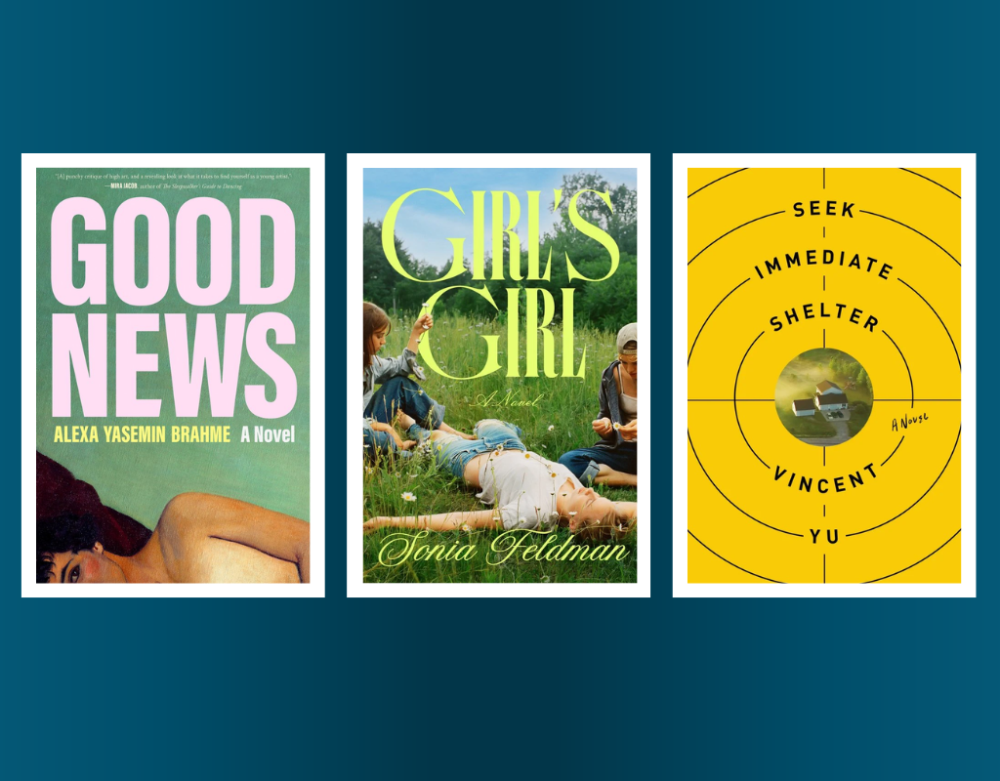
For the spring edition of our debut craft series, three debut authors—Alexa Yasemin Brahme, Sonia Feldman, and Vincent Yu—discuss in detail their journeys through writing about imaginary lives. One may argue that all fiction is rooted in imaginary lives, but these novels especially feel centered around the stakes of these imaginary lives as the protagonists confront, examine, wonder, and muse upon each of their choice’s ramifications on the rest of their years. From the gritty-and-glamorous art scene of Manhattan to the humid teenage June of northeastern Ohio to a suburban, emergency-laden town in Massachusetts, these three novels feature forks in the road and irreversible decisions that fall like dominoes upon characters and their next chapters.

“It was strange to see John in the studio, completely at a loss as to how to move his body, unsure of how to orient himself toward art.” So begins Good News by Alexa Yasemin Brahme, a novel centered on Maggie, a Turkish-American MFA student finalizing her evocative thesis painting of “feminine suffering” while competing with her brother’s girlfriend, who has given herself the moniker of “the Artist.” Set in the contemporary New York art scene, the novel follows Maggie as she tries to orient herself within a branching future. Through gallery openings, social climbing parties, doubts about her boyfriend, and the return of an enigmatic ex, Maggie is forced to decide which life or alternate life she’ll end up choosing. In this world, a vertical brushstroke can change the entire canvas, and one phone call can upend everything she’s built. Good News invites it all, plus the chaos, pleasure, and temptation of being young—that is, of creating worlds that leak out of our heads.
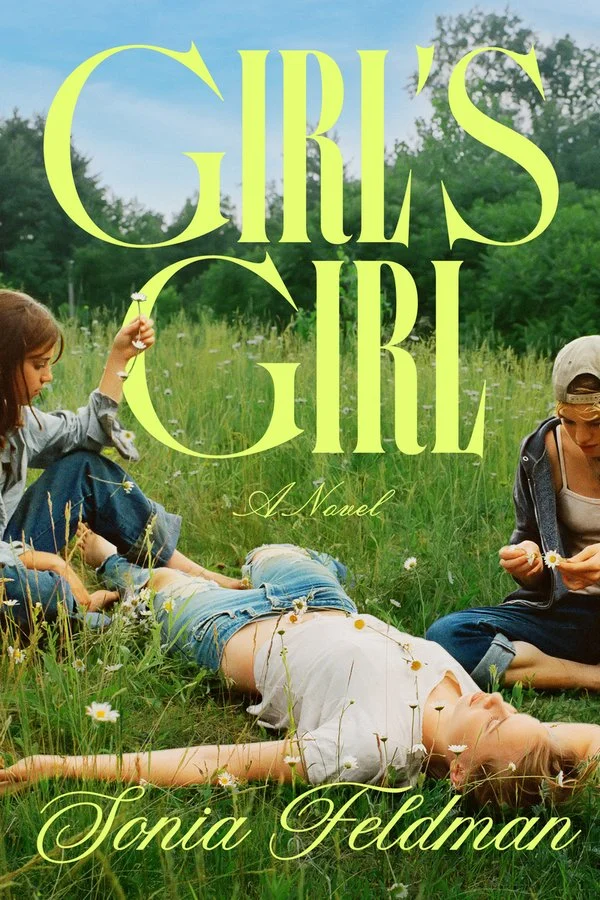
“Growing up, I had two best friends—Margaret, whom I had known my whole life, and Eleanor, with whom I was in love, though for years I had no reason to tell my feelings for one apart from my feelings for the other.” In Girl’s Girl by Sonia Feldman—set in that long summer between freshman and sophomore year of high school—Mina is caught in a web of desire, both platonic and erotic. It is a novel about living in suburban Ohio and creating those “capital E Experiences” that stay with you long after graduation. Reading it, I could almost smell the chlorine of untouched pools and that sticky perfume of bug spray sweating off skin at the end of the night. The messiness of the Midwest summer and unrequited love and dazzling adolescent confessions run rampant in this debut.
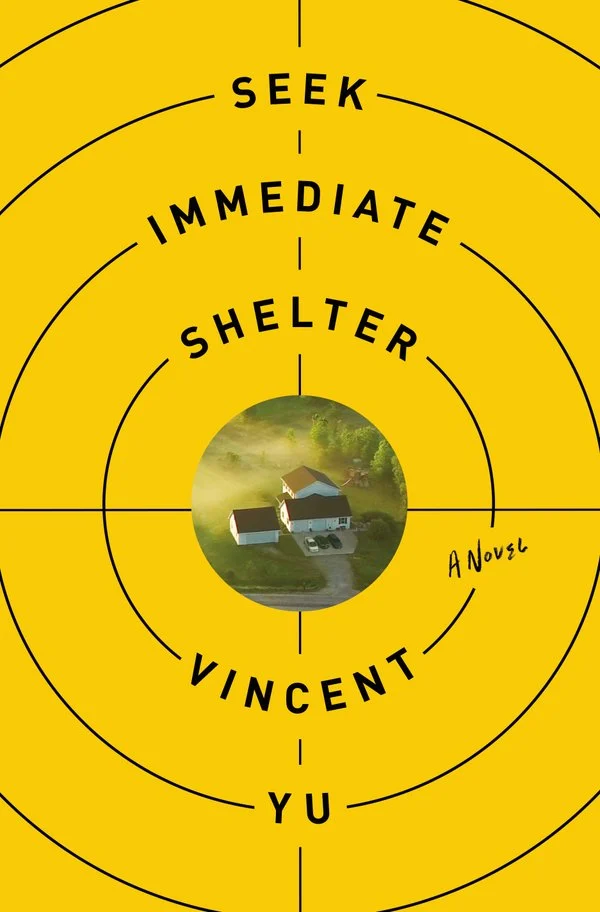
“Beckitt’s emergency began on a calm spring morning: an expansive chill in the air; the sun soaring over rangy, adolescent clouds; miles of rolling green mowed into submission, flanked by grand columns of oak and maple, through which the wind shivered.” When a ballistic missile alert threatens the town of Beckitt on a mundane morning, the town and its cast of characters are confronted with that most human decision: fight-or-flight. But when the second alert comes in, claiming that the first was a false alarm, the real decisions become clear. Where does one go from here? What did each person choose to save or leave behind? And how will these ramifications infiltrate the rest of their lives and those surrounding them? Seek Immediate Shelter by Vincent Yu explores the question of “what if” at its zenith. The novel follows five different characters and moves through each of their perspectives when the alert was sent, and then the aftermath, which for some may prove to be an even more daunting emergency than that initial missile threat.
Brahme, Feldman, and Yu corresponded with me on the significance of perspective in their novels, the spark that ignited and transformed their hypothetical questions into fiction, and the advice they would impart to anyone becoming a debut novelist.
Kyla D Walker: Did you know right away that the book would be from Maggie’s third-person limited POV, or did you consider a first-person POV as well? What ultimately led you to choose third-person narration, and how did this change the novel’s approach?
Alexa Yasemin Brahme: First person is an intimidating point of view—“I” can be very powerful. First person felt immediate, intimate, and had a sure-footedness that wasn’t quite right for Maggie. The first person feels to me like certainty. We readers are getting the account straight from the source, and when that source is unreliable, like I think Maggie would be, the first person feels like a slight of hand a character is performing against the reader. What’s presented as fact is actually distorted. I wanted there to be a little distance between the reader and Maggie so she couldn’t hide from their gaze. Maggie can’t present her take on the situation because the reader can see multiple sides at once. While Maggie can trick herself into believing one version of the story, she can’t trick the reader.
That said, when I was drafting and editing the book, if I got stuck in certain scenes wondering what Maggie would say or do, I would write them in first person to see if there was anything Maggie could reveal to me about herself. If it proved to be useful, I’d take what I’d written and massage it into a third-person version for the final draft.
First person is an intimidating point of view—’I’ can be very powerful.
KDW: I love Maggie’s thesis painting and all it represents, and I’m so curious about its conception. Did the painting’s concept—the image of multiple women in mundane settings yet extreme pain—come before the novel, or did it arise through the novel’s writing and Maggie’s character?
AYB: The painting was challenging for me to conceive of while I was writing the book. Turns out, not being a visual artist is a huge impairment to writing about visual art. When I started working on the novel, I had no idea what the painting would depict. I knew I wanted the subject of the work to be about women and their particular plight in this world. And it wasn’t crucial, at least to me, that the painting be perfectly visible throughout the book. My main concerns were the feelings surrounding the art. At times, the painting feels bleak and depressing, and later in the book, Maggie realizes its greater meaning is deeper than just “Women Suffer.”
Strangely, writing the painting felt like a process Maggie and I were constructing together. It feels like we figured it out, which makes me sound absolutely insane.
KDW: Which part of the writing process required much more time and energy than you initially expected? And which was your favorite part of the process?
AYB: I couldn’t anticipate how any part of the writing process was going to go, which was challenging, and unfortunately seems to be emerging as a pattern. Sometimes a scene would rush by while I was writing, and then there would be a month of agony when I didn’t know what was going to happen next. It seemed there was nothing I could force that would speed up the agony. In these waiting periods, I’d watch a lot of movies, go to museums, read books, listen to music, all in hopes that I might feel something new or think a new thought. Sometimes it worked, and sometimes it didn’t. The key was trying not to feel too depressed when it didn’t work, and to just keep showing up until eventually something showed up on the page with me.
The most fun part of the process is when these horrible periods end because of a single thought that flashes in my mind and feels like it solves all my problems. Likely it solves one or two, but after suffering, anything feels like a rushing wave of relief. Then when things click into place after that rough patch and the writing is moving again, my memory is short enough to forget ever having suffered in the first place.
KDW: And finally, what advice would you now give to anyone currently working on a debut novel?
AYB: My advice to anyone working on anything creative is to try to stay connected to yourself. It is so tempting to share a scene with someone, an early sketch of something, and wait for them to tell you how good it is. But more often than not that experience isn’t as rewarding as you think it’s going to be. Maybe someone says it’s amazing, and you don’t believe them. Or worse, maybe you do believe them and it’s, tragically, not yet amazing. Someone may not understand what you’re doing, which isn’t their fault but can be absolutely crushing. Someone may be jealous and dismissive, which can discourage you from continuing on.
Whatever you’re making, it’s a delicate thing for a longer time than I ever realized. I was glad when I was writing my debut, that I protected it from outside forces until it (and I) had enough body and heft to withstand other people’s reactions. People could say whatever they wanted about the work, and I had spent enough time with it, built a relationship with it, that I knew if their comments were brilliant critiques I had to incorporate, or well-meaning remarks that had no bearing on what the book would become. That way, I’ll say most of the time, I didn’t take things personally. I was in conversation with the work, other people were saying things, and sometimes those things were right, and sometimes they weren’t. It didn’t always have to be so painful.
KDW: When was the moment you felt ready to begin writing Girl’s Girl? And what was that initial spark—maybe a specific sentence, scene, or character’s voice—that kicked off the writing of the novel?
I had to ask myself: Would you prefer to write a bad book or to write no book?
Sonia Feldman: I wrote poetry for years before I started writing fiction, and I entered this book the way I usually enter a poem—with a sense of emotional atmosphere. I knew that the protagonist, Mina, was in a very particular, difficult to express mood. My poetry also almost always has weather, temperature, or a time of year. I think I need this kind of information in order to feel oriented. So I also knew from the very start that Mina’s mood had to take place in the summer. It was a summer kind of feeling. From there, I began the long and slow process of asking why Mina felt that way and trying to turn her mood from something I could feel into something I could help someone else feel.
KDW: Did you know right away that the book would be told in first person? Did you consider third person or a shifting POV to capture Eleanor and Margaret’s interior monologues as well?
SF: I spent several years trying to write Girl’s Girl in the third person and basically banging my head against the wall. I really wanted to write in the third person because I grew up loving 18th century British literature and Jane Austen, especially. Also, I was afraid to write in the first person. But I couldn’t figure out who that third person voice telling the story was. She wasn’t me, but she also wasn’t a character defined by the book. I would try to describe Mina, Margaret, and Eleanor in an omniscient narrator’s voice, and then immediately disagree with my own descriptions. Only once I let myself write as Mina did the perspective of the voice telling the story start to make sense. Because then the book no longer had to contain “true” descriptions of the characters. Instead, it merely had to offer Mina’s opinions about herself and the people around her at a given moment in time.
KDW: What did research for Girl’s Girl look like?
SF: Calling my best friends on the phone and asking them what they fought about with their moms when they were 15. Attending a county fair as an adult. Deep and sustained introspection. Reading girlhood and coming-of-age novels like Dogs of Summer by Andrea Abreu (translated by Julia Sanches), Sweet Days of Discipline by Fleur Jaeggy (translated by Tim Parks) and How Should a Person Be? by Sheila Heti. Reading novels that were tonally quite different from mine but had incredible first person retrospective narrators, like Never Let Me Go by Kazuo Ishiguro, Housekeeping by Marilynne Robinson, and The Emigrants by WG Sebald. Rewatching Sailor Moon. Looking up the lifecycle of nodding thistle. Playing The Sims.
KDW: And finally, what advice would you give to anyone currently working on a debut novel?
SF: What comes to mind is a kind of crisis that I had during the writing experience. I was incredibly frustrated with the book and my own lack of progress. I’d been trying to write it in the third person for years and had what felt like nothing to show for it. I had no story, no causality, just a bunch of information about people. I had a pile of pages that weren’t in any way a book. This felt horrible.
I suspected that I might be able to make progress if I tried writing in the first person instead. I really didn’t want to do this. I was afraid of what I would produce if I did. I felt like if I wrote the book in the first person, then it wouldn’t be the book I’d been dreaming of because it wouldn’t sound the way I’d been dreaming it would sound. So in effect, I would be letting go of a dream of what the book could be.
Another way of saying this is that I felt like if I wrote the book in the first person—I might be able to actually write it, but—the book would be bad. And so I had to ask myself: Would you prefer to write a bad book or to write no book? Because those were my two options. I had to truly in my heart accept that I’d rather write a bad book that embarrassed me than to write no book at all. I think if you can do that, you can finish your manuscript. And then you can try to make it better.
KDW: The concept of Seek Immediate Shelter and the stories that unravel throughout feel like a thought experiment and a fictional philosophical journey through the different decisions and shocking paths one may take in times of crisis, touching upon the faults of human nature and the complicated expectations and nuanced responses individuals have against a collective/conventional society. How did the idea of the false missile crisis come about, and what led you to follow an eclectic cast of characters rather than a single protagonist?
Vincent Yu: Seek Immediate Shelter began as a question that would not go away: What would I do if I thought I might die at any moment? Writing fiction has always been a means of self-discovery as well as self-expression, and so my instinct, after continuing to be nagged by this hypothetical, was to explore it in a story. When I recalled the 2018 ballistic missile alert sent in error to Hawaii, I realized that a fictionalized version of this event might create the ideal set of conditions under which to investigate the gut reaction of a flawed but believable human being.
It’s really apt that you use the term “thought experiment” to describe this book—that is precisely the mindset I had when I started writing! The book actually began as a short story with a single character, exploring his response to the alert and its rippling effects.
Robust experiments, however, often require multiple iterations and control groups in order to capture the full scope of investigation, to take into account the truly surprising results and novel conclusions. And so, after I finished that first story, I realized that I wanted to do more with the idea: I wanted to pressure test an entire battery of characters with an equivalent variety of behaviors. That was how the book really came into being.
KDW: With so many varied occupations represented—from violinists to PR executives—what did the research process for this novel look like?
Every form of discovery begins as a kind of disturbance.
VY: The research involved in writing this book was fairly light, in large part because I was a competitive pianist and violinist growing up, and because my first career was in public relations! I wanted very much to write what I knew—that way I could focus a bit more on creating empathetic and convincing psychologies for people who experienced things with which I was unfamiliar: parenthood, substance abuse, false missile alerts (!), and such.
The most research-heavy chapter was the sixth, in which I follow the character who worked at the Emergency Management Agency and actually sent out the false alert. This required investigation into the bureaucratic processes that are actually involved in sending out such notifications. It also gave me tremendous, terrifying insight into how fallible these kinds of systems are, and how quickly a single offhand decision can yield a runaway reaction.
There were also moments in which research popped up out of necessity. For example, when I needed to determine the best way to acquire a dead person’s DNA for a paternity test, or to understand various bluegrass violin techniques, or to clarify the human pupil’s reaction to opioid use, among others. Falling down these little rabbit holes and emerging with greater knowledge, however random it may be, is one of the greatest pleasures of writing fiction.
KDW: Did you write Seek Immediate Shelter with an outline or a specific order for each character’s chapter in mind?
VY: Not really. The idea of a literary experiment really took hold of me from the very beginning, which led to a large amount of trial and error in my writing process. I let each character make his or her own decisions, and then tried to gauge as honestly as possible if their behaviors seemed believably human. There were a lot of false starts and many branching plot points that I pursued and ultimately pruned.
The whole process was a bit like mapping out a completely dark room. I started in the middle, without knowing the shape of the space I was in or its contours or objects. I had no choice, really, but to move and feel my way around. I bumped into many things, but I think every form of discovery begins as a kind of disturbance. After a while I began to feel more confident in my explorations.
The real light switch, however, was my editor, Caroline Bleeke. Her guidance and vision for the manuscript was completely illuminating. Once she and I started working together, I knew exactly how to order the stories and unite the characters into a cohesive whole.
KDW: How did the backdrop of Beckitt help sculpt the story or shift the style of prose, if at all? And is the town’s name a direct allusion to a certain canonical existentialist absurdist writer?
VY: Ha! There was a little bit of intentionality in my choice of the town name, but certainly not enough to put the work in any meaningful dialogue with that of Beckett’s. All I really wanted was to invoke a sense of strangeness even in the everyday. Beckitt was actually based on my own hometown of Longmeadow, which is also located in the Pioneer Valley of Western Massachusetts.
After I decided to tell the story through multiple characters, I realized that setting the entire thing in a single community would allow me to believably intertwine their lives and to explore the particular drama that occurs in small, tight-knit communities.
Many people (including some of the characters in the book) assume that towns like Beckitt are perennially quiet and unchanging. One of my goals in sending a false missile alert to its residents was to create enough of an emotional disturbance to reveal the richness of all the lives within it, the vast interiorities of every single resident, living and dead.
Read the original article here