
All writing, at some level, grows out of obsession—the need to get our most intense and unwieldy feelings down on paper so that we might begin to see them clearly, or persuade others that our passions matter. But sometimes the obsession is right on the surface of the plot—is the plot. An obsession makes a strong engine for a novel, engendering intense prose and risky choices.
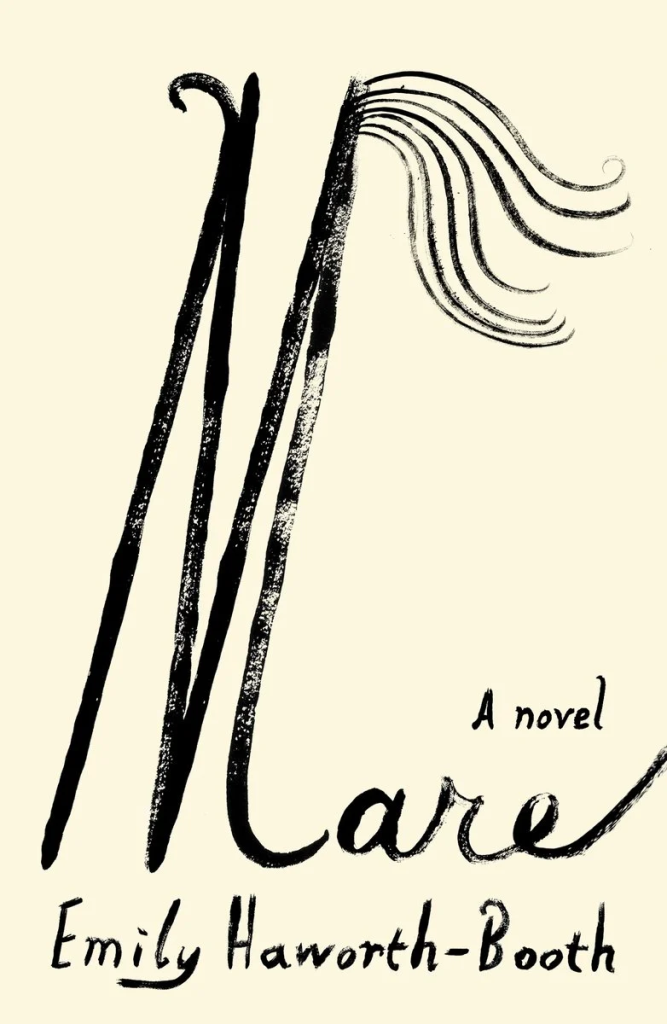
All of the books on this list were on my desk and in my mind when I wrote Mare, a novel based on my own experience—and my own obsession. In Mare, the protagonist takes on the casual, part-time care of a horse, in part to avoid thinking about a future in which she will not have children. When her feelings about the horse turn into affection, and, later, obsession, she struggles to explain their strength to herself or others. After all, as another character insists—the mare is “just a horse.” Sure, in pony books girls are obsessed with horses. But once you’re past the age of about 16, you’re expected to move on to more adult obsessions. I failed to find any other books about a woman obsessed with a horse. What I discovered is that the quality of obsession in literature is transferable across objects. The books on this list spoke directly to me as I swam in the dark waters of infatuation, trying to work out what kind of story I was in.
More often, the female protagonists of novels are obsessed with other people, often men. Of course, there are Tolstoy and Flaubert’s famous novels of the affair, in which Anna Karenina and Madame Bovary’s obsessions with their respective male objects reach tragic ends. But for this list, I was interested in female obsessives written by women. At first the list seems to be sameish, with many of the narrators fixated on an out-of-reach man. But when you look closer, it becomes evident that even apparently similar obsessions can take very different forms. What is fascinating in most of these books (no spoilers!) is how the obsessed woman, appearing at first to be powerless, is ultimately empowered by her obsession. To be obsessed is to have a mind, a heart, and a body—to actively want something—to be, in other words, centered in one’s own story. In the grip of obsession, a woman’s gaze is returned to herself.
By Grand Central Station I Sat Down and Wept by Elizabeth Smart
By Grand Central Station I Sat Down and Wept is one of the most obsessive books on love ever written. Like the love it chronicles, it is itself uncategorisable—a memoir that reads like a novel, a letter, a sermon and a prose poem. Divided into ten breathless sections, By Grand Central Station tells the story of the unfolding love between Elizabeth Smart and George Barker. Smart had chanced upon a volume of Barker’s poems while in London in 1937 and fallen in love with his writing. Her book brings to life the affair which began when she flew Barker and his wife out to stay with her at an artists’ colony in Big Sur, amid the drama of redwoods, thunder and canyons. It shows us a woman in the depths, and at the heights of, her obsession—one that led not only to social castigation but, at times, actual imprisonment.
Convenience Store Woman by Sayaka Murata, translated by Ginny Tapley Takemori
When Keiko begins her job at the convenience store she becomes what she most wants to be: “a normal cog in society.” Not only has the store supplied her with a personality, a purpose, and a behavioural code in the form of the store manual, it is literally the stuff she is made of: “When I think that my whole body is made up of food from this store, I feel like I’m as much a part of the store as the magazine racks or the coffee machine.” She thinks of the store on her days off; she even dreams of it at night. When the novel begins, Keiko has been working at the convenience store for 18 years. What follows, as the events of the novel threaten to dismantle her obsession, is not the whimsical comedy we might expect from a story set in a supermarket, but a provocative investigation into societal pressure.
The Woman in the Purple Skirt by Natsuko Imamura, translated by Lucy North
It is never quite clear why the narrator is obsessed with the Woman in the Purple Skirt. Maybe it’s because she reminds me of my sister, she wonders aloud, or someone from school. Perhaps it’s because she’s striking, or is it because she’s boring? Likewise, the narrator herself remains obscured, hidden within the margins of the story. “I observe her from a distance,” she writes, “a silent spectator in the drama of her life.” But when documenting turns to string-pulling, the narrator invisibly manages to arrange for the Woman in the Purple Skirt to get a job at the same hotel she works at, setting in motion a chain of events leading to a dramatic conclusion. And yet, as the novel closes we are left with no answers, nothing that will put to rest the obsession with the Woman in the Purple Skirt, so that it lingers on within us, becoming our obsession, too.
I’m a Fan by Sheena Patel
I’m a Fan plays with all the conventions of obsession, both traditional (stalking, creepy letters) and contemporary (endlessly refreshing instagram stories). “The woman I am obsessed with” is what the narrator names the woman that “the man I want to be with” has left her for. Yes, the narrator of I’m a Fan is obsessed with the man with whom she is having an ill-advised affair. But it is this foundational obsession that carries the more interesting one: the painfully perfect object of his obsession: a pretentious Californian influencer whose fans fawn over her online. “She would be complimented for farting,” thinks the narrator, “someone would write, ‘I usually hate farts but when you do them, my god, so floral and unusual!’” Over the course of the book, in short vignettes that criss-cross time and space, the narrator sharpens her scalpel and gradually dismantles the woman she is obsessed with.
The Possession by Annie Ernaux, translated by Anna Moschovakis
Even more so than I’m a Fan, Ernaux’s short memoir is monotropically focused on the woman she has been left for. She embarks on a quest to discover the identity of the woman who has replaced her, each new piece of information causing a shift in her attitude towards the entire world. On discovering, for example, that the woman is a professor, “I discovered that I hated all female professors—though I myself had been one, and many of my friends still were.” The obsession is of course painful, a boil that needs to be lanced, a problem seeking resolution—and yet, one of the beautiful surprises of this book is the energy Ernaux gains from the obsession. “This woman filled my head, my chest and my gut; she was always with me, she took control of my emotions. At the same time, her omnipresence gave my life a new intensity.”
I Love Dick by Chris Kraus
Reading I Love Dick sometimes feels like listening to a very clever, very funny and very drunk friend going on and on about her crush, showing you what she wrote to him and what he wrote back (if at all), when she called and whether or not he answered. Chris Kraus’s passion for Dick, a boring “English cultural critic” who she has only met once, appears entirely unjustified. But it is his blankness that allows her obsession to become a kind of enlivening game. In fact, Chris, an artist and filmmaker, might be more in control than she first seems: far more interested in the project of obsession than in Dick himself. On the surface the novel is about a woman’s infatuation with an unworthy man. What it’s really about is who gets to be obsessed with whom. “Who gets to speak and why,” Kraus writes, “is the only question.”
My Husband by Maud Ventura, translated by Emma Ramadan
My Husband tells the story of a different kind of obsession: here, the object is within reach. There he is, with a wedding ring on his finger, already committed to a life with the narrator. So why is she still so “lovesick,” as she calls it? Yes, she admits straight away, her obsession is both unlikely and unusual. Her love hasn’t followed the “natural” progression from infatuation to something milder. She has no fictional heroines who can show her “how to behave.” The unnatural intensity of her feelings towards him feeds the sinister, gothic atmosphere of the book, the sense of something brewing, about to boil over. In My Husband, obsessive love is the monster looming in the shadows of the house. But as the plot twists towards its conclusion, we discover that there is more to her obsession than meets the eye. Is there one monster in the house, or two?
Read the original article here