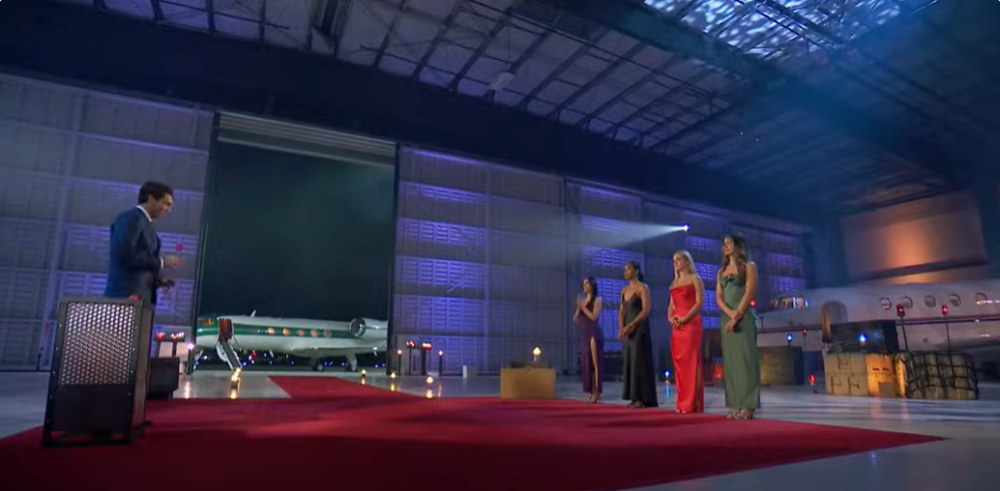
Reality TV has always prompted discourse. From its earliest days, critics have decried it as the downfall of civilization even as viewers tuned in in droves for the interpersonal drama, the competitions, and the bizarrely artificial setups. Decades into the genre’s formation, critics and fans still abound, and we’re still asking the ever-titillating question: How much of what we see is actually real?
It’s a question that has, in a sense, escaped containment in recent years, where entire media ecosystems may be based on outright lies and propaganda, where mis- and disinformation are spread online both deliberately and not, and where the boundaries between reality TV and social media stardom seem to be eroding. How did we get here? And why are so many of us still lapping it up?
We—Stevie and Ilana—cemented our friendship in grad school by watching The Bachelor franchise every week, and we began asking each other these and many other questions. For example: Why does the franchise keep casting leads who used to play professional football and have really thick necks? And why oh why don’t these people ask each other basic questions about each other’s political views before deciding to get engaged? What started as a way to turn off our brains for a couple hours increasingly became another place to use our critical thinking skills. We couldn’t help it; there was so much there to dissect.
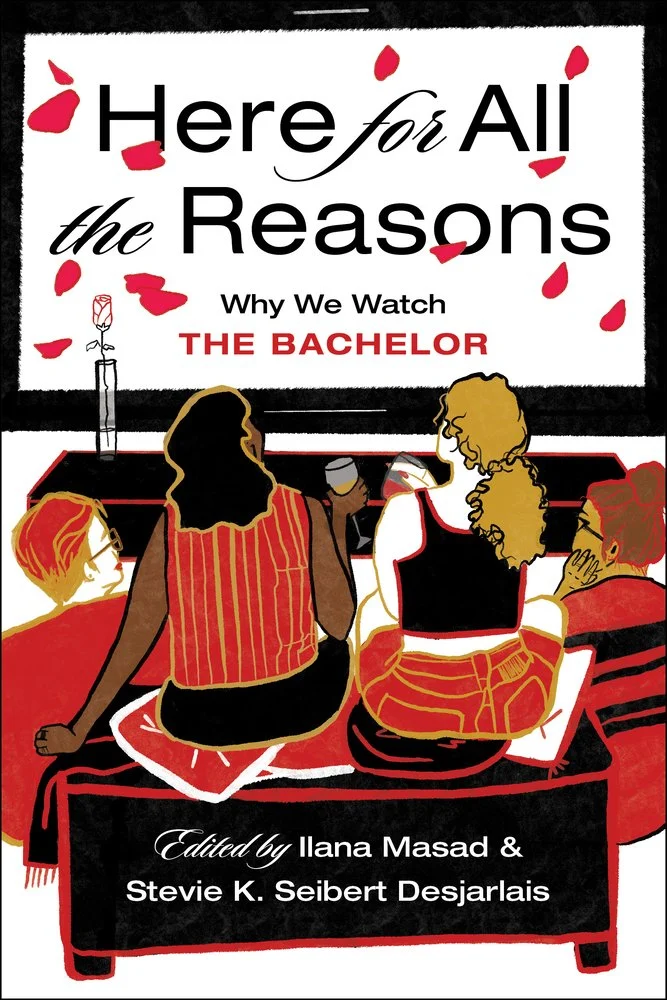
Our joint anthology, Here For All the Reasons: Why We Watch The Bachelor, was born out of our conversations surrounding the franchise, as well as the question we kept asking each other—and that we knew other fans, friends and online strangers alike, asked themselves too: “Why are we still watching this?” The result is a polyvocal collection of personal essays sharing the thoughts, opinions, images, theories, and critiques of nearly 30 contributors with the world. It’s the first anthology of its kind—dedicated specifically to a reality TV product’s fandom—and we’re eager for readers to join the conversation.
The eight books below also engage with reality TV in unique and interesting ways. These authors showed us we’re not alone in thinking reality TV is a genre full of legitimately rich texts that reflect back to us so much of what is wrong with our contemporary social and economic structure, while at the same time giving us glimmers of true human compassion and hope, albeit via extremely imperfect vehicles. Each of these books is thought-provoking and engaging—and proves that whether you love it, hate it, or love to hate it, reality TV is a genre with enough cultural cachet and sticking power to be taken seriously.
Cue the Sun! The Invention of Reality TV by Emily Nussbaum
In this thorough history of the reality TV genre, New Yorker staff writer Nussbaum begins by contextualizing it with what came before: audience participation shows on the radio like Queen For a Day, which started in 1945 and involved women talking about their financial and emotional hardships in the hopes of winning financial help and whatever items sponsors donated to the show. (Audiences in the US, Nussbaum shows, have long enjoyed schadenfreude-tinged entertainment.) The book also introduces readers to what many consider to be the forerunner of our contemporary understanding of reality TV: An American Family, a 1973 cinéma-vérité project that followed the Louds, a typical middle-class white family, as they went about their seemingly ordinary lives. Except it turned out that audiences found nothing mundane about getting to pruriently peer into another family’s dysfunction. Nussbaum doesn’t stop there, of course—she brings readers all the way up to the present with the making of an American reality TV star president.
Patricia Wants to Cuddle by Samantha Allen
GLAAD-award winning journalist—and Here for All the Right Reasons contributor!—Allen’s debut novel (after her first nonfiction book, Real Queer America) is a hell of a hoot. Patricia Wants to Cuddle follows contestants in a Bachelor-like reality TV dating show who are all vying—with varying degrees of sincerity—for the heart of the dull entrepreneur Jeremy Blackstone. Each of the final four contestants will feel familiar to reality TV aficionados. There’s Lilah-May, a Christian influencer; Amanda, a fashion vlogger; Vanessa, a model; and Renee, an HR rep. For the last two weeks of filming, the cast and crew arrive on a small, isolated island in the Pacific Northwest that has a dark history of women hikers disappearing there. As tensions rise among the contestants, and between them and the cutthroat producers, rumblings in the woods begin to threaten not only the show itself but the very lives of its participants. But what if whatever—or whoever—is out there just wants to be loved too?
Dekonstructing the Kardashians: A New Media Manifesto by MJ Corey
Even if you’ve never seen a single second of Keeping Up with the Kardashians or their Hulu revival, The Kardashians, you’ve heard of the Kardashian-Jenner family. Whether you’re fascinated or disgusted by them, the fact is that the clan has managed to make themselves relevant and stay that way despite not having any particular talent other than the accrual of fame and money. Then again, in the US, the accrual of fame and money is itself a highly valued kind of talent. MJ Corey, the voice behind the popular @kardashian_kolloquium Instagram account, has written a fascinating deep dive into the Kar-Jenner dynasty, examining how Kim in particular has used the contemporary media landscape to self-mythologize and cement herself as an icon. Kim, Corey argues, has made herself the medium, and her various transformations—through costuming, contouring, and plastic surgery alike—connect her to icons of yore, informing us that she’s as important to the culture as they are. Whether we like it or not, Corey argues, she’s right.
Dream Facades: The Cruel Architecture of Reality TV by Jack Balderrama Morley
In Dream Facades, Morley, managing editor at Dwell, argues that the houses so many reality TV shows take place in and around are crucial to understanding the genre, our relationship to it, and how thoroughly it reflects the woes of the ongoing colonial mindset of US culture. In Selling Sunset, for instance, they point to how so many of the houses being sold have panoramic views of the sprawling and expensive city of Los Angeles, and how this showcases the eventual owners’ positionality—they are literally above the smog, the dirt, the plebs. As for The Bachelor mansion—of particular interest to us, of course—Morley shows us how its Mediterranean Revival style is actually local to nowhere and barely Mediterranean, really; it’s instead a kind of colonial fantasia. We’ve gotta be honest here—we’ve spent years considering reality TV from what we thought was every possible angle . . . but Morley’s book showed us how much we were missing by not taking a deep look at the spaces in which the genre is set.
The Compound by Aisling Rawle
The reality show in Aisling Rawle’s debut novel is like a supercharged version of Big Brother: Amid a vaguely dystopian background, contestants occupy an extremely isolated compound where they have to complete challenges to get even their most basic needs met. Lily, the narrator, wakes up on the compound. She and the other women await the arrival of the men, who are forced to trek across the surrounding desert to arrive at the house and its grounds. Once they arrive, things begin to heat up quickly as they complete group and individual challenges for rewards like a front door, coffee, food, and water. Meanwhile, Lily makes it clear that getting on the show can be a literal lifesaver, a way to achieve status and financial options in the outside world. It’s bleak, but then again, how many people get into reality TV these days for the same reason?
Here for the Wrong Reasons by Annabel Paulsen and Lydia Wang
In Paulsen and Wang’s debut rom-com, Here for the Wrong Reasons, seemingly straight competitive rodeo rider Krystin signs up for the dating show Hopelessly Devoted with the hopes of, well, becoming hopelessly devoted to its leading man. Lauren, meanwhile, is gay as a three-dollar bill, but she’s closeted to enough people in her life that she’s able to secure a spot on the show, and she plans to get as far as she can in order to grow her influencer brand. Once she gets big enough, she figures, she’ll be able to come out to her audience. When the two women begin to have feelings for each other, they have to reckon with their individual goals outside of the show, and what it might mean to change everything for a chance at a true happily ever after.
True Story: What Reality TV Says About Us by Danielle J. Lindemann
Lindemann (who blurbed our anthology) is a professor of sociology at Lehigh University—and this year a visiting professor at Princeton—and argues that reality TV is worth interrogating because of how it affects us, the viewers. (We heartily agree, obviously!) In her deeply researched book, Lindemann sidesteps the question of how real reality TV is—because, as she points out, it doesn’t really matter when it can teach us how much our own reality is socially constructed—and instead examines the ways reality TV portrays the many intersecting identities of those who appear in them and how those portrayals largely uphold the status quo of contemporary power dynamics. She also explores how concepts like coupledom and family are constructed on reality TV, and shows how conservative ideals are nearly always the foundation for whatever seemingly liberal shenanigans we might witness onscreen. Lay readers, have no fear—while Lindemann may be an academic, this delightful book is geared toward a general audience, not the ivory tower.
Real Love by Rachel Lindsay
Rachel Lindsay is Bachelor Nation royalty. The first Black Bachelorette, Lindsay is beloved by many in Bachelor Nation for being openly critical of the franchise and its treatment of contestants and leads of color. In her debut novel, Real Love, written with author Alexa Martin, Lindsay explores what might have happened if someone a little bit like her had said no to being on a Bachelor-like dating show. When Maya Johnson turns down the opportunity to go on Real Love and recommends her best friend Delilah instead, she feels good about it. After all, her life is going according to plan. But when Delilah becomes the show’s lead, Maya begins to wonder: Did she make a mistake? Delilah seems so happy and in love, her life entirely transformed. And while Maya might have a great career, she’s beginning to think that her grand plans for a stable, predictable future might not be fulfilling her as she’d always imagined. When her sister comes for a visit, along with a good-looking fellow traveler, Maya discovers that there might yet be some surprises and swoons in store for her too.
Read the original article here