
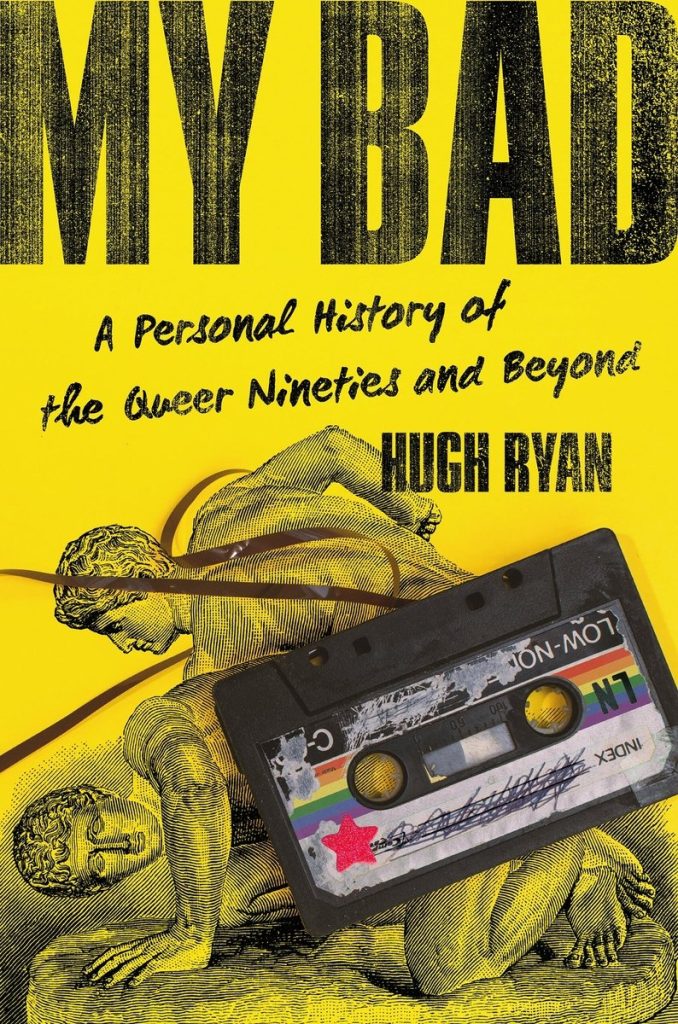
“The Last Analog Childhood,” an excerpt from My Bad by Hugh Ryan
Señora was my favorite teacher for the first half of seventh grade, one of the few who didn’t seem to hate spending her wild and precious days getting tweens to care about something. She had us write skits where the characters from Beverly Hills, 90210 inexplicably found reasons to discuss our vocabulario words, every girl doing her best Shannen Doherty (RIP), pulling on a scrunchy and asking, “Don-DE ES-ta el presiDENTe?” Our other teachers were old, ancient, forty; Señora did a Mariah Carey impression that was fully off-key but got the essence of her. (In that, she was my early training for understanding drag.)
It was 1990 in Irvington, New York, a sleepy town on the outskirts of New York City where my parents and their extended Bronx Irish clan had landed post White flight. My middle school Spanish class had maybe fifteen students total, and we’d all known each other since kindergarten, to our great regret.
In elementary school, I mostly had incidental friends—neighbors, classmates, or the children of familial acquaintances. With the transition to middle school, they peeled away. I remember sixth grade mostly as a procession of phone calls where embarrassed parents made obvious excuses for why their sons couldn’t come to the phone right now, or ever again. It was a little like being dead, and I haunted our cold, brick middle school like a scrawny ghost in a ginormous Ocean Pacific T-shirt that read, “Surf Legend: Gateway to the Sun.”
(Why did I own that shirt? The closest I’d been to a surfboard was getting tangled up in a buoy and nearly drowning on the Jersey shore when I was ten.)
Other kids were rarely mean to me because the school punching bag—Booger—was in almost all the same classes I was. When that mob energy whipped up and the playground became a school of piranhas looking for something to eat, we usually turned on Booger. Yes, we; I’d have done anything to be part of something. I kicked that kid because he was lower than I was, a smudge on my soul that will never come out. But it got me nowhere, because shared hatred is not the same as friendship; it just sings in the same key for a minute.
So perhaps I was particularly open to Señora’s kindness, but we were all a little ensorcelled by her. Other teachers wanted us to like them, but we all wanted her to like us.
She listened to us—not our feelings; it was 1990, no one cared about that shit. But Señora eavesdropped on our conversations and found ways to work Nintendo and Vanilla Ice into our lessons (“Yo, yo, yo means I, I, I”). That’s how it all started, on a gray day in late fall or early winter. I have a hard time remembering the rest of that year, and as I’ve grown older, that block has worked its way backward, devouring the seventh grade quiz by quiz and week by week, leaving a few unforgettable moments bobbing unmoored in an indistinct ocean.
Shared hatred is not the same as friendship.
It was cold, I remember that, and Stevie C. was being a little shit. He was one of those kids who never came at you directly but was always talking smack just loud enough for you to hear. As we settled into our metal chairs with desks attached and waited for the bell to ring, he kept up a steady string of gay jokes directed at the air around me: “Know what GAY stands for? Got AIDS Yet?!” etc. And he and his friends all laughed.
I don’t think he came up with any of them; he was just a hateful parrot who hadn’t yet graduated to edgier racist jokes. Like most Americans, he understood AIDS as a disease that infected only homosexuals and Ryan White, the apple-cheeked poster child for the “innocent victims” of the crisis, who contracted HIV from a blood transfusion when he was thirteen.
The bell rang, and we all quieted. Stevie’s last fusillade rang out in the silence, a homophobic riff on the tagline for Trix cereal: “Silly faggot, dicks are for chicks!” Then he barked his signature manic laugh, a highpitched parody of Woody the Woodpecker. “HahahaHAha, hahahaHAha, hahahahahahahaha.”
Stevie and a handful of boys like him (it was always boys) were my primary education up until that point in what it meant to be gay. They taught me that my light blue sneakers were gay, that skipping was gay, and that if you looked at your nails by holding your fingers out instead of curling them in, you were definitely gay.
It was an odd but undeniable paradox of the time: Everything could be gay, but no one actually was gay. Not in my family, not in my classroom, not on sitcoms, not in books, not in the past or the present or the future. AIDS had put homosexuals on the news, but they were vectors for disease, not people. Occasionally, you’d hear a fag joke about San Francisco, but that might as well have been Oz. And in the absence of real queer people talking about real queer lives, boys like Stevie got to define our existence for us. I think Gen X queers placed such a high priority on visibility because we grew up in a black hole of representation. George Michael wasn’t gay, and neither was Ellen, or Peewee Herman, or Doogie Howser, MD.
Just me.
And somehow, boys like Stevie all knew it. Or half-knew it. My sexual orientation was invisible, unclockable, and frankly a little confused, but my gender was a Lisa Frank Trapper Keeper: bright, weird, and obvious. Not feminine exactly, but not masculine, not boy, not straight, not right. And while some adults might pretend that gender and sexuality are unrelated—that being gay and being trans are entirely separate phenomena—children, bullies, and the Republican Party instinctively understand that the line between the two is porous and unimportant. I’d learned in elementary school to hold my tongue and never mention the inchoate feelings I had about other boys, but my body was ungovernable. When Stevie called me a faggot that day in class, it had nothing to do with whom I was fucking (no one) and everything to do with my limp little wrists that flapped like broken wings when I got excited.
“Stevie!” Señora snapped at him, and in that last instant before everything changed, I loved her more than I ever had.
We all waited for the hammer to drop, which in our small, suburban public school meant at worst being held for a day’s detention. But Señora seemed unsure what to do once we were all staring at her. She had a high-key sensitivity for that oily, mocking tone children use to signal an insult, but she couldn’t tell whom Stevie was making fun of. I wouldn’t even look in her direction in case I somehow intimated I was the butt of the joke. After a long moment, she shrugged.
“Cómo se dice faggot en Español?” Señora asked, in that chipper voice she used to hype her fun lessons.
It was an odd but undeniable paradox of the time: Everything could be gay, but no one actually was gay.
I’d heard adults use the word faggot before. I had both an older brother and access to my parents’ cable, so films like Blazing Saddles and Eddie Murphy: Delirious entered my life very early. I liked the Dire Straits song “Money for Nothing” because they said faggot—or, more specifically, because they described what a faggot was: “See the little faggot with the earring and the makeup? Yeah buddy, that’s his own hair.” And I loved the comeuppance in the next lines: “That little faggot got his own jet airplane / That little faggot, he’s a millionaire.”
But this was different—official. Sanctioned. Like the pope when he spoke ex cathedra. We were in uncharted territory, and none of us knew if we were really supposed to answer her question (also I just don’t think any of us knew how to say faggot in Spanish). Shock faded quickly to numbness, a sense that I should have expected this. I wasn’t angry at Señora, just disappointed in my own vulnerability.
“Pato!” Señora announced brightly. “Pero . . . ”
She held up one cautionary finger, walked to the front of the class, and unscrolled the vinyl map of the world tucked at the top of every chalkboard. (Remember those? Old and rarely used, with an unpredictable number of Vietnams and Koreas.)
Spanish, Señora explained, was spoken in many places. Each had its own peculiarities, but we were learning textbook American Spanish, which would sound a little stilted to native speakers, so today she was going to teach us about Spanish slang. Words we knew already—like pato, which meant duck—had other connotations in other countries, and we had to be prepared for that.
For the next forty minutes, she pointed to different Spanish-speaking countries and explained their words for faggot—where I would be a pato versus a mariposa versus a maricón—with a bonus lesson at the end on dyke. I noted with a glazed and mild interest that truck driver, when combined with a female pronoun, meant lesbian—as did crazy person.
Years later, I’d discover for myself how easy it is to fail as a teacher, so I have some sympathy, but Jesus Christ, what the fuck was she thinking?
Sorry. I’m not sure why I’m writing this. Doing this is like channeling. When I open my mouth, dead selves come pouring out, each a poppet made from memory, using my tongue to repeat the only story it knows, the one it whispers constantly in the back of my head. Or maybe I’m just a cat with a hairball, horking up bits of myself I’ve never been able to digest. This isn’t a thank-you letter or an accusation. I thought this might be an exorcism, but the ghosts haven’t gone anywhere. They can’t go anywhere. That’s what makes them ghosts.
So call this a recognition: Señora taught me that day that the nicest motherfuckers I knew could accidentally curb-stomp my heart at any moment. I don’t think Señora disliked queer people, and if she’d known Stevie was making fun of someone specifically, I don’t think she’d have taught that lesson.
Señora was simply engaging with the world as it was, and as it was, the world was dangerous for me.
I get it: This was 1990—homophobia was funny! And mean. And everywhere. There was not one out student or teacher in our town. We played a game called “smear the queer” at recess, a sort of reverse tag, where one person was the queer and everyone else tried to tackle him. Until the end of that year, the World Health Organization still categorized homosexuality as a mental illness, and US immigration law still saw being gay as a “psychopathic personality disorder” that was grounds for deportation. There were two high-profile antigay murders just in New York City that year alone (but also: until 2009, homo- and transphobic violence was not included in federal hate crime legislation, so who knows how many murders went unmarked). Señora was simply engaging with the world as it was, and as it was, the world was dangerous for me.
I wanted—want—to believe she didn’t do this out of cruelty, but on some level, she felt this kind of hatred was trivial or acceptable, and without an apology, I can never forgive that. It’s a small stone, but it’s one that’s been lodged in me since the seventh grade. Maybe I’m writing this so that if she ever reads it, she has to carry it too. For all I know, she already does. But that doesn’t lessen the burden. Someone I trusted hurt me in a novel way, and that still hurts, no matter how many candles I light or jokes I crack.
And maybe, I’ve come to realize recently, I’m writing this because Stevie and all those other boys are still out there. Gen X went harder for Trump2024 than any other age group. But it’s not just us. If there’s one thing that growing up queer in the Nineties gave me, it’s an antenna for danger, and it tells me that bad days are here, and worse are coming. A week ago on the subway, I heard one high school boy call four others faggots in the hateful-playful way I knew so well in the seventh grade. “You can’t say that,” the other boys gasped, and he yelled back, his face wide with joy, “It’s 2025, FAGGOTS!”
And they laughed they laughed they all laughed.
Who am I kidding? My ghosts aren’t even ghosts; they’re cops, fathers, doctors, monsters, and sons. So maybe I’m writing this as a warning and a promise to the queer kids of today: We’ve made it through before.
Excerpted from My Bad: A Personal History of the Queer Nineties by Hugh Ryan. © 2026 by Hugh Ryan. Available from Bold Type Books, and imprint of Hachette Book Group, Inc.
Read the original article here