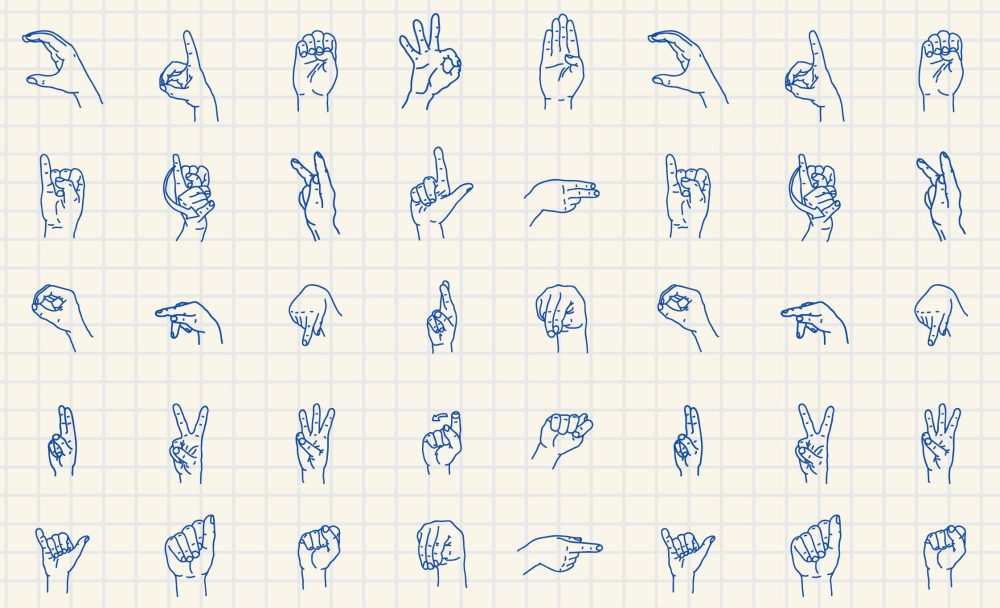
At age 12, Sara Nović went deaf, but not all at once. First, she lost the wind, then the dripping of a leaky faucet, and then certain consonants. She writes in her memoir, “What is a mother tongue, and how do you get one? What if your mother has no tongue? What if you have no mother?”
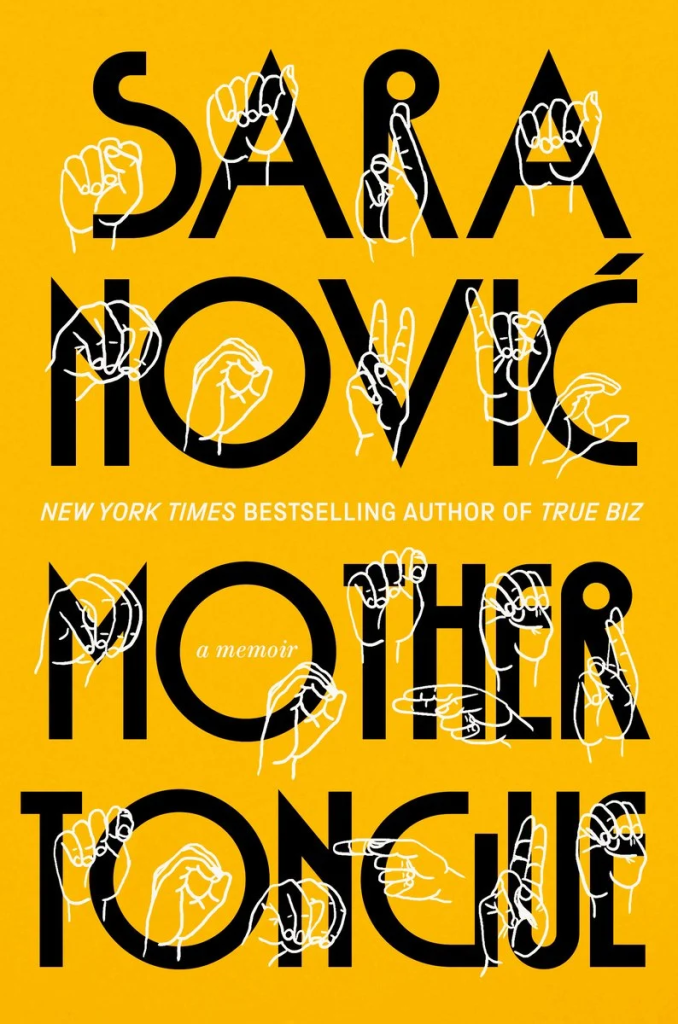
For much of her adolescence, Nović masked both her disability and her queerness, until an experience of spiritual humility led her to claim not only her deafness, but Deafness: the political act, the community. The book’s raison d’etre seems to be about honoring that experience, resisting erasure, and changing the sociopolitical landscape to be one that celebrates difference, rather than trying to stamp it out. Nović takes on the history of deaf ableism in America, including Alexander Graham and the invention of the telephone, as well as the Oralist movement, which grew out of a white supremacist Christian nationalist vision of America. An advocate for the disability community (check out her Instagram!), she pushes hard against threats facing the Deaf community: the closing of Deaf schools and the supplanting of ASL for cochlear implants, the dangers of medical documents being translated into myriad languages but rarely ASL, the suspicion that someone like her will give birth to a deaf child and their misguided, solipsistic hope that she won’t. But the book is also a tender examination of family, touching on Novic’s pregnancy and the sleepless nights when her first child S was inconsolable and she’d have to belt out her own rendition of “Take Me Home, Country Roads.” It ends, touchingly, on her adoption of her second son, K, a deaf child in Thailand living in an orphanage, and who lights up when he finally learns to sign. This crip-queer memoir, which reads as a Deaf manifesto on motherhood, shows us how far we have to travel to claim ourselves.
Over late-night Google Doc, Nović and I discussed being in Deaf community, motherhood, and her work as a disability advocate.
D/Annie Liontas: Is Mother Tongue a queer, Deaf manifesto about motherhood?
Sara Nović: I think it kind of is! It didn’t start out that way; it started out as a series of letters to my sons. The subject matter became more expansive as I realized how each part of my own identity, and theirs, was inextricable from the next, but the intimacy of the original drafts remains. I think intimacy is an overlooked component of a manifesto, too—people hear the word and expect some big, sweeping, shouty ideas, but really the emotional power comes from its specificity, just like it does in fiction. Ultimately I think “manifesto” is the perfect word, because nothing has radicalized me more than parenthood.
D/AL: I love that you are claiming intimacy as essential to a manifesto—and I can feel that coming through in the writing, especially when you’re sharing your experiences in adolescence.
You confess that you concealed your deafness for a long time, even from those closest to you, until you were in college. As someone living with a brain injury, this kind of masking is very familiar to me, especially when it comes to family, school, the workplace. Can you talk about the experience of passing and what it took to overcome the impulse to hide? What did it require to insist that the world meet you as you are?
SN: It’s so interesting talking about this book to folks, because the notion of passing or trying to hide my deafness seems to confound nondisabled people, but most disabled people get it right away (and have their own similar stories). But of course disabled people try to hide in a society that also actively tries to push out and segregate disabled people, where disability is stigmatized, even criminalized. It takes a lot to unlearn that. One of the most effective ways to dissolve that internalized ableism is to be in community with other disabled people, which I think is why certain rehabilitative programs and workers going back to AG Bell were and are so keen to keep us apart from one another. When we stop believing something is wrong with us, it makes their job of “fixing” us or getting us to comply with norms much harder.
I think intimacy is an overlooked component of a manifesto.
The other thing is that trying to pass is exhausting. There’s a moment in the book where I sing to S after not having sung for a long time, and in that moment it was purely a move of desperation. But out of that experience, I was then able to think about how I had been trying to compartmentalize my identities in a way that wasn’t serving me. I often say my kids radicalized me, and I think a lot of parents feel this way, that an investment in our better selves, and a better future, gets extremely real when you have kids. But also the kids wear me out! I don’t have the time or energy to dedicate toward masking for the comfort of other people anymore—which is ultimately for the better.
D/AL: You write beautifully about a moment in a church service when you move from identifying as deaf to identifying as Deaf. You describe it as a conversion. What has claiming deafness and the Deaf community brought into your life?
SN: I think the metaphor of conversion worked for this moment not because it happened in a church, or not only that, but because there was an element of spiritual humility that had to happen for me to cross into Deafness. I had to admit that I had nothing to lose and no idea what I was doing and put my trust in something bigger than myself, which in my case was the Deaf community, but certainly parallels how a lot of people come into spirituality and religion.
Being a part of the Deaf community has enriched my life greatly. It has given me a linguistic and cultural home wherever I go. Especially in those early days before the internet as we know it today, I became fast friends with folks with vastly different interests, careers, and life experiences simply because we were linked by language and happened to be in the same city. I really love that about the deaf world, that feeling of home inherent to the language.
D/AL: In “This Be the Verse,” your faith runs up against your queerness. You say that what you hated most about church was the dresses, “a sensation I wouldn’t be able to explain for another 30 years—like my skin was trying to flip itself inside out.” In one scene, you write about being at a youth group event—almost like a nightclub—which included fiery sermons and graphic depictions of the crucifixion. In that moment, you prayed for God to cure you of your queerness. Looking back, what do you wish younger Sara had understood at that time not only about herself, but how evangelical theology functions as a praxis of white Christian supremacy and ableism?
SN: There’s so much I wish I knew back then about the way people’s inherent need for connection and spirituality is manipulated by organized religion. I really left the links between the Church and white supremacy, racism, ableism—or any of the ways people use others’ faith as a way to wrest power—completely unexamined, and whether that was because I was slow on the uptake, or because deep inside I feared what I would find, I’m not really sure. I was pretty incapacitated by my own guilt and fear. That’s the thing I would tell Past Sara if I could—that you don’t have to be afraid or feel guilty for breaking some set of arbitrary and very tenuous “rules” with your existence. You don’t have to get back in that line every summer and pray the “cure” takes this time.
You also don’t need organized religion to be a good person, or even to follow the teachings of the gospel if you’re into that. I think we’re seeing that particularly right now, the behavior of the hardline Christian right or the megachurch industry has very little to do with the actual teachings of Jesus, and a lot more to do with hoarding money and control.
D/AL: There is so much Deaf history in these pages. Alexander Graham Bell used science and the invention of the telephone as a way to advance a white supremacist Christian nationalist vision of America, even as he relied on ASL on his deathbed to communicate his final wishes. “He understood that to exterminate a culture, one must come for the language. . . . and campaign for the removal of ASL from deaf schools.” What is his legacy and that of other oralists, and what do you think is required to take down such historical heroes and mythologies?
SN: Bell’s legacy is fascinating because it is still so prevalent throughout the fields of deaf education, speech therapy, audiology today. Many people see him as the father of this world-changing pedagogy that gets deaf kids to talk. And he is that, but not in the way people tend to think. Bettering deaf education and speech therapy wasn’t necessarily Bell’s goal—maybe it was a piece of it, and certainly the deaf education space was what he had access to given his father’s and grandfather’s work in the field. But ultimately his intent in deaf education doesn’t even matter, because the reality is that his pedagogy became the vehicle through which he could most effectively proliferate his xenophobia and ideas about eugenics.
Being a part of the Deaf community has given me a linguistic and cultural home wherever I go.
Some people, I think, are truly ignorant about Bell’s love of eugenics. Others know a little and want to fight about it. A friend of mine got into hot water with some moneymen at their university for saying Bell was a eugenicist, for example. Sirs, he was literally the honorary president of the Second International Congress of Eugenics! Optimistically, maybe this combativeness about his legacy is actually a good sign, because it means folks know on some level that what they’ll find at the root of Bell’s work is morally reprehensible. Deaf and disabled folks and allies have to be able to speak to that gut instinct. Money would also help. The oralist lobbies are very powerful.
D/AL: The raison d’etre of this book—the tender heart of it—seems to be about your experience with motherhood. You write lovingly about singing S, your firstborn, to sleep, as well as the joy you felt when he signed his first word (“finished”). How has motherhood surprised you? Opened up the world in a different way for you?
SN: It’s probably not a surprise that watching my kids learn and play with language has been the most magical part of parenthood for me. It’s like nerd Disneyland to get to watch language acquisition in real time. Being a parent has also changed the way I use language. When signing with adults, I think we increasingly have a tendency to fall back on the manual alphabet to spell difficult concepts, but that just doesn’t work as well with small children. You really have to embody your words and ideas, and that practice has in turn made me think about those words differently, and also made me more confident in my own use of the language, in my own body. That’s something I’ve always loved about ASL, and it’s magnified when you’re with kids.
Parenthood has remade me in the usual ways, in that it has irrevocably shifted my priorities. I think sometimes writers with kids project a layer of bravado about how they protect their writing time or how having a family doesn’t interfere with their career as a Serious Writer, and I get the impulse, but for me, having kids absolutely has changed my writing and my career, sometimes in ways that are hard, but often in great ways.
D/AL: You relay, very relatably, the anxieties around being a parent of an infant during the pandemic, especially after contracting COVID in the early days. Add to this that, as a Deaf person, you were fielding judgments and biases from the people and systems that were meant to support you. “How many strangers wanted to know, would I hear the baby cry?” Can you talk about the challenges you faced, and still face as a deaf mother from strangers and medical professionals?
SN: As you’ve probably experienced yourself, I think nondisabled folks really go one of two ways when they’re interacting with a disabled person: Either they panic and try to disengage as quickly as possible (having been told their whole lives “look away!”), or they really feel free to say the quiet part out loud. While the former is uncomfortable, they’re still bringing vulnerability to the table. The latter group I find frustrating, because they’re more set in their ideas about disability, so much so that they expect us to agree with them when saying ableist stuff to our faces. These are the, “I would kill myself if I couldn’t listen to music” folks and the “don’t worry, your kid probably won’t be messed up like you” people; they assume that we find only a deficit in our disability, and that there’s no other way to look at it, so they feel comfortable saying so aloud.
The microaggressions can be tiring, but larger biases in the education and medical fields are actually dangerous. Because of a lack of trust of the medical view of deafness and disability, deaf folks as a population typically wait until the last minute to go to the doctor, and end up in the ER more frequently and with worse outcomes. There are some real horror stories in the book, but it makes sense, too—why would deaf folks trust a system bent on our eradication? And then when we do get there, desperate, there are so many barriers to access. Hospitals and doctors’ offices are often the worst offenders of not providing interpreters, and that can mean dire consequences. (People asked me how The Pitt’s representation of a deaf person’s hospital visit was, and I kept saying, “Well, they forgot about her for a few hours, so that’s very authentic!”)
Another thing I’ve noticed is that whenever I take K to a medical appointment, healthcare workers assume the interpreter request is for him, and can’t really wrap their heads around the interpreter being for both of us. For a while I thought they just weren’t used to seeing two deaf people in the same room, which is maybe still true, but given the broader experiences I’ve had in dealing with the school system, I think the bigger problem is that people don’t expect or trust disabled people to be parents.
D/AL: You and your husband decided to adopt your second son, K, who is deaf and was living in an orphanage in Thailand. Can you take us through that monthslong journey of becoming K’s parents—from the application process to the delays with the state department to your first meeting?
SN: We came to the adoption process backwards from most people. More commonly people know that they want to adopt, and they fill out all the forms and get the required background checks and are placed in a queue, waiting for long periods to be matched with a child. Often these adoption journeys start because of fertility problems within the adoptive family, and those families are frequently looking to adopt babies.
Parenthood has radicalized me, in a time when being radicalized has never been more necessary.
But none of that applied to us. We had been discussing adoption because Z is adopted and had always wanted to adopt a child, too, but the decisive point for us was really learning about K himself. K was part of a population known as “waiting children”—kids over age two, often disabled or coming from difficult medical or social/emotional circumstances, whose placement options with relatives or in their country of origin have already been exhausted. His profile noted that he was deaf and had some other medical concerns, and for me being able to provide him with sign language access—something most deaf and hard-of-hearing kids don’t get in their homes even in the best of circumstances—outweighed some of the trepidation I had about the more nefarious nature of the adoption industry. It doesn’t ameliorate the harm and trauma that is inherent to adoption, but I am also a pragmatist, and at the end of the day I don’t think it makes sense to leave disabled kids in an orphanage with no home of reunification or in-country adoption just to prove a point. So we applied to adopt K, specifically, and worked in reverse.
The process was really grueling, and made worse by COVID, and a UPS nightmare that led to all our documents getting lost en route to the State Department. During the delta surge we lost contact with the orphanage for over six months, and when we did finally hear from them, their report was filled with stories of how traumatized the kids were from lockdown. For my part, the whole time I was panicking about the ways in which K was missing out on language, as it can become exponentially difficult to acquire language outside what’s called the “critical window,” from birth to around age five. By the time we met K he was months away from turning five, and he tested as having the language of an 18-month-old. Because of ASL, he was able to catch up quickly, in both signed language and now in spoken language, too. But it haunts me, thinking of how close he came, and how many other kids might be out there languishing in institutions at risk of permanent brain damage, when all they need is sign.
D/AL: Your sons, S and K, are very close. You’ve shared with me that, at times, they share their own private language of sign, and even teach you words. Can you tell us about the moment that, anticipating K’s arrival, S signed his name?
SN: We are so lucky that S and K took to one another right away. They’re a real odd couple, opposites in many ways, and they both challenge and support each other.
Before K was here, we had a picture of him on the fridge, and S would talk to him all the time. That was why K has a relatively generic sign name—not necessarily based on a personality trait like many sign names are—because we were always talking to and about him before we even met. S used to try and feed the photo spoonfuls of oatmeal, or he would express worry about how K didn’t have a coat on in Thailand. Across the ocean, we’d sent K a book of photos of family members and different rooms in the house and places we’d go in the city, so they were thinking about one another even years before we were together.
Later, when K came home, he learned sign and then started speaking English. Almost no one could understand his speech, but S always, always knew exactly what he was saying and interpreted for him. And K is kind of the same for S in a physical and social way—S is much more cautious and nervous about the way he moves through the world, and K is the ultimate wingman.
D/AL: What has it meant to you to make that space for them? To make this family?
SN: Parenthood is the best part of my life. Being a parent forces me to be present in my body and in the world in ways I just wasn’t before. Parenthood has radicalized me, in a time when being radicalized has never been more necessary. I think sometimes writers are cornered into talking about how they write despite their kids, or how having a family makes writing harder. And that’s true, but I also think I write because of them, and I write better because of them. I see the world like it’s brand new every day. There’s really nothing better for a fiction writer than that.
Read the original article here