For several years, I’ve enjoyed Stacey Yu’s videos about literary fiction on TikTok. On a particularly cozy, intellectual corner of the platform, she spotlights forgotten classics, works in translation, and contemporary novels—particularly those with elegant, careful prose. So when Yu announced that she would be releasing her debut novel, Kitten, this summer, I had no doubt that it would be skillfully crafted, steeped in the influence of all the literature she raves about online.
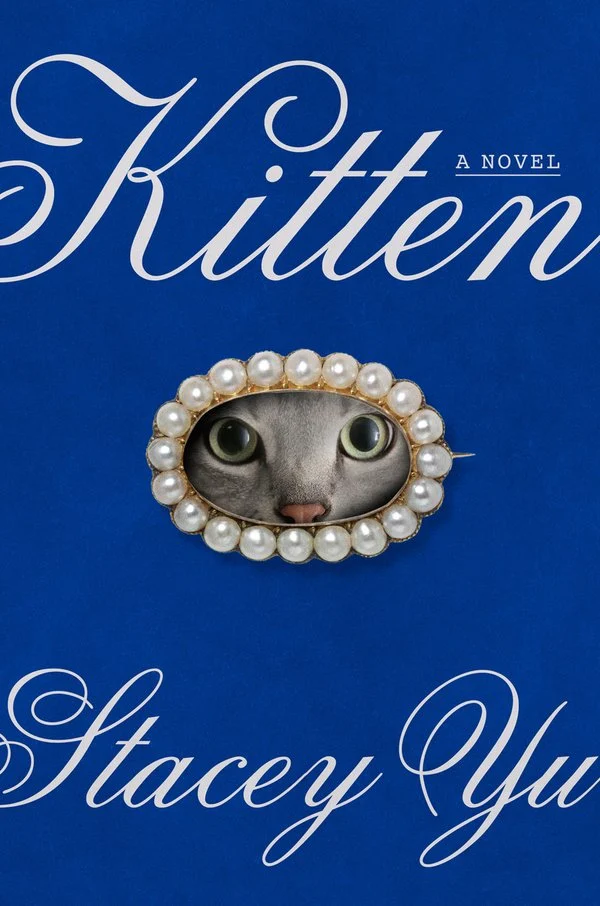
I was right: Kitten was a joy to read, and Yu’s prose is indeed deft and exquisite. The novel follows Katie, an adrift college graduate whose loneliness and discomfort with the world around her manifest in an overwhelming feeling of imbalance. Katie disconcerts others to not inconvenience them; she says things that are sincere but socially off-putting; I adored her from the start.
When Katie’s boyfriend, James, invites her to his wealthy family’s beach house and introduces her to his cat—the beautiful, smart Silver, who likes to swim in the ocean—Katie becomes fixated on the animal. I loved that Katie’s admiration of Silver was thoughtful and meditative, never approaching hackneyed depictions of obsession or skirting into the realm of thriller. I also found myself surprised—despite the novel’s title, cover, and synopsis being so intensely cat forward, it’s a book about the depths and nuances of human connection. Katie’s interest in Silver first serves as a haven from her complicated relationships with other people; then, it leads her to work through them.
I had the chance to speak with Yu on Zoom—her in her London home, me in New York. From our respective riverside cities, we talked about going to the ocean to convalesce, social media, and depictions of naïve young women.
Amulya Tadimety: You’re a literary tastemaker online, so I was delighted to see you sharing some behind the scenes publishing knowledge with your followers. I really liked the videos you shared about the cover design process, which went somewhat viral! How did it feel when those videos took off, and how does it feel sharing the nuts and bolts of debut publishing with a broader community of readers?
Stacey Yu: It’s always fun when a video takes off. It can be scary, but the book community online is so much more supportive and less harsh than the general audience . . . I didn’t realize that people would be so interested in the nuts and bolts of the process, but that’s kind of how I got myself online anyway. When I first started making videos, [they were] about [a] job that I had back then, when I was reading for a literary scout. I didn’t realize that people would be so interested in a job that they didn’t know about, but they are.
I get really fascinated by these things. One of my friends has a job as a librarian, and when they talk about their day-to-day, for them, it’s so boring and standard, but for me, it’s always interesting. It’s just nice to see how much interest there is in things that feel like quite a standard process for debut authors.
AT: Absolutely. And the cover came out beautifully, so I think people were interested in how something like that gets made.
I thought it was a great experiment for my character to be a quasi-parent when she herself just wants to be parented.
SY: The cover also is a way to talk about the book, because it’s not separate from the themes and the feeling of the book itself. In fact, a good cover is meant to build on that. Obviously, the old adage of not judging a book by its cover doesn’t really run true anymore, because there’s so much thought that designers put behind a cover and the way that it extends the language and the atmosphere of the books. I just thought it would also be a good way to talk about Kitten to an audience who has never heard of me before.
AT: And it’s such a good way to draw people in without giving too much away.
SY: Yes, which a cover should do.
AT: I’m very eager to talk about Silver—do you have any favorite pets or other animals in fiction?
SY: Lost Cat by Mary Gaitskill—it’s a memoir about this real cat that Gaitskill found and adopted. It’s a really beautiful but devastating memoir. I felt such an attachment to the cat in that book because of the way that she characterized him, the way that she talks about her love for this cat, and the way the cat becomes a springboard for her to explore all these other relationships and unprocessed walls of grief she has about other people in her life. I felt so attached to that cat.
And also The Wall by Marlon Haushofer. It’s an apocalyptic novel which is quite dark and serious, but the narrator has a few animals that help her survive. They’re just described in such a beautiful way. So I love those animals, too.
AT: I love the way that you explore the relationships between humans and animals in Kitten. Katie and Silver’s relationship is such a great representation of how there can be a need met when there are messy, failing, or lacking human and family relationships. There can be a transference there, with caring for something else. How did you decide that it would be a cat fulfilling that need for a lonely young woman?
SY: I don’t know that I set out to write a book about [the] transference of love and relationships, which is absolutely what it has become about. At first, I wanted to write about childhood and leaving childhood and the reluctance that a young person might have in stepping into the rest of their life. My main character, Katie, is so ill-prepared for what she sees as her adult self and the rest of her life that she wants to go back. She wants to stop time.
And that’s all connected, ultimately, to her wanting to recreate a love that she is familiar with: the love [from] when she and her mother were still close. When I started writing more, I realized the reason she misses childhood is because she misses her mother. And so then the parent and child transference became clearer to me as a theme. I think animals give us an opportunity [for that]. They’re not like children. I feel like we have to get things right before we become “real” mothers. Things feel so much more serious when it’s a real person.
And yet, an animal is also a living creature who needs love and care, and needs also to be parented in a way, just in a different way. So I thought it was a great experiment for my character to be a quasi-parent when she herself just wants to be parented. There were just lots of fun and rich parallels there.
AT: I would be interested in learning a little more about your process in writing from Katie’s perspective. I’ve been saying that she fits into—there’s almost a canon of 21st century, detached female protagonists at this point. I’m curious, what did your own writing process and headspace look like to achieve this feeling of a protagonist who’s grounded in one physical space, the beach house, while also being mentally detached and processing and transitioning in a lot of ways?
SY: For Katie, her voice came so clearly to me from the beginning. I knew that the story would get a lot of its momentum through her voice alone because she is such a detached and passive character.
I was really inspired by the narrator, Selin, in Elif Batuman’s The Idiot and Either/Or. [That] was an experience where the voice and the lens of the narrator makes everything more fascinating and interesting [and] very humorous. I love her total naiveté, but also, in some ways, she knows more than most of us ever do, because she’s 18, which is an age where you know nothing and everything.
And so I wanted to kind of capture and play with the humor of just knowing nothing at all for Katie. The part where I had to massage it a bit was how dark to take her. At first, she was a little bit more dark and spiky, but then I realized that what really made her, and the most fun I had in writing her, was leaning into the more silly and frivolous aspects of her psyche that feel playful. And that is the reason why she would relate to an animal, because she has this inherent immaturity that can be destructive, but can also be very enchanting.
Everyone just becomes a poet when it’s raining out. I think there’s something universal. We are just so moved by the water.
AT: I think a lot of the humor comes from not only the frivolousness and silliness of her personality, but also the irony about the class and regional aspects. The book is set amongst coastal elites who have very specific jobs and very specific social mores, but Katie is Southern and doesn’t come from money and doesn’t feel like she can fully fit in. Why was it important to you for the book to come from this perspective?
SY: Class is a big theme in the book. And I always knew I wanted to write about class because, especially in America, it’s such an invisible way of organizing the world. People can move and transcend their class backgrounds in ways that they can’t with other categories. That is a really clinical way to put it, but I thought it would be interesting to write about someone who is drifting, who’s moving into a different class position just by nature of the spaces that she’s ended up in and the friends that she has . . . versus the world that she grew up in with her mother.
Those class differences can then further exacerbate the distance that you might have with a family member or an old friend. So, to me, that was more interesting to explore in a way than race, which also plays a role in Katie’s sense of isolation and atomization in the world. But it’s much less pronounced because what she’s really feeling is the dysphoria of not knowing why she feels so out of place. And a lot of that has to do with these invisible influences of regionality and money.
AT: I really loved the character of Isabelle as a foil to Katie’s loneliness, her mental health, and all of the ways that she feels out of place in society. Isabelle’s a character who struggles with a lot of the same things, but is able to reach out to Katie instead of isolating herself further. Were you trying to portray a specific type of complicated relationship between young people or a specific kind of jealousy or connection between young women?
SY: When I had my first draft of Kitten, I was sharing it with people [who] were like, “Oh, I thought that she and Isabelle would be rivals.” I felt it was interesting that people would assume that because there’s a duo of women that [means] there could be an element of rivalry or jealousy there.
I didn’t want Katie to be jealous of Isabelle at all, whether that was romantic or even [about] wealth, because I feel like jealousy and those kinds of dynamics can mask the more honest roots of discomfort, the more honest sources of discomfort, which I think for Katie goes back to the class element. I feel like Isabelle and Katie struggle with the same things, so I wanted Isabelle to be a character who, like Katie, also felt really isolated and un-self-actualized. But Isabelle does have access to all of these other things. She has doctors and therapists and a place to stay. So they’re on different levels with their struggles, but that doesn’t mean that one is more valid than the other.
AT: I also really like the way the book deals with communication. Katie and her boyfriend James communicate a lot over text, and she and the cat Silver communicate through one-sided verbal conversations. Later in the book, she has more intense conversations in person and also over the phone. Was it difficult to write those different modes of dialogue?
SY: Some came more naturally than others. I think text messages came [most] naturally. [For] some people’s text tones, it just came to me so clearly. Like Lou, she was always so easy to write. I loved writing her text messages, just so sharp and barbed and kind of snarky. And when Katie is “talking” to Silver—I found that so fun and easy, because it is just Katie’s voice. What I found more difficult actually was the [spoken] dialogue between her and James. I want every single line to serve a purpose. I don’t want any line to just be filler, and I wanted each line to characterize the person who is saying it.
I don’t know why that’s harder to do with spoken words than with text messages. I think because when you’re speaking, you aren’t necessarily always saying what you’re thinking. And so [in] my first draft, the dialogue would be very blunt. James would be like, “I don’t understand you.” And Katie would be like, “I don’t understand you!”
You wouldn’t ever say that out loud . . . Those miscommunications are so hidden behind what we’re trying to project ourselves as, and we’re trying to project confidence. We’ll try to project understanding, but we really fail to. Whereas with text messages, I feel like you are saying what you actually believe, because you can revise and control it.
AT: One of my favorite types of novel is a “going to the sea to convalesce or heal or grow” novel. And I feel like that’s exactly what Kitten is. What is your relationship to the sea?
SY: I think it’s funny because the sea is such a cliché. I remember reading this quote once in a Sylvia Plath journal where she was like: After the rain, apparently The New Yorker just gets inundated with poetry submissions. Because everyone just becomes a poet when it’s raining out. I think that’s something universal. We are just so moved by the water. And I can’t point to a specific text or song or anything that has inspired me most about the sea. But, you know, I grew up in California. The sea is a place that you can convalesce in. It has these mysterious healing powers.
Mythology and folklore always cement it as this great mother, but it’s also a place of great danger. You can literally die! And it’s not just the sea. People drown in swimming pools; people drown in bathtubs. Water feels both very healing and violent.
The book was always playing within these extremes of total safety, childhood, and the violence of adulthood. And so the sea, for me, became a way to track Katie’s relationship with herself. I won’t go into the nitty-gritty of how each character’s relationship with swimming shows their relationship with adulthood. But Silver is a natural swimmer; she doesn’t struggle at all. James learned how to swim when he was a kid, and Katie never did. I could nerd out about the ways that the sea tells us the inner psychodramas of each character, but I’ll just leave it there.
Mythology and folklore always cement the ocean as this great mother, but it’s also a place of great danger. Water feels both very healing and violent.
AT: It’s the class representation; it’s also the knowledge of the self; it’s all the things. Do you have a personal relationship with the sea right now? Do you go to the sea? Swim in the ocean?
SY: No, not really. I miss it, though. I live in London [in] the middle of the city. There are no pools, which makes me sad, because when I grew up in California, everybody had [access to] shared public pools. I do miss it. And the English sea is just so different. Even if it’s the middle of summer, it’s just chilly and freezing and unpleasant. But that actually inspired the setting for Kitten, which is this fictional New England town called Holm. I just was so stricken [by] my first seaside vacation in England; it was in the offseason and the sea was just totally brown and ugly. And I found it so striking, the moodiness . . . It gave me a different relationship to the sea than I ever had, because I grew up near the Pacific Ocean.
AT: It really contextualizes a lot of these old British books, too. It’s like, oh, God, that’s what you were talking about when you were sent to the seaside? How was that supposed to make you feel any better?
I was curious to ask if there were any unexpected literary influences for your debut—things that you didn’t think would have an impact on your process or the content, but that ended up influencing you regardless.
SY: When I was drafting Kitten, I went to see the movie Poor Things and I just left it feeling completely electrified . . . The movie did such a beautiful, chilling, haunting, gorgeous job of depicting development.
The main character is a baby in a woman’s body. And it just plays with the drama of becoming alive, of growing up, but sped up, and it has such extremes. There is this one scene where she realizes that suffering exists and she just bursts out bawling. And I thought that was so beautiful and funny and scary, which are the three base animal emotions I wanted to tap into with Kitten. A lot of Katie’s feelings are in extremes, and she feels like she’s learning things for the first time. So after I saw Poor Things, I was like, I kind of want Kitten to capture the absurdity, but also the meaningfulness, of being naive and caught between childhood and adulthood.
AT: Poor Things is such a good shout because it’s not a traditional ingenue story, and neither is Kitten, but they both have a protagonist who is surrounded by so much she has to learn about in such a short period of time.
SY: Yeah, and I think Poor Things takes it to the nth degree, which is something that I always admire in art and writing. I was just revisiting this poetry collection, My Baby First Birthday by Jenny Zhang, that really influenced me [and became] the epigraph for Kitten. Her writing is always just so gross and beautiful at the same time, and I feel like she’s almost daring you to squirm.
Sometimes we attribute more value to the beautiful and the descriptive and the verbose, but her writing is just so frank and blunt and base. It reminded me to squash the impulse to make [my writing] beautiful, and just to make it clear and powerful instead.
Read the original article here