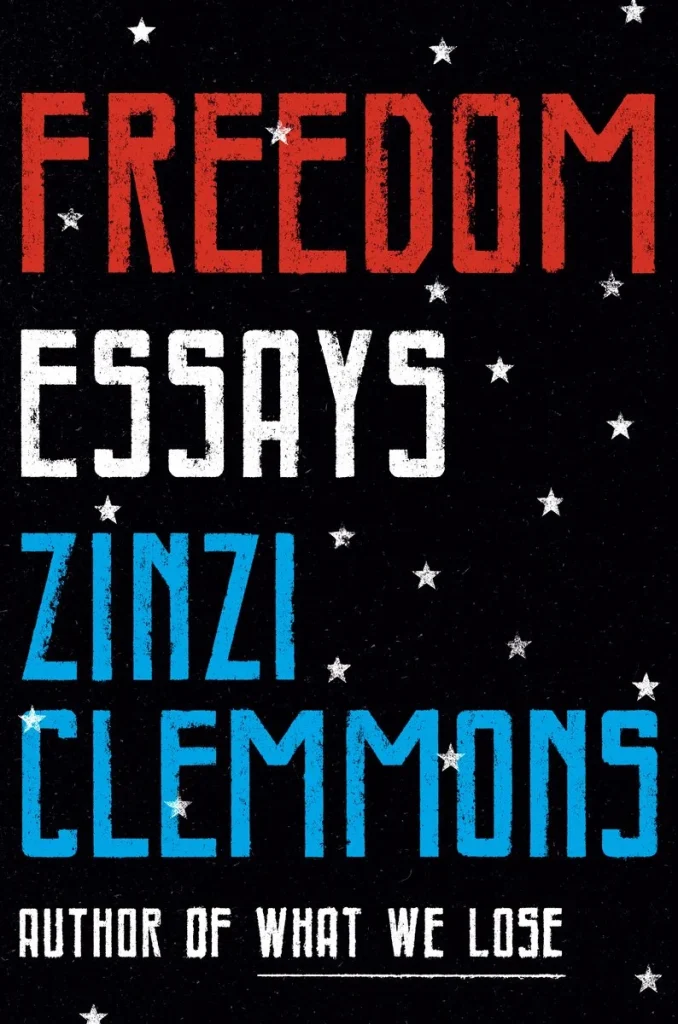
“Swan Song for the Republic,” excerpted from Freedom by Zinzi Clemmons
We are born into good times. “Dream big,” they tell us. “The sky’s the limit.”
We are lied to.
One day at school, I’m shepherded into the band practice room, the TV set rolled out of the closet and switched on. On the screen I see smoke billowing from familiar buildings, the broken body of a plane in an empty field, reporters screaming, everything veiled in dust.
We start to fear.
The whispers of war crescendo and no one seems to realize that the people who attacked us don’t come from the small country we now wish to invade. I sneak onto my family’s computer and read article after article, trying to make sense of what we are about to do, but it can’t be made sense of.
Liza and I cut class and load into my mother’s car, certain we are about to change the world. When we show up, there are just a handful of people shouting slogans at harried passersby on their way home from work. We return to where our car was parked to find it has been towed. My mother picks us up from the impound lot across town and drives us back to the suburbs in silence.
We are too young to know better.
I needn’t worry, I’m told, my future is bright and my dreams will all come true.
My parents manage to save enough for college. The money is the accumulation of so many years, missed dinners and band recitals. It’s swallowed whole; the rest I will pay in parcels for the foreseeable future, the total sacrifice unknown. But I needn’t worry, I’m told, my future is bright and my dreams will all come true.
We sign on the dotted line.
In the exit counseling session, just before graduation, we’re taught about the dangers of default—wage garnishment, impacted credit score, imprisonment, depression, anxiety, loneliness, death . . .
I manage to earn enough for my expenses with nothing left over. My friends work in retail and tutor and crowd their parents’ basements. I couch surf with relatives and then pay my friend’s mother 200 dollars a month to live in his little sister’s bedroom, under a pink comforter, with her basketball trophies and stuffed animals gazing upon me.
One day at work, I see bankers carrying boxes down the elevator of my 20-story office building, a look of terror and exhilaration in their eyes. The markets have crashed; the bankers take off like bandits.
We are easy marks, open targets.
All of my friends lose what few jobs they have, their parents’ companies fold, childhood homes are foreclosed. I recall the small, scared look of my father—the only black man in his division—when his company announced layoffs.
But something is stirring in this country. There’s a name on the lips of our friends.
Years ago, he spoke at my college, and on the day tickets were given out, the line stretched from the box office clear across the main quad. I snuck into the building before the event began and crouched behind the wall of the balcony. I listened to him speak. My friends take jobs on his campaign and move to towns I’ve never heard of. The night of the election I go to my neighborhood bar, the place that plays old‑school hip‑hop on Thursdays and golden soul on Fridays. When the result is announced we scream and embrace each other; I call my parents breathlessly, text disbelief to my friends. We rush out onto the street, to sidewalks packed with strangers of every color; a bus drives by and inside, lit up, all the passengers are dancing.
We let ourselves hope.
I put money away, but it is always eaten up.
I go to graduate school. My friends find new jobs, and I find new friends. I put money away, but it is always eaten up. The city becomes too expensive, so I move to a smaller city, and when that becomes unaffordable, I move to the countryside. Then to another coast. Our lives are shuffled around in boxes and, in between self‑storage lockers and garages, some items are lost in transit. A paperback lovingly creased and annotated, a photo of long‑gone friends, a family heirloom.
We learn to let go of our attachments to material things.
More murders are publicized, more every year, so many that they begin to punctuate our lives. I hear news of a teenager in Florida, killed walking through his family’s neighborhood, and it brings our parents’ warnings to life. How could that face mean anything but innocence to anyone?
Our outrage becomes mundane and soon we don’t even realize we are numb.
When the country elects a reality‑TV star we are shocked but not surprised. When I lived in the countryside, I saw white people living in rusty trailers and broken‑down shacks, saw their anger at being left behind. One of them asked me to my face, Why would you want to live here? I had no reply, unsure of how to explain that I’d been disappointed, too.
We realize we’ve been sold false hope.
I go away one weekend and return home to find the grocery store completely emptied out, nothing at all left on the shelves—a zombie movie come to life. I sell off everything that won’t fit in my car, load in my husband, my dog, and the handful of belongings we still hold dear: my mother’s wedding ring, an old teapot, a flower pressed between glass.
We spend months indoors, watch the world reorient around a new, darker loneliness. Every day, someone dies, and sometimes it is someone we know. We live side by side with death, begin to see it everywhere. We cry until we can’t anymore, drink until we make ourselves sick. The world expands and contracts, and I contemplate which is worse: death or exile? Oblivion or rootlessness?
Our outrage becomes mundane and soon we don’t even realize we are numb.
We are finally set free, and the world instead turns inward. Time zips by with the speed of a thumb on a touchscreen. A smiling family dancing in unison to a Top 40 song. A mother pleading for formula to feed her daughter. Here are five things married people do. Here are five vegetables to plant in your backyard garden. Here are five steps to financial health. A sea of tents amid the quad I used to cross on my way to the library. The police are called. The protesters are beaten, locked away, doxxed, deported. “This is not about free speech. This is about people that don’t have a right to be in the United States.” We shiver with recognition.
We know that a house is made of bricks and mortar and can collapse, but every day I dream of a little bungalow just big enough for my love and me, a set of pots to make him dinner, and a garden to catch the sun—that no one can take away from us. Once, we brought a sick bird inside and it flew away the next morning, healed by safety.
What happens to fear without four walls to keep it in? I know. We’ve always known, it’s just that no one has believed us.
— California, 2025
From Freedom by Zinzi Clemmons, published by Viking, an imprint of Penguin Publishing Group, a division of Penguin Random House, LLC. Copyright © 2026 by Zinzi Clemmons.
Read the original article here