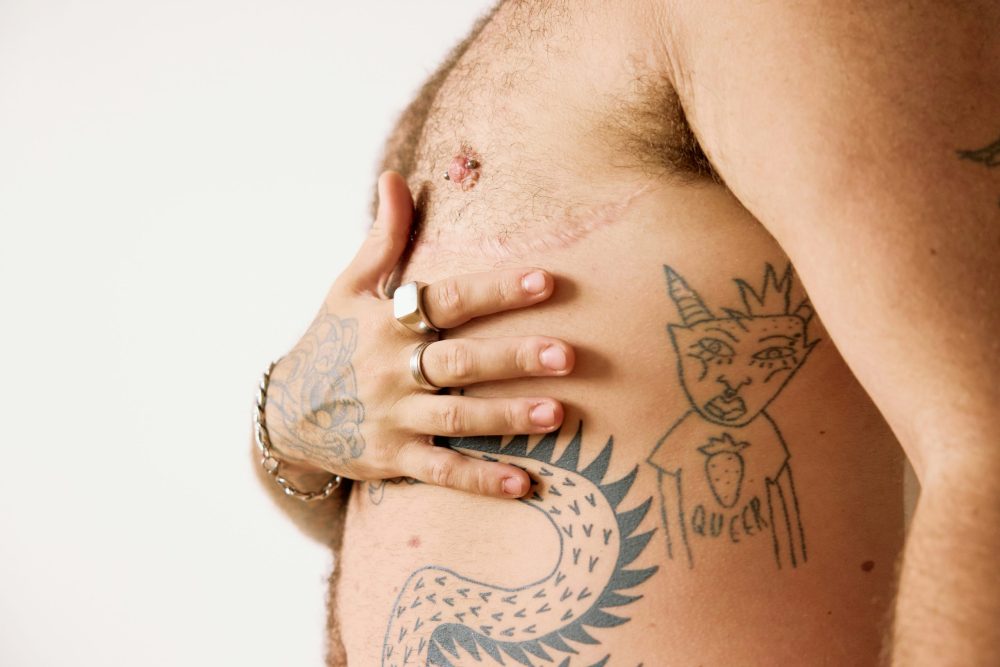
Minor Meats by Billy Lezra
The right one weighs 568 grams, the left one, 547, over two pounds off my chest. For five days, two tubes drain the incisions. Ruby, then amber, fluids pool into translucent bulbs pinned to my white compression vest.
It’s Christmas.
I am the tree; the blood bulbs, ornaments.
Inside the bulbs my red blood cells are shaped like marbles, tiny spheres. The name of this condition is hereditary spherocytosis, which means I got these marbles from my mother, a hematological heirloom. Behind our upper left ribcage, our spleens destroyed these marbles and made us anemic, jaundiced, low iron, high platelet. My mother’s spleen was six years old when it was removed; mine was 13.
The night before my splenectomy, she ran me a hot bath and massaged my legs with lavender lotion. When you wake up you won’t be able to see or move for about 30 minutes, she said. But you will be able to hear. The surgery lasted four hours. I didn’t read or talk to anyone while you were under, she said. I just imagined your body inch by inch.
Once my destruction site was excised, the spheres passed through my blood undetonated. Spleenless me did new things: hike, run, make plans, keep plans, get good grades. The words on my report cards changed. The green insuficientes became suficientes, bienes, notables, sobresalientes.
Sobre, above.
Saliente, salient.
Spleenless me rose above.
“Rigor” appeared everywhere, underlined.
20 years after my splenectomy, three weeks before top surgery, my surgeon calls to discuss how my blood might behave.
Spleenless people with spherocytosis have high platelets.
Platelets make the blood clot.
When it comes to surgery, you want to clot, not a clot.
Normal platelet levels range between 150,000 to 450,000.
What I want is to become my own occupant.
Mine are between 600,000 and 750,000.
Because I’m a spleenless person made of marbles, my surgeon says my chance of developing a post-surgical clot that could move somewhere “tricky” is something to “consider.” By “tricky” I assume she means lung, heart, brain.
“Do you feel comfortable doing the surgery?” I ask.
“Absolutely. It’s important to you, and you’ll be so happy when it’s done.”
I open my brown Moleskin and write down the words “happy” and “important.” I remind myself: I trust this surgeon. She’s thorough, serious, kind, a total genius; I love her results.
Toward the end of our conversation she asks if I’m “excited.”
The word surfaces in my clinical notes.
I’m officially medically excited.
I’m not excited to have surgery.
I do not feel certain about this choice.
Uncertainty does not negate desire.
Some people modify their bodies to experience self-alignment, but I don’t have a coalesced self I feel misaligned from.
I sense my lack of coalescence is my misalignment.
“Dysphoria,” writes Max Delsohn, “[feels] like being a tourist in my own body.”
Right: tourist, interloper, spectator, seditionist, assailant. I watch myself from below and above. What I want is to become my own occupant.
“It sounds like this surgery is gender-expansive,” says my friend Moa.
Her language piques me, a progression: gender confirmation to affirmation to expansion. We confirm dates and times; an external action concretizes the event. We affirm, state, declare; to affirm implies an awareness of the thing being affirmed. It makes sense to feel excitement or certainty if body modification stems from what is known. But expansion doesn’t have to be sure or aware of itself. Dough expands, and moss, and mycelium, and water. Expansion doesn’t require certainty, just curiosity; curiosity is enough.
“And expansion can become affirmation,” says Moa.
After wildfires tear through forests, dormant seeds germinate—slowly, then all at once.
But I am terrified of my marbles, of my blood.
In the weeks leading up to the surgery, I spend hours trying to make appointments with hematologists who can’t see me in time because I’m new to the area and the waiting lists are long. I find an online hematology service and meet with a practitioner who looks at my labs and assures me I’ll be fine. I ask my primary doctor whether this conclusion is enough to clear me for surgery and she says yes. I ask my surgeon the same question and she says yes. But my fear gets the better of me, so I seek a fourth opinion. I book a flight out of state to see my old doctor who specializes in spherocytosis.
Then I cancel the trip.
It’s too expensive, another risk.
I’m more likely to get sick from a trip than from a clot.
Spleenless people are prone to infections. Certain bacterias—streptococcus or neisseria—sneak around our immune systems cloaked in capsules made of polysaccharides. These capsules protect pathogens from the body’s attacks; spleenless people have less ammunition. If I catch a bad cold, they’ll cancel the surgery. And if they cancel the surgery, it may not be rescheduled because look at the United States.
When I think about not going through with it, I feel crestfallen.
And yet it would be so much easier to absorb risk for something I’m excited about.
“No one said this would be easy,” says Liam, my partner of 11 years.
“I haven’t had a plan, or an ulterior motive, or a rhyme or a reason [for] what I’ve done,” says Dr. Susan Stryker. “I was just doing my thing to unfold the mystery of my transness to myself.”
Unfold as in germinate as in expand.
Years ago I went on social media and shared the name and pronouns that make me feel like a person rather than an assumption. Once the language around me changed, my curiosity teethed. Might I feel closer to myself if I shapeshift? “Sometimes the feelings are certain and come first, and the action follows,” writes Krys Malcolm Belc. “But other times, the action has to lead the feeling.” And sometimes clarity comes after action, after feeling.
It’s an incredibly bureaucratic process, to become. I consulted, scheduled, perused pictures of stunning chests, found a few I loved, and set the date for my deconstruction. Then I graduated and moved down the coast, twice. Now I’m supposed to go under in two weeks, and I’m bone tired. Liam, who went through this surgery a few months ago, asks me if it would be better to wait.
“It’s not an option,” I say.
My stubbornness surprises me.
I am unyielding—not excited. Rigorous—not certain.
I read essay after essay after essay.
From Naomi Gordon-Loebl, I learn the Latin roots of the word “decide.”
De, off.
Caedere, to cut.
I read medical studies about clots and spherocytosis.
I check my blood, once, thrice.
My platelets climb.
662,000, 681,000, 738,000.
The day my surgery date was confirmed, I was with my friend Heather in the Nashville International Airport. This was before my surgeon cautioned me about my marbles and platelets. I was in the luxurious space between opportunity and execution; this was my specter of “excitement.”
I’d met Heather in graduate school, where she was earning her Ph.D in fiction. I was drawn to her incisive humor and to the way she noticed subtle patterns in the novels we studied. We’d just spent 10 days in a writing conference on a campus with gothic chapels; at night we slept in a dorm that faced a cemetery. With hours to kill before our flights home, we drank iced coffee and I told her my news.
“Congratulations,” she said, with a smile that seeped through me.
A few months later, Heather showed up to my graduating thesis defense with roses, carnations, and lilies in a round glass jar. For two hours she listened to me answer questions about my work; she observed a pattern, an undertone; she wrote it down.
Later, over chicken yakisoba noodles, she air-dropped me this note:
“Billy uses information & research to feel in control but it also feeds their anxiety—can we sit in knowledge and use it to process & understand while accepting lack of control?”
I do not accept lack of control.
I will control my body.
I will carve it into what I imagine.
I can’t control the way my blood clots.
But I can control the information I have about the way my blood clots.
I can read the right studies and ask the right questions and ask for the right tests and the right medication. And by that I mean: I can control the way my blood clots. No?
Once my imagination seizes danger, I gallop toward a solution.
In my house I have a metal door jammer, a panic button, a radon detector, a propane detector, an alarm system. I can’t control whether an attacker or toxin infiltrates my house/body, but I can control how guilty I feel if something goes wrong. If I lock and jam my door and set the alarm and plug in the radon detector and something bad happens, I can forgive myself. If I read medical studies and get blood tests and talk to nurses and doctors and something bad happens, I can forgive myself. The problem with this logic is its perversion.
The system that tries to protect me assails me.
I’m afraid I’ll die if I have this surgery.
I’m afraid I’ll die if I don’t have this surgery.
I don’t have a panic button for the panic I create.
The system that tries to protect me assails me.
I am the hydra: I cut down one head, turn around, and there I am.
Three days before the surgery, I walk along cliffs.
The sea is choppy.
Clouds coagulate; within days an atmospheric river will run through the coast.
These currents of air can be over 1,000 miles long, 400 miles wide, more than two miles deep.
My phone buzzes with flood, wind, and landslide alerts.
My father calls.
“I want your right breast in a jar,” he says.
“Should I get it preserved in formaldehyde?”
“Absolutely not. I don’t want the tissue to shrivel. I want it to grow arms.”
“And where will you put my breast? Next to Tomás?”
Tomás is his human skull, a found relic from his childhood.
We laugh.
We talk about the river, my missing organs, my weird blood.
Along with my spleen went my gallbladder; several years before that, my appendix, minor meats. My appendix almost burst after the first time I visited my father, Michael, in the United States.
Cambridge, 2001, Christmas. Rain, slush, snow, Moulin Rouge. I’d just turned nine. Before this, Michael and I had only spent time in Madrid or in the south of Spain, once or twice a year. His girlfriend, Hilary, paid for many of his flights to see me, even though she’d never met me in person.
I liked her immediately. We walked around Central Square, baked salted chocolate chip cookies, and chatted. She was writing her first book, which I thought was the coolest thing in the world. I also loved the precise way she and Michael assembled dinner every night, a choreography they’d learned together in culinary school. This was the first time I stepped into my father’s life. He introduced me to his rituals, Iron Chef, Terminator, good knives, duck fat, pickled beets, and salmon grilled on charcoal. After nine days I returned to Madrid; two days later a surgeon rolled me into the operating room.
“Apendicitis aguda gangrenosa,” she said, after.
Aguda, acute, sharp.
Madrid, 2005, Christmas, again.
Four years after my appendectomy, Michael flew to Spain for my splenectomy; my mother left our apartment so he could stay with me the week before. On sunny days we wandered through outdoor markets that sold items for nativity tableaus: tiny angels, goats, sheep, barrels of hay, myrrh. On rainy days we watched movies.
On our fifth night I wanted a burger from a place called Foster’s Hollywood.
Michael said no.
Anger prickled me.
“I’m about to be cut open. Just give me what I want.”
He said no.
Later, he knocked on my door. In his hand was a blue ceramic plate with a burger. He’d bought the bun from a bakery, mixed and spiced the organic meat, frosted it with thick flecks of sea salt, and caramelized the onions.
“I barely used any oil,” he said, “so this shouldn’t hurt you at all.”
I devoured it.
The thing about only seeing each other once or twice a year was that our time together was all text, no subtext. We talked about concrete objects: movies, books, food; we didn’t have nonverbal shorthand accumulated in shared space. I don’t remember talking about how sick I felt. I imagine my mother may have told him that greasy food, from Foster’s Hollywood in particular, made me curl up in bathtubs, knees to chest in hot water, and pant with pain.
By the time it was clear my spleen had to come out, I’d lost count of how many times my mother had to drive me to the emergency room after I ate something oily. For years I’d tried to control my diet to control the pain. I subsisted on bland things until I caved and reached for chips or cheeses or burgers that hurt with ferocity. My doctors couldn’t figure out the problem; they accused my mother of having Munchausen’s syndrome by proxy. I’m not sure what was more disorienting: the pain, or watching medical professionals mistreat the person who brought me peppermint tea and lavender bath balls and demanded they take me seriously.
Eventually, as a result of my mother’s rigor, the right doctor ordered the right test and confirmed my gallbladder was atrophied. Up until I started writing this, I thought my awful stomachaches were unrelated to my weird blood. But a quick Google search reveals that people with spherocytosis often have gallstones. The chronic destruction of red blood cells releases too much bilirubin, which then crystallizes into sediments. I’m not sure why it took my doctors seven years to solve something the internet told me in seconds. But right after I turned 13, they decided to excise my troubles. Once I was two organs lighter, I’d be able to run, swim, dance, study, eat oil.
“Te vas a re-encontrar,” the surgeon said.
You’re going to find yourself again.
As if there was an authentic self I’d lost.
On the day of the surgery, while my mother imagined my body, Michael helped my grandmother with her Hebrew. My mother didn’t understand how my father could distract himself at a time like this; my father didn’t understand how my mother could not. As I came to, the wind whined and my parents shouted. I dipped in and out of consciousness, and by the time I could see again, they were gone. When I ask Michael why they put me in the intensive care unit, he says he doesn’t remember.
What I remember most from the ICU is a little boy who I believe died in the bed next to mine. The sound of his anguish was desbocado, des-boca, un-mouthed. To be a body in pain so close to a body in so much more pain left me between shock and high octane fear.
At some point, a nurse brought me a TV that played Monster in Law.
To make oneself visible is not neutral: Visibility begets violence; spectacle begets spectatorship.
With white curtains she sectioned off the little boy’s bed.
His cries turned to rasps turned to quiet.
In the morning the bed was empty.
The nurse told me the boy left, but the underwater tone of her voice made me wonder where “leaving” was. She didn’t say, “Se fue a casa,” or, “Se fue con sus padres,” which would have meant he went home, or with his parents.
She said, “Se fue con los suyos.”
He went with the people who belong to him, who he belongs to.
Pain is relative, a relative.
“Rate your pain one to ten,” says the nurse.
It is over, it is done, over two pounds off my chest.
“One.”
“That’s unlikely.”
“Overwhelmingly, patients tend to rate their pain as a five, unless they are in excruciating pain,” writes Eula Biss in The Pain Scale. “At best, this renders the scale far less sensitive to gradations in pain. At worst, it renders the scale useless.”
“Two,” I say.
“Are you sure?”
Later, Liam will tell me I gripped his hand so hard his thumb changed color. Hours before the surgery, I’d convinced myself that an earthquake would shatter the tectonic plates under the hospital, that I’d be the reason Liam ended up dead. I was also certain a shooter would come murder the people providing affirming care. 30 minutes before I went under, I Googled fault lines and blueprints and police records and clocked all the hospital’s exits and tried to figure out which waiting room would be safest for Liam. I am the hydra with hijacked heads. My terror must have glistened through the drugs, because as I woke up the nurse said: “You are completely safe here, and I would die for you.”
Little presents arrive: two blankets and a pot of lavender honey, from my mother.
A plant cutting with white roots in a glass jar, from Moa.
A mastectomy pillow, from Hilary.
A coloring book, from Michael, titled: Well that’s a weight off your chest!
A t-shirt, from Heather: “New tits, who dis?”
For a fortnight Liam injects me with anti-coagulant delivered through a needle to my stomach. It lowers the risk of clotting but raises the risk of bleeding.
The atmospheric river comes and goes; the clouds thin.
My phone reminds me to move once an hour.
I walk up and down the hall and will my platelets to loosen but not too much.
Every day I measure the ruby I leak.
At night, I re-read Jane Eyre.
In graduate school I became obsessed with Charlotte Brontë’s body.
I learned she had a toothache the day she started writing Jane Eyre.
I imagine the throb that travels from her molars to her jaw to her neck to her head as she writes the first sentence: “There was no possibility of a walk that day.” Then she describes the weather: “Since dinner the cold winter wind had brought with it clouds so somber, and a rain so penetrating, that further out-door exercise was now out of the question.”
In the medical manual used in Brontë’s household, Modern Domestic Medicine, Thomas John Graham recommends walking to soothe toothaches and headaches. As her mouth radiates, Brontë writes that Jane can’t walk that day. The weather that confines the character mirrors the pain that encloses the author. Jane can’t leave the house; Brontë can’t leave her body.
In Brontë’s extant letters she connects weather to pain. “Today the weather is gloomy and I am stupefied with a bad cold and a headache,” she writes to a friend. She implicates the weather, observes scholar A.J Larner, “including the east wind or cold wind, autumn, fog.”
When I send Heather this essay, she texts: did you know a walk killed Branwell Brontë? Charlotte’s brother, found in a ditch. I read about him. I read about the sequence of deaths Charlotte endured: her sisters, Maria and Elizabeth, then Branwell, then Emily two months later, then Anne, five months after that. Many of her siblings died from tubercular complications catalyzed by bad weather.
With this context I see Brontë’s pain on almost every page.
In Jane Eyre, the fog itself breeds “pestilence.”
The word “rain” appears 34 times; “cold” 65 times, “clouds” 34 times; “wind” 42 times.
I think about the atmosphere, about the writer’s grief, teeth, skull.
Books come from cells, fingers, bones. The way I read a text transforms when I learn about the pain that spread through the body that made it; texts ache, pain patterns and leaves marks. One of the problems with my writing, my teachers say, is that my body is nowhere to be found. You never describe your hands or hair or clothes or tattoos, they point out in college, in grad school, in workshops. To describe my body feels akin to describing a city I’ve flown through, a fool’s errand. My absence is the illustration: Nothing to see here, do not imagine me.
To make oneself visible is not neutral: Visibility begets violence; spectacle begets spectatorship. I want to erase myself as much as I want to be seen. Writing shears my mind from body. I have no canvases to fill, no stages to cross. I make no noise, no music. For years I wrote tucked in the back of a closet. I’ve backspaced that detail at least twice because everyone makes fun of me for it, so on the nose it’s embarrassing. My point is that I’ve been told my body is hiding, missing.
As I write this, I wear a purple robe.
A white bandage wraps around my chest.
The drains are out, so are my blood bulbs.
My incisions don’t hurt.
My bones hurt.
My mind hurts.
The pain in my mind amplifies the pain in my body.
“Don’t forget,” says my therapist, “most people feel like shit after their surgeries. It’s normal to feel like you made a mistake.”
I don’t feel like I made a mistake.
The feeling is akin to infection.
Encapsulated bacteria sneak around my psychic immune system.
I have nothing left to fight anything off.
Every few days a nurse calls and asks me to rate my pain. I say one or two.
“The pain scale measures only the intensity of pain, not the duration,” writes Biss. “This may be its greatest flaw.”
Before they took my spleen, I was listless; before they took my appendix, I was gangrenous; before they took my gallbladder, I had stomachaches so piercing I asked my mother to find a doctor who would kill me. But not all pain is legible in a blood test or in an ultrasound. I don’t know how to measure the pain I put my body through to escape the dysphoric pain it was in: the alcoholism, the anorexia, the pulse behind my panic buttons and alarms for catastrophes lived and imagined. Right now, right now, I am “in” pain, not above or below it. It swallows, like fog.
Euphoria can be as quiet as collagen fibers, synthesizing.
I receive my post-operative report on Christmas Eve.
I highlight the weight of each breast, record the grams in my brown Moleskine, next to “happy” and “important.”
I turn the page and start writing this.
I give myself a constraint: This essay will end as soon as the pain passes. I’ve written through discomfort before, but this particular ache shortens my sentences, takes me to Brontë’s mouth, and mixes my parents and my organs into the same text. I send drafts to Liam, Moa, Heather, Michael, Hilary, to my best friend, my writing group, my writing partner, my editor. I absorb notes and questions and line-edits and corrections; I have a fantasy: There is a right way to tell this story. I’ll sandpaper one word after another until I become legible to you and real to myself. “It is the narrative constructed in retrospect—perhaps even more than the body—that makes the self recognizable, even cognizable,” writes Alex Marzano-Lesnevich. “But narrative requires language.”
And language confirms, affirms, expands, harms, regulates, warps, blesses, sanctions; like the body, language is wielded, not controlled. The pain passes and I don’t stop writing. If I revise, research, get more feedback, read another book, maybe I’ll get it right: sobresaliente. I just don’t know what “right” means. Or rather, the definition keeps shifting. To reverse-engineer a narrative around an experience that lives at the end of language feels like catching mist; I am tattered and embryonic at once.
Winter ends.
Now, I’m 99 days out.
It’s spring.
I look up the symbolism of 99.
Google tells me I’ve completed one cycle and begun anew.
I should “trust” myself and “embrace a major life transition.”
I look up the symbolism of my missing parts.
Appendix: uselessness, resilience.
Gallbladder: courage, judgment.
Spleen: melancholy, fear.
Breasts: nourishment.
“Something I’ve noticed,” says Liam: “when we hug our hearts feel closer.”
I had an idea of euphoria, loud, bang, ecstatic.
But when I read about the word’s origin, I learn it comes from Greek: Euphoros.
Eu: well or easily.
Pherein: to bear.
To bear well.
Around the eighteenth century, “euphoria” surfaces in medical contexts. A patient may experience euphoria after acute periods of illness, treatment, suffering. This euphoria exists not outside pain, but within its endurance. A sentence from my post-op report: “The patient tolerated the procedure well.” Meaning: Even unconscious I was euphoric; my body metabolized its expansion. Euphoria can be as quiet as collagen fibers, synthesizing.
“I said to the sun
“Tell me about the big bang,” writes Andrea Gibson.
“The sun said
it hurts to become.”
Today feels like the first hot day in forever.
I walk 15,000 steps down the coast past the harbor, boats, and seals.
I sit in the shade.
I open Instagram.
I assemble a carousel of images: wet dough dotted with pools of oil; leaves of mint crystallized in ice cubes; Liam carving our initials in the sand; me, shirtless, stunning chest turned toward ocean. Days ago I put my silhouette on my close friends’ stories but now it will live on my grid. The caption: winter decadence. I’m not sure who I’m posting this for.
The performance of self is as strange as the performance of certainty, but sometimes spectacle makes the self concrete. By that I mean: I become aware of how much I love this body as I watch myself want to put it on the internet, like a painting: Look at me. But I feel pressure to resist the arc in which I finally get the surgery and look in the mirror and think: There I am. This may be true, but I’m also as unknown to myself as ever and have zero interest in arrival. I don’t think my authentic self awaits; I don’t think such a self exists. It’s mutable if it does: mycelium, water.
I post my carousel and think about the month ahead: By the time Christmas lights climb the streetlamps, I’ll be long gone from this slice of coast that teems with rain and fog and seals. I’m moving once again and so many tasks await: sorting, bubble-wrapping, packing; all the minutia of taking a life apart. I think about a lecture I went to once, about ruins, how a site’s destruction teaches us as much about its history as its construction. What I abandon—apartments, clothes, books, organs, oceans, concepts, tissue, names—matters as much as what I generate. There is no right way to expand, and I anticipate more destruction. But right now there’s not a cloud in sight.
Read the original article here