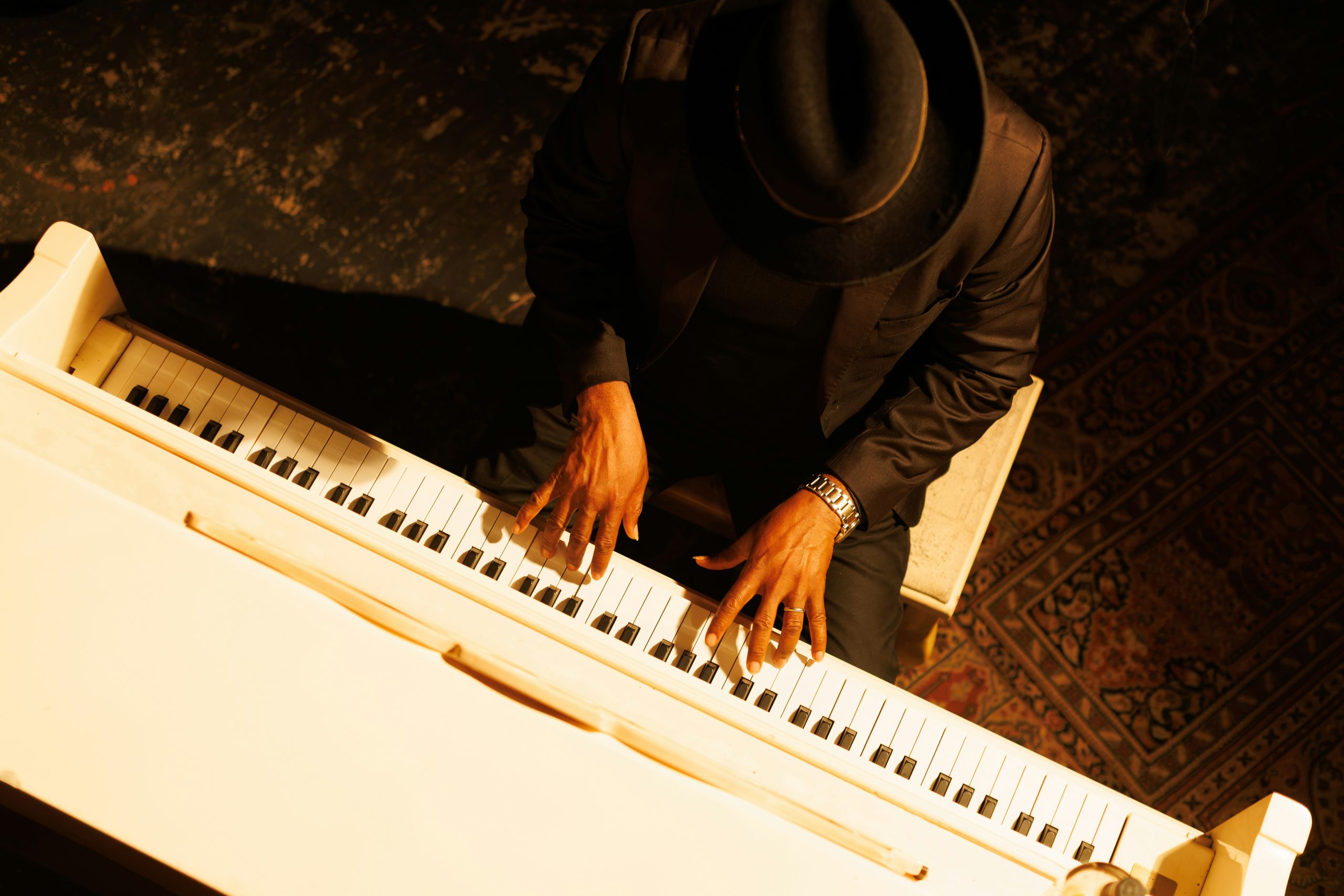
I Will Never Be the Pianist My Father Loves Best
An excerpt from Hudson by Hernán Ronsino, translated by Mallory Craig-Kuhn
When Navia finally says my father is dead, I am about to go on stage to play. I don’t know why it is that in transcendent moments I always think of trivial things: the world opens out into a multitude of dots, and I can’t help but illuminate the lesser plotlines, the hidden sounds. For example: backstage, with my body overtaken by an airy calm, and as I probe the gentle movement of a molar with the tip of my tongue, I think that this city has a river that cuts it in half; a Gothic cathedral; a statue of Leo Tolstoy with one arm longer than the other; and a name that’s impossible to remember. It’s a city in Eastern Europe. Navia’s voice repeats that it just happened. If you want, Juan, we can cancel, he says, we can cancel everything. And he gives my shoulder an exaggerated squeeze; a squeeze that lasts and lingers, that makes me intensely aware of one part of my body. But I want to carry on even though I’m far away, or perhaps precisely because I’m far away. I want to sit at the piano and play while I think about the figure of Tolstoy next to the gentle river. To hear the restless, living movement of the forty people in the audience. I want to carry on. To run with my fingers so the keys become the precise point of pain, the discharge point. And as I play, the word “fugue” and that scene my father described over and over—Bill Turner lost for months in the countryside—appear like a possible harbour, like a light suspended in the dark.
After that night, there are three more concerts scheduled in cities very far away. Navia manages to cancel two and move my flight up to the afternoon following my last performance in a city on the shores of the North Sea. Ostende. The truth is, when I find out that’s what the city is called, just like the resort town on the Argentine coast, I tell Navia that he mustn’t call it off, that it has to be the end of the tour. Navia hesitates because it’s the easiest city to cancel and the most expensive to get to. And barely any tickets have sold. I insist. It might sound fickle, but it’ll be the last one, I tell him. There’s a hint of sorrow in my voice, and Navia, who argues with me about everything, bites his tongue and tries to be considerate with me. I think deep down, Navia doesn’t understand why I want to carry on instead of making it back in time for my father’s funeral.
It’s raining in Ostende. The signs say: Öostende. A small city, nearly deserted in autumn, that unfolds like a fan against the bay. All the vertical streets descend towards the sea. Or they begin at the sea. And the others, the horizontal streets, contain an unending succession of hotels, restaurants, hair salons. It’s striking how many hair salons there are, and how few trees. Navia decided to book a single room for both of us on the main drag. He’s uneasy at not having cancelled the concert. The rain sweeps away any hope of a walk. But with an annoyed Navia in the room, there’s no space for anything else but to go out. I lie. I say I’m going downstairs for a smoke. From the doorway of the hotel, the rain looks less intense. So, taking an umbrella from the reception desk, I decide to get lost in the city. And getting lost in the city inevitably means choosing one of the vertical streets. The first thing I notice is the strength of the wind, of the way it feels like water. I walk down a cobbled street, hearing the whine of seagulls. And it doesn’t take me long to realize how useless it was to have brought an umbrella. The wind whirls and pulls it from my hand. It guts the wire structure that holds the fabric, drags it along and leaves it trapped in the tires of a car. Finally, I give in and carry on walking. Because there’s nothing else I can do. I shove my hands into my coat pockets and begin to discover, through the mist, the shape of that strange sea. I perceive its texture, its nuances: the grey against an amorphous, foggy background. If, for example, I had to make it into music, I would play it like that: grey against an amorphous, foggy background.
My father always used to say, by way of advice, that life is a staircase. The hardest secret to master is knowing when and how to put your foot onto the next step and, if possible, for it to be the one above you and not below. That’s why he chose money over music. All the values he picked apart to explain his reasons were just excuses: I have a family, I’ve got responsibilities, you think you can just live for free. He chose money because he liked it, too, and because he was scared of music, I’m sure of it; it’s almost always a difficult road that leads nowhere. He started working at a large company when he was twenty. He had a good salary and room for growth. He rose up through the hierarchy. And, more and more, he took on a central role. His first trip abroad was in 1962. He went to New York to meet with some investors who focused on agricultural machinery production. What made the biggest impact on him during that trip was not the city or its skyscrapers, or the huge deal he ended up closing with a percentage that allowed him to buy several properties: what had the biggest impact on him, and forever, was a music.
He chose money because he liked it and because he was scared of music; it’s almost always a difficult road that leads nowhere.
My father couldn’t remember what the name of the New York airport was before it was called JFK. It was an unimportant detail, but for the story, for the way my father always told it, it did matter. When his plane landed and then made the necessary manoeuvres to park at the correct gate, before disembarking, the entire crew and the passengers had to wait in their seats, for safety reasons, for almost an hour so that President Kennedy’s official plane could land at the same airport that, nearly a year later, would bear his name. Those are the curious facts of history, my father would say, you never know what pieces you’re playing with or which of all those pieces you’re carrying around with you is the key, the one that will find its match and fit, bringing about what no one could imagine would happen: an event. But mine, he said, my event wasn’t having been so close to President Kennedy. Mine began to unfold, because of President Kennedy, in the taxi I took leaving the airport. I told the driver I was very late and that he should take the fastest possible route to drop me off at the hotel. The man barely nodded. And off he went. It took me a while to really notice him: he seemed to have come loose from the landscape, balanced within his own body. He had Indian features. It also took me a while to really notice the sound coming from the radio. It had the power of a moving sea, sometimes calm and sometimes overtaken by a contained violence, as if the pianist were playing in desperation. It was just the piano. But in each sound, my father said, it founded the complexity of a world. He was about to ask the driver who it was when the radio announcer began to talk over the music to say we just heard a fragment of “Poughkeepsie.” And when he heard that, my father would say, the Indian said: Oh, “Poughkeepsie!” And he kept me from hearing the full name of the musician. I asked again, before getting out of the taxi, who the musician was. But the Indian just repeated: Oh, “Poughkeepsie!” I retained just three words from all that confusion, my father would say: Poughkeepsie, Bill, and Hudson. With those three words, he started his search.
On that first trip, my father scoured over twenty record stores in New York. It was the only thing he did when he wasn’t in meetings. Indeed, he felt he had come to know the city as he carried out his search, as he went from one record store to the next. He would find himself crossing Central Park or plunging into the Bronx or travelling the subway lines. There was, evidently, something incorrect in those three bits of information he wrote down when he got out of the taxi because when he showed people Poughkeepsie, Bill, or Hudson, no one really knew what he was talking about. Or what he was looking for. As the days went by, that music, more and more, became an ambiguous emblem that only continued to exist in his ear. He knew that if he didn’t find the record, that moving experience—in the taxi it had felt like he was receiving a true revelation—would be lost, irretrievable and unrecorded. Two days before going home, he walked into a street mall in Brooklyn. It was a tumble-down place. In the last shop, a tight space crammed with records that blocked the aisle, he got up the courage to ask. The shopkeeper was fat with a white beard, wearing a Lakers cap and a t-shirt full of holes. The man was sitting on a wooden crate, panting and staring at a fixed point on the ceiling. When he heard my father’s question, he remained silent, staring off into space. My father thought he hadn’t understood because of his poor pronunciation and repeated the details of his search. The fat man shook his head, and my father, tired, began to leave. But then the fat man spoke. He said that wasn’t the musician’s name. Hudson is the name of the record. The pianist’s name is Bill Turner. My father walked out of the mall with the record wrapped up in plastic. Outside, it was pouring rain.
Soon after he got back to Buenos Aires, he invited his friends over, including Delfor, the Uruguayan, to listen to his wonderful discovery. They got together on Sunday evenings at the garage Delfor ran downtown. The two friends were joined by taxi drivers, guys who lived in the neighbourhood and parked their cars at Delfor’s, that is to say, guys with rural tastes in music. They were more used to half-listening to tango orchestras, maybe a bit of blues. My father was young, he was making money and he spoke to them respectfully, as someone does when they’re trying to pass along a valuable secret. That was the key. He didn’t force anything. He piqued their interest, softened their ears. Nobody plays like this anymore, he would tell them, no one knows who he was, this Black guy playing the piano in the Chicago suburbs, but years from now, people are going to realize how revolutionary he was. That’s what my father was betting on: being the great discoverer. He even managed to get the album played—all of “Ticonderoga”—on one of the most important radio shows at the time: “Jazz Thursdays” on Radio El Mundo. One afternoon, something happened to strengthen that discoverer’s dream. A taxi driver who was always drinking mate in a corner, who let himself be carried along by the current of the group and never said a word, while silently listening to one of the songs—my father said it was “Tránsito”—broke down. He started to cry uncontrollably, with sobs that made everyone look over at him. Atilio, are you okay? they asked. Apologizing, wiping away his tears, Atilio left the parking garage a little embarrassed. Delfor said later that his wife was very ill. But my father was sure that Bill Turner’s piano, the beauty of it, had touched him.
The album was called Hudson for several reasons. That word is a single point overloaded with planes of meaning. It is a materiality that seeks, on the one hand, the interior of things, and, at the same time, an escape. But it is, fundamentally, a river. The only geographical line present on the album, one that also allows for drifting. In a way, my father took Bill Turner’s life and music as a roadmap. Every trip he took, he always looked for some musical novelty, a new album or some biographical fact beyond the scant references that appeared on the back of Hudson (Turner, William, alias Bill, 1937, Poughkeepsie, NY, musician and bird enthusiast). But it was difficult for him to find any information beyond that little bit held by people who knew of the musician. For two or three years after Hudson came out, there was nothing new. Until one trip with a layover in Dallas, a layover of more than ten hours that gave him the chance to go downtown, check out a few record stores, happen upon a bookstore with a café, since he was looking for a good cup of coffee and thought that might be the place; when he was least expecting it, on a table of new releases, just as it began to snow outside, he saw Bill Turner’s biography. It was a short book, just over a hundred pages, written by John Banthe. It was called The Silent Life. On the cover there was no photo of the musician, as would be expected on someone’s biography, but rather one of a man, who might have been Bill Turner or any other man, pictured from behind, playing the piano. He began to devour it.
So, instead of his work expanding like a galaxy, what would take over now was centripetal force.
He couldn’t do much else, even when he got back to the airport, as it snowed outside. He absorbed each fact, each piece of information. The story fixed itself in his mind. But it was only when he was back on the plane, in the middle of the flight, that he realized what had moved John Banthe to write the book. The pianist had died just six months earlier. John Banthe was a journalist and Turner’s agent, and he felt a moral obligation to “chisel out,” a phrase he repeated several times throughout the book, according to my father, a true portrait of his dear friend and his abortive musical career. My father read the book twice through on that trip back to Buenos Aires. And when he arrived, he had reached two important conclusions. First, the radical nature of his music could be appreciated by anyone: a Buenos Aires taxi driver or a New York Times critic. The other was that he would never find another recording by Bill Turner besides Hudson. That was it. That was all. So, instead of his work expanding like a galaxy, what would take over now was centripetal force. The search for all possible universes would have to take place within Hudson to find all the clusters, the points of compression. And they would have to be squeezed.
My father kept up his ritual in Delfor’s parking garage. He took the record wrapped up in a red velveteen cloth that smelled of car deodoriser. And though the audience began to shrink, since listening to the same record every Sunday and trying to say something about it was no easy thing to maintain, my father managed to convince four or five guys to keep coming back and become truly involved, for a variety of reasons, in listening. Among them was the taxi driver who had cried the first time. While that happened, my father was building his empire. Houses, apartments, trucks, commercial properties. He travelled the country and the world. But he never lost his humility, that was what people said around Delfor’s garage. They would point to him and whisper: he’s making money hand over fist, they would say, but he’s a good guy. There was respect there. Sincere respect. In the late 1970s, I can’t remember if it was 77 or 78, before the World Cup, the company where my father was already one of the executive directors started to collaborate with the military junta on public works in the interior of the country. It provided raw materials to build roads, schools, bridges, stadiums. That was why he started to travel constantly, first to the northern provinces and, in a later stage, to Cuyo. My father said it had been on a trip to Tucumán, but I also remember him mentioning Santiago del Estero. In any case, on one of those flights—he had left very early in the morning—he fell asleep. When they landed, he stumbled off in a rush and got on with his work meetings, made a few visits, and that night at the hotel, before going to bed, only then, when he would usually leaf through the Turner biography to discover something new, since something new appeared in every reading, he realized he had forgotten the book on the plane. At first, he felt deep anxiety, and in fact slept poorly. The next day, he started to write down in a notebook—knowing it would be nearly impossible to find the book again—all the stories about Turner that he remembered reading. With each story he recorded, he started to appropriate that life, little by little. That is why he began to set down, mixed in among his memories of what he’d read, his own personal hypotheses about the pianist’s tragic fate, or the idea of beauty that had perturbed him constantly. “The Silent Life of Bill Turner,” he wrote on the cover of the notebook, which he kept in the middle drawer of his desk. He had always felt there was something lacking in Banthe’s title: the pianist’s name, for example.
Read the original article here