A few years ago, a student at the university where I’ve been teaching for the last decade asked me about my working process as an art historian. Without thinking too much about it, I said that I find the tools of the method actor useful. I told the student that I tried to develop an intense understanding of the great artists of the past, one so thorough that the men I study start to feel like real people I’m interacting with in my daily life.
Article continues after advertisement
I don’t remember if the student asked me any follow up questions, but I realize now that the idea had been percolating in my brain long before I verbalized it that day. I’d spent much of graduate school and the first years of my career as an academic developing expertise in masculinity studies to write my first book—a study of how paintings produced in Russia during the nineteenth century provide insight into the hidden anxieties and evolving identities of men in that period. The first chapter was on an artist named Karl Briullov, who I found enthralling. Briullov’s tense relationship with his father, his temper when he felt dissatisfied with his paintings (he once threw a boot at a canvas so hard that it ripped through the fabric)—all of it made him come to life for me, made him feel like a man I actually knew.
These men may have been horrible, but they were also fascinating companions. And it was undoubtedly their misogyny that was the source of so many of their problems.
So close was my study of Briullov that at some point, it started to feel like we were dating. It probably helped that he was quite handsome, and he produced a slew of dreamy self-portraits that fit in well with the style of romanticism which was then prevalent. But as soon as I finished writing the chapter on him, I began to feel morose. I knew it was time to turn to the next artist in the book and do a similar deep dive into his letters and paintings, but I just couldn’t bring myself to start. Slowly but surely, it dawned on me: it felt like I’d broken up with Briullov. Like I’d lost him. And I missed him terribly.
Now this is not (as far as I know) a normal feeling for an art historian to have. At least, I’ve never heard another scholar report any experiences along these lines. But the feeling plagued me as I finished the work and began my next major project—a book on some of the most awful misogynists of the modern art canon. To write about them I had to get to know each artist as thoroughly as I possibly could, down to the nittiest and grittiest of details. When did they wake up every day? Did they enjoy going out on the town or were they introverts? What did they like to eat in their studios? Did they have a lot of male friends? How tall were they? And then there was the bigger picture stuff: what was their relationship with their mother like, did they visit brothels, or pressure their models into sex?
Everything was fair game and every bit I gleaned from the primary sources fueled my ability to write about each of the men. My goal was to make the nasty things they said about women leap off the page, to make the abuse they inflicted on their models and wives and girlfriends come to life for my readers. To write an effective and gripping book, essentially.
But what I found as I underwent this process both surprised and devastated me. It had been one thing to imaginatively “date” an assortment of Russian and Ukrainian painters who lived more than a century ago. When I co-opted the method actor’s tools and used my own emotions and memories (and dating history) to feel into and for these men, it made me sad when it was time to move on from them, but the sorrow didn’t last long.
The men I was writing about now were absolute monsters, and I was using all of my emotional intelligence to summon them from their graves. I felt as though I was in relationships with men who enjoyed painting women being stabbed to death (Eugène Delacroix), who believed that women never evolve beyond the condition of childhood (Auguste Renoir). I had as my imaginative partners men who cheated on their wives with thirteen-year-old girls (Paul Gauguin), who slapped their girlfriends if they went out without permission (Pablo Picasso). I was terrified of each of them, but in different ways, and that fear only grew as I wrote each of the chapters devoted to them.
At the same time though, I still felt so much weird compassion for them. I couldn’t shake my crush on Eugène Delacroix in particular—the things he said in his journal and his letters sometimes just broke my heart. He was so concerned about his height, his inability to afford the latest cut of a jacket, his tendency to be lured “by foolish distractions.” But then he also wrote about women in ways that disgusted me, calling them “monkeys” and “toys” and “monsters.” I know so many men like this, and I’ve loved some of them deeply, though it was always tortuous to grasp at the moments when they showed some vulnerability or treated me with tenderness, only to then become ever more controlling and argumentative.
I ended up feeling similarly about Edgar Degas, the artist whose depictions of ballerinas are so beloved today. It quickly became clear to me that he abused many of his models, making them hold grueling poses and threatening them with a hammer if they couldn’t do it to his satisfaction. But Degas was obviously no happier for acting that way. His letters made it clear that he was often terribly lonely, but he just couldn’t see a way out of the prison he’d built for himself. He too reminded me of some of the men I’d dated in real life, the ones who refused to seek therapy though their depression was interfering with their ability to keep a job. I couldn’t help but think that I was continuing some pattern with Degas, one that most definitely centered on a desire to help pull broken people out of their misery.
I knew what I felt for them was a weird kind of love—the kind born of pure captivation and a commitment to doing the extent of their perversities justice as a historian.
These men may have been horrible, but they were also fascinating companions. And it was undoubtedly their misogyny that was the source of so many of their problems, just as it is for the thousands of men and boys who haunt incel forums or find solace in emulating manosphere influencers today. I thought about the manosphere a lot when I was writing and I couldn’t help but draw connections between that contemporary realm and the toxic masculinity of the men I was writing about from the past. I felt a huge responsibility toward them—to get the details of their lives right, to make sure I always quoted them accurately. Day in and day out, their voices echoed in my head as I turned over page after page of the books written about them, as I followed every brushstroke which comprised their most important (and misogynistic) masterpieces. I watched as they sank into alcoholism (Gustave Courbet), as they became blind and ever more miserable (Degas). Sometimes the stories of their lives made me cry real tears; something that had never happened in all my years working as a scholar.
I knew what I felt for them was a weird kind of love—the kind born of pure captivation and a commitment to doing the extent of their perversities justice as a historian. It was twisted and damaging but I couldn’t seem to help it. It had become my process and as self-destructive as it felt, the pages I was sending to my editor were consistently getting a thumbs up.
So I kept at it. My progress was often brutally slow, and sometimes each man’s proclivities got under my skin enough that I realized I was changing my behavior—the same way I likely would have if we shared a bed. Degas didn’t like his models to wear their hair up; I started growing mine out and styling it more loosely. Renoir liked to paint women with their mouths open (to make them look more immature and brainless); I found myself becoming hyper vigilant about never letting my mouth hang open, even a little, while I was writing or reading.
Eventually I got through it, but I never felt like I was able to shake the men who were at the center of The Misogynists: A Reckoning with Modern Art. Even after the final corrections were made and the book was off to the printer, I still felt like any one of the artists I’d written about might call me up, like they were a bunch of exes I never had the heart to block on my phone (though all my friends said I should). I just knew too much about them, and I still find each man too fascinating to freeze out of my life completely.
Maybe once the book is released, I’ll finally have the strength to say “we’re done” to each of them in my own mind. It would be great to close the door on that chapter of my life and let myself forget all the things these men said to their lovers, to let the thousands upon thousands of their sketches that I poured over fade from my memory. But until then, the twisted kind of love I feel for them remains. It’s a feeling I’m ashamed of, but maybe I shouldn’t be. We historians should love the subjects we write about—our empathy is what makes us good professors and it might just be what makes our books worth reading.
_______________________________
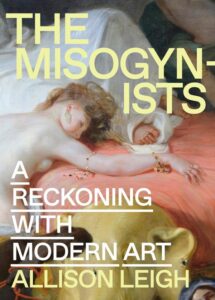
The Misogynists: A Reckoning with Modern Art by Allison Leigh is available from Abrams Books.