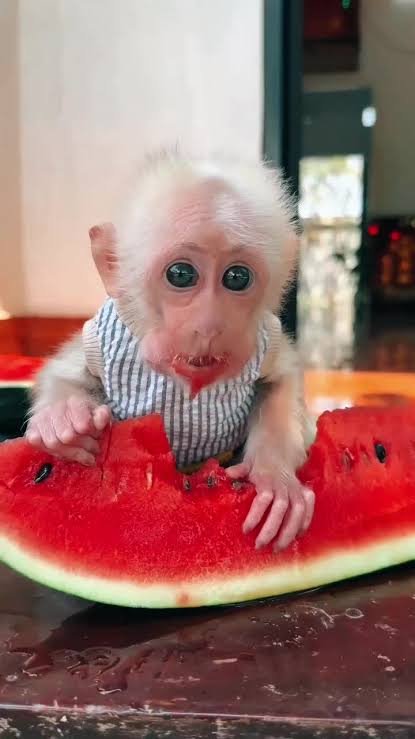
We’ve entered a season of gratitude. And gratitude is not just an emotional thing. Science shows us that gratitude is literally the stuff of life.
For a reason. A huge number of species that have lived on this planet have been social. And gratitude is a social binder, a social glue. Gratitude allows a group of humans to act as a unit. And acting successfully as a unit is a key to our survival.
Think about it for a second. An alarm clock woke you up this morning. Even before you opened your eyes you were plugged in to a social web. It took roughly 1,500 generations of thinkers and tinkerers to invent the mattress you’re lying on. It took someone able to raise money to build a factory to manufacture your mattress. It took something else invented by a pyramid of humans to invent the internal combustion engine and the truck that delivered that mattress to your home.
So even with your eyes shut and still under the covers, you are kept alive by a vast society of others. A society that uses the accumulated ideas and labor of roughly 1,500 generations of your fellow human beings.

When you had your Thanksgiving dinner, you carried out a ritual that reconnected you to others. Why? To glue you into a functioning group. A group that, if put in peril, can pull together and make it through catastrophe.
But gratitude is not the product of a moral system given to us by a founding father like Jesus, Moses, Mohammed, or Confucius. It is built into our biology. Our great, great grandmothers, the grandmothers of nearly all the lifeforms on earth, are microbes. Single-celled creatures. Their lives often depend on generosity: giving and receiving the substances and services that help them survive.
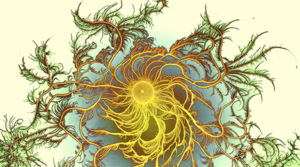
Take Bacteroides ovatus and Bacteroides vulgatus. B. ovatus can feed on inulin, a fiber found in chicory, onions, garlic, and bananas. It can digest inulin inside its body. But it also makes enzymes that break some inulin down outside its cell wall, releasing food fragments into the surrounding liquid.
B. vulgatus, on the other hand, cannot digest inulin, but it can feed on the fragments B. Ovatus scatters about. This sharing costs B. ovatus. In one laboratory experiment, bacteria without the sharing enzymes grew to higher numbers. So why keep sharing?
When B. vulgatus was hanging out nearby, the B. ovatus gained a competitive advantage. B. vulgatus, in turn, improved B. Ovatus’s fitness.
Scientists call this cross-feeding and reciprocal fitness. But when vulgatus feeds ovatus and, as if in gratitude, the vulgatus pays it back, that’s a primitive precursor of our Thanksgiving. Giving generously to those who have given to you.

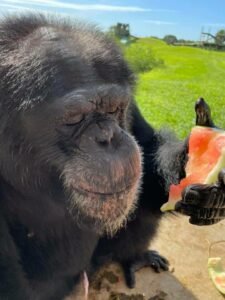
But there’s a more overt form of gratitude among another cousin on our family tree—chimpanzees, from whom we parted six million years ago. At the Yerkes Primate Lab 30 miles outside of Atlanta, Georgia, at noon the keepers would throw in a few watermelons to be divided among 20 chimps. Often a low ranking female chimp would be the first to scramble to the prize. The other members of the troop would crowd around, begging for a piece of the treasured treat. Yes, even the haughty chimps high above her on the social ladder put their hands out begging. But there was a peculiarity,
The low ranking female with her arms wrapped around that big, green ball of sweetness would allow the first chunks of fruit to be taken not by the high-ranking chimps above her, but by a relative stranger, another chimp she scarcely knew. But a relative stranger who, a few hours ago, had stood behind her stroking her fur and looking at the fur’s roots for bugs.
Apparently the chimp hogging the watermelon was grateful.
About the author: Howard Bloom of the Howard Bloom Institute has been called the Einstein, Newton, Darwin, and Freud of the 21st century by Britain’s Channel 4 TV. Bloom’s new book is The Case of the Sexual Cosmos: Everything You Know About Nature is Wrong. Says Harvard’s Ellen Langer of The Case of the Sexual Cosmos, Bloom “argues that we are not savaging the earth as some would have it, but instead are growing the cosmos. A fascinating read.” One of Bloom’s eight previous books–Global Brain—was the subject of a symposium thrown by the Office of the Secretary of Defense including representatives from the State Department, the Energy Department, DARPA, IBM, and MIT. Bloom’s work has been published in The Washington Post, The Wall Street Journal, Wired, Psychology Today, and the Scientific American. Not to mention in scientific journals like Biosystems, New Ideas in Psychology, and PhysicaPlus. Says Joseph Chilton Pearce, author of Evolution’s End and The Crack in the Cosmic Egg, “I have finished Howard Bloom’s [first two] books, The Lucifer Principle and Global Brain, in that order, and am seriously awed, near overwhelmed by the magnitude of what he has done. I never expected to see, in any form, from any sector, such an accomplishment. I doubt there is a stronger intellect than Bloom’s on the planet.” For more, see http://howardbloom.net or http://howardbloom.institute
______
References
______
Algoe, Sara B., Patrick C. Dwyer, Ayana Younge, and Christopher Oveis. “A New Perspective on the Social Functions of Emotions: Gratitude and the Witnessing Effect.” *Journal of Personality and Social Psychology* 119, no. 1 (2020): 40–74.
Chang, Yen-Ping, Gao-Xian Lin, Xu Peng, Tzu-Yun Kung, Chen-Ya Liu, Chieh Lu, and Hui-Tzu Lin. “Thank You, Whatever You Are: Gratitude for Nonhuman Entities through Anthropomorphism.” *Emotion* 26, no. 7 (2026): 1750–1770. https://doi.org/10.1037/emo0001682.
de Waal, Frans B. M. “The Chimpanzee’s Service Economy: Food for Grooming.” *Evolution and Human Behavior* 18, no. 6 (1997): 375–386.
de Waal, Frans B. M. *The Age of Empathy: Nature’s Lessons for a Kinder Society*. New York: Harmony Books, 2009.
Fox, Glenn R., Jonas Kaplan, Hanna Damasio, and Antonio Damasio. “Neural Correlates of Gratitude.” *Frontiers in Psychology* 6 (2015): 1491. https://doi.org/10.3389/fpsyg.2015.01491.
Gu, Y., J. M. Ocampo, Sara B. Algoe, and Christopher Oveis. “Gratitude Promotes Teammates’ Challenge Responses.” *Journal of Experimental Social Psychology* (2022).
Hori, Daisuke, Shinichiro Sasahara, Shotaro Doki, Yuichi Oi, and Ichiyo Matsuzaki. “Prefrontal Activation While Listening to a Letter of Gratitude Read Aloud by a Coworker Face-to-Face: A NIRS Study.” *PLOS ONE* 15, no. 9 (2020): e0238715. https://doi.org/10.1371/journal.pone.0238715.
Kini, Prathik, Joel Wong, Sydney McInnis, Nicole Gabana, and Joshua W. Brown. “The Effects of Gratitude Expression on Neural Activity.” *NeuroImage* 128 (2016): 1–10.
Nowak, Martin A., and Sébastien Roch. “Upstream Reciprocity and the Evolution of Gratitude.” *Proceedings of the Royal Society B: Biological Sciences* 274, no. 1610 (2007): 605–610. https://doi.org/10.1098/rspb.2006.0125.
Oguni, R., and K. Otake. “Gratitude Promotes Prosocial Behavior Even in Uncertain Situation.” *Scientific Reports* 14 (2024): 14379. https://doi.org/10.1038/s41598-024-65460-z.
Pande, Samay, Shraddha Shitut, Lisa Freund, Martin Westermann, Felix Bertels, Claudia Colesie, Ilka B. Bischofs, and Christian Kost. “Metabolic Cross-Feeding via Intercellular Nanotubes among Bacteria.” *Nature Communications* 6 (2015): 6238.
Rakoff-Nahoum, Seth, Kevin R. Foster, and Laurie E. Comstock. “The Evolution of Cooperation within the Gut Microbiota.” *Nature* 533, no. 7602 (2016): 255–259.
Tong, Eddie M. W., C. X. Ng, J. B. H. Ho, I. J. L. Yap, E. Chua, J. W. X. Ng, D. Z. Y. Ho, and Ed Diener. “Gratitude Facilitates Obedience: New Evidence for the Social Alignment Perspective.” *Emotion* 21, no. 6 (2021): 1302–16. https://doi.org/10.1037/emo0000928.
Zhu, Ruida, Zhenhua Xu, Song Su, Chunliang Feng, Yi Luo, Honghong Tang, Shen Zhang, Xiaoyan Wu, Xiaoqin Mai, and Chao Liu. “From Gratitude to Injustice: Neurocomputational Mechanisms of Gratitude-Induced Injustice.” *NeuroImage* 245 (2021): 118730. https://doi.org/10.1016/j.neuroimage.2021.118730.