Meta is on an app rampage that extends far beyond its hit AI personal assistant, Muse.
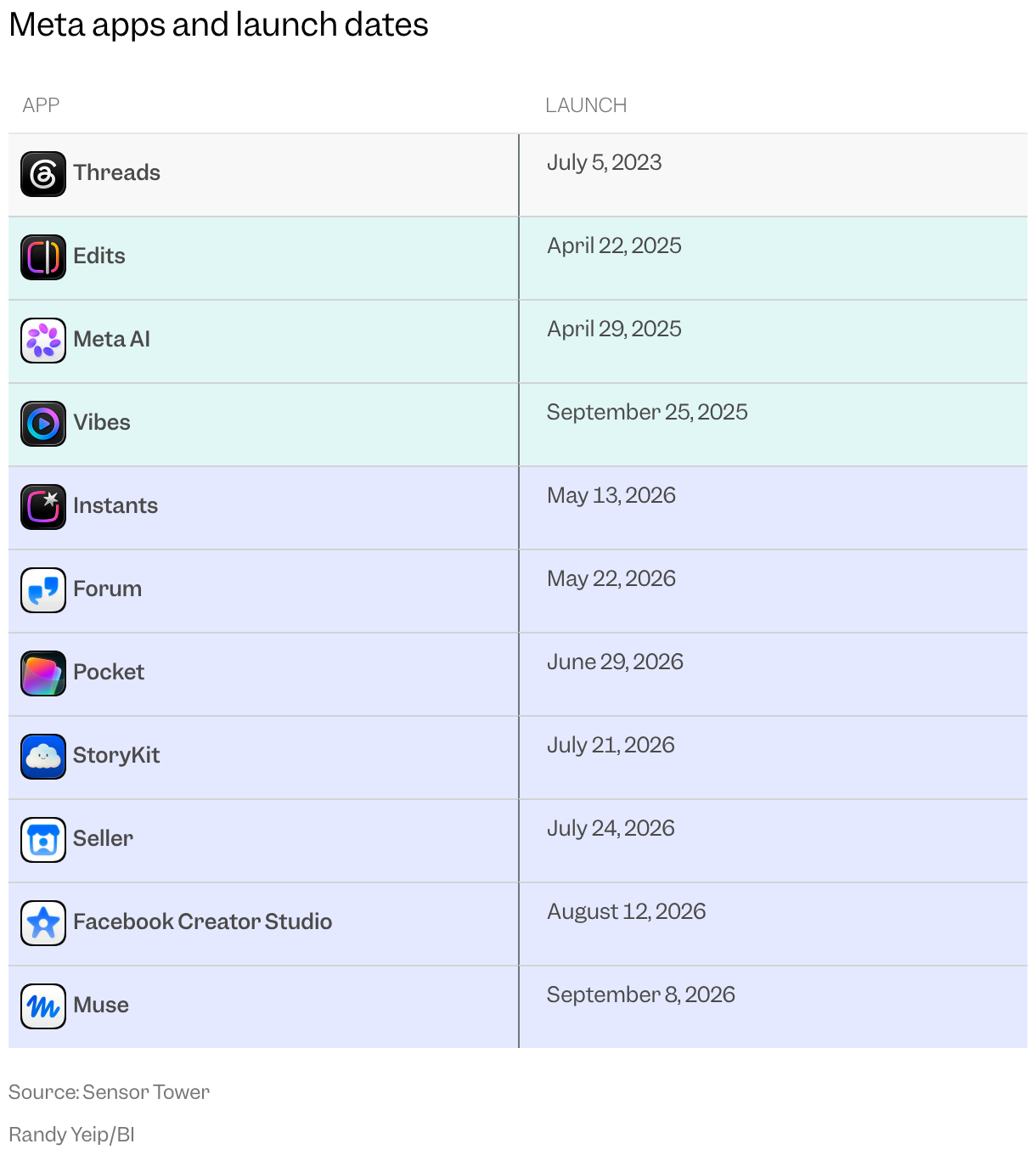
The tech giant has released seven new apps so far in 2026. They range from getting back to Meta’s basics of sharing photos to testing AI use cases for everyday people.
It’s all part of Meta’s biggest task at hand right now: Winning the race to build the AI era’s Facebook or Instagram.
Meta CEO Mark Zuckerberg has also credited AI with helping the company quickly turn new ideas into real products.
“AI is helping our teams speed up product development,” he told investors during Meta’s July earnings call. “I expect it to become a lot easier to ship new apps, so we’re planning to build out more ideas and use our recommendation systems to scale them to the people who will find them interesting, as we’ve done with Threads.”
In May, Meta globally launched Instants, a Snapchat-like app that it spun out of Instagram. In August, it released Pocket, a vibe-coding social app, and began testing an AI-powered bedtime story app, Storytime, in some regions.
Meta also recently shipped three new Facebook apps: Forum (for groups), Seller (for Facebook Marketplace), and Creator Studio (for Facebook content creators).
“They’re constantly still trying to innovate,” Amy Wu Martin, an investor at Menlo Ventures, told Business Insider.
This isn’t Meta’s first time throwing spaghetti at the wall and seeing what sticks. In the 2010s, Facebook had a Creative Labs team that launched a handful of apps. In 2019, the company announced its New Product Experimentation org, which tested, launched, and ultimately shut down several apps, from livestreaming to social apps for music and couples.
The NPE org was short-lived, however, and was deprioritized following Meta’s major layoffs in late 2022. Now, the company is embracing new products again with open arms.
One big reason: the success of Threads.
Threads, Meta’s bid to compete with X (formerly Twitter), was one of the company’s first successful breakout apps added to its roster in recent years. Since its launch in 2023, Meta has touted the social app’s growth. In July, Zuckerberg shared that Threads had surpassed 500 million monthly active users, “making it the fastest-growing conversation app ever.” The app welcomed advertising at the start of the year, too.
Meta’s AI advantage
While AI has ushered in a wave of new ideas for consumer-facing apps, there haven’t been “a lot of winners yet,” Martin said.
That leaves Meta — with massive resources compared to a scrappy startup — at an advantage.
Forrester principal analyst Kate Winick said that, with Muse, Meta is “going back to its roots.”
The company is “figuring out how to put a very accessible, very friendly consumer-centric wrapper around technology that exists elsewhere,” she added.
Meta didn’t invent the AI personal assistant — startups like Instinct, Town, or Poke have stirred industry buzz — but the company made lots of noise with Muse’s rollout.
Bloomberg/Getty Images
The biggest leg up Meta has for Muse, as well as for any app it’s pushing, is the billions of users already in its ecosystem. In July, Zuckerberg said that 3.6 billion people use “at least one of our apps each day.”
When Meta launches an app, it can instantly promote it to its existing users.
Have you opened Instagram in the last few weeks? If you have, odds are you’ve seen an advertisement from Meta suggesting you try out Muse.
Meta employed that same strategy to funnel Instagram and, eventually, Facebook users over to Threads.
Launching an app into the void no longer cuts it. To stand out in the noise, Meta needs to pour gas on the flame. The company seems to be learning a lesson from its previous app flops by “putting the full might of the company” behind pushing its newest and latest, Winick said.
Tempering the super app dream
If you download all of Meta’s major apps — in addition to the Holy Trinity of Instagram, Facebook, and WhatsApp — that leaves you with 14 Meta-owned apps.
Move all those apps to one iPhone page, and it takes up about half the screen.
Instead of consolidating everything into one giant super app, Meta is going for a sprawling approach.
Screenshot/Meta/Sydney Bradley
Dreams of a super app aren’t ancient history. Only a few years ago, Meta seemed to be morphing Instagram into a super app with video, photos, livestreaming, shopping, and more. Meanwhile, in China, WeChat dominates as the everything app. Tech executives from X’s Elon Musk to Microsoft’s Satya Nadella have shared their super app aspirations.
“In the Western markets at least, the super app has not been a form factor that has really taken hold,” Martin said. “People want to use an app for a specific thing.”
Meta seems to be giving that a shot.
Want to send a disappearing photo to a friend, but not on Instagram DMs? Open Instants. Want to sell a piece of furniture on Marketplace but don’t want to deal with the distractions of the Facebook app? Open Seller.
This approach could also help Meta as it pushes into subscriptions and looks for potential bundles.
“They’re really creating an ecosystem” instead of one massive app, Winick said. “And it’s persuasive.”
Read the original article here