My Boyfriend Is a Wounded Animal I Want to Save
“Porcupine” by Sarah Braunstein
We met in a bookstore, the Strand. The late nineties. I was trying to decide between E. B. White’s books, the pig or the swan or the mouse. He saw me deliberating. For my sister’s kid, I told him. “The mouse,” he said, with appealing confidence. He had chin-length hair, a square jaw like Kurt Cobain’s. “I’m Edgar.”
“Susannah.”
Edgar said he identified with the mouse, a New Yorker like him, born inexplicably into a family of humans. I went with that one. He said I was a good aunt and asked me out for coffee. This led to dinner, drinks, bed. He was threadbare and grungy, which didn’t necessarily mean poor. He wore vintage Brooks Brothers pants in what he called aubergine. Battered designer boots and luggage. A high-class hippie, I decided. He was between apartments, staying with friends, had just returned from Europe. I was in the process of finalizing a divorce and had a decent sublet for that month on Twenty-Second Street. We fell into—something. He was twenty-five; I was forty-two. Robbing the cradle is the expression people use, which sounds dastardly. I couldn’t believe my luck.
Several weeks into it he said, “We should go to my island in Maine. It’s perfect this time of year.”
It was early May. We were sitting in the window of a cafe in the East Village.
“You don’t have an island.”
“I do. I actually do! A farmhouse on its own tiny island. There’s a little bridge. You don’t need a boat. No one else in my family uses it, which tells you everything about my family.”
He asked if this surprised me. I said it did.
“All stockbrokers. Money managers. Criminally rich. I don’t like to talk about it right away. You understand, don’t you, Susannah?”
He smiled, leaned closer. I could see that he liked my expression, whatever I was doing with my face to hide my abject greed. At this point in my life, I longed above all else for a wealthy man. My parents were dead and had left only debt. It was the family weakness, like a flaw in the genetic code. My sister had finally found her way to money in the form of her husband, who worked in office supplies, but I was helpless, always sputtering.
“My family can only breathe in the city,” he told me. “Only polluted air. Country air’s toxic to them. Sunlight to vampires.” I sensed a sort of shifty glee, the energy of an exaggerator, but I didn’t mind. Coming out of a difficult period, low on funds, I was in a mood to value novelty. To go with the flow . He told me that women his own age depressed him profoundly. It was all status with them, all social climbing.
A week later we got on a bus, then two more buses, then took a cab into a town. Barely a town. Just a general store, a single old-fashioned gas pump standing out front. The taxi left us two miles past the general store, where the dark road intersected a darker road. It was late, and I remember being stunned by the completeness of the dark. Relieved when he pulled out a flashlight, though he didn’t seem to need it. He walked briskly. We moved along a dirt road until we came to a short footbridge, crossed the bridge dragging our suitcases. I saw the farmhouse in the flashlight’s beam—cedar shingles, copper drain, rooms and rooms. He took the key from a hiding place in a stone wall. Inside it smelled like money: wood, leather, furniture oil, mothballs. In the morning I followed him around while he got the water running, unlatched the shutters, primed various pumps. I saw the property. The sky screamed blue. I screamed too.
“You didn’t believe me, did you?”
“I did. Sort of. I wanted to.”
He gazed at me happily.
“Is it winterized?”
“Well enough.”
I imagined never going back to New York. I imagined telling my sister: I met a man and I am moving to Maine!
He smoked all day. Smoking did not undo the sense of health, as it would these days. Back then it made everything better. I took drags too. The air was fluid with insects. A flowering meadow spread out before us like a quilt. On our bed inside was a pile of quilts made by his relatives. I loved the house, its nooks and ornate hinges, creaky stairs and glass cabinets, and I loved the woods surrounding the house, and the meadow. But the shore—a hundred yards down a brambly trail—I found sinister. Rocks upon rocks. Rockweed and barnacles. No sand. No place to get your balance. The ocean hissed, produced curious froth. Even before he died, I was suspicious of that cold water. I’m going to jump ahead to say he went for a morning swim in late July and never came back. The death was ruled accidental, and I believe it. Still, I suspect the current wasn’t unwelcome. He’d been swimming farther and farther out in the previous weeks, alternating between backstroke and crawl. I saw this, talked to him about it. Didn’t he himself tell me to be careful after storms, when tidal currents were stronger? Didn’t he say it wasn’t safe beyond those rocks?
“I like when you worry about me, Susannah,” he told me, out of breath, patting his pretty torso with the towel I’d brought down for him. “I like when you worry, but only a little.”
The first days he took real pleasure showing me around: the claw-foot tub where he’d read comic books on rainy days, the spooky basement, all the secret shafts and cupboards. He gave me a tour of the woods as though it were an extension of the house, rocks he’d hidden under, trees he’d climbed. He resurrected the clothesline, where he’d hung his underwear, between the shed and the southwest corner of the house. “I can’t believe it,” he said, watching our delicates tremble in the breeze. I imagined his past in a glowing montage, beautiful rich children, sexy boys, summering, figuring things out, zinc on their noses. He was the sensitive, inward one, the River Phoenix. He showed me the well where he’d plunked stones. The dry, hot attic, crumbling leather diaries of his ancestors in a chest up there. An antique teddy bear in a cradle. A porcelain doll missing an arm. We spent a lot of time in two wooden chairs in a meadow. I took drags off his cigarettes. I loved watching him smoke. I knew that if my sister could have seen him—the way he blew smoke, quizzical, pondering some deep idea, handsome as a movie detective—she’d call him smoldering. My sister’s husband, nearly two decades older, office supply king, was the opposite of smoldering.
I peppered him with questions, but he didn’t like to talk about his childhood. I got the sense of chilly parents, absent a lot, permissive, drinkers. Old money. He’d gone to school in Manhattan, he explained to me, but spent every summer out here. Then he stopped coming. He hadn’t been back in many years. But why? When did he stop coming? Why if he liked it so much? “I went other places,” was all he said. I asked where but he didn’t say, just flicked his ash, and I didn’t press him because I wanted to stay there, to keep the arrangement copacetic.
One day he told me, “There was a groundhog I made friends with one summer. I’d feed him breakfast cereal. Cheerios. I bonded with that groundhog.”
“I didn’t know they were bondable.”
“Every mammal is, give or take. You’d be surprised. But you have to be steady.”
I would have been cynical but saw it happen. Twitchy squirrels stilled in his presence. Once a deer allowed him to come within two feet. I was in the kitchen opening a can of beans and watched him in the meadow, talking to that deer.
He sought a perpetual present, he said. If I had been rich, that’s what I would have done too, but I wasn’t rich. This fact began to concern me. He did not show interest in my work schedule, which should have been a warning. If I mentioned the job I was supposed to start in September—office administrator for a sociology department at a college on Long Island—he’d bristle and say, “I don’t want to think about that yet.” And since I didn’t really want to either, I didn’t. One night after dinner, he was sweeping the kitchen, I was doing dishes, and I said, idly, “Maybe for Christmas we can go to Chicago. I’d like you to meet my sister.”
He had a way of making reasonable worries dissolve. I credited his wealth.
My poor sister. Now I might have more empathy, but back then I was so angry. I wanted to get back at her for something she’d done after my marriage failed. A look she’d given me, holding her new baby in a swaddle, a pitying smile: you’ll never have this. If I took Edgar there, I could give that look back to her. Such was the nature of our dynamic, petty as our parents.
Edgar said, “I don’t like planning,” and must have imagined a critique, because he added, “Look, if you want mature, find a retiree.”
He had a way of making reasonable worries dissolve. I credited his wealth. One of those people free to be anything, which includes being nothing, being depressed, riding the wave of his moods. Too rich for a planner, for a wallet or good watch. His was a Timex. All of it made sense. Of course this was the kind of rich man I’d get, I thought, the melancholic kind, the adorable ne’er-do-well. I could handle it. But he began to get more withdrawn, vacant. I’d wake up in darkness and he wouldn’t be in bed. I’d find him in the grass outside the kitchen door, in his baggy underwear. He spent a lot of time in the gingham chair, whittling pieces of balsam fir with a penknife, or just looking out the window. He would ask odd questions, apropos of nothing.
“Do you think Charles really loved Diana?”
“Do you know that one termite queen produces five hundred million children?”
He didn’t sleep much. He ate toast and jelly at night. In the morning I cleaned the crumbs. He got tan, so looked healthy enough, and in bed we could not get enough. He was so game. He could do it whenever I wanted, two or three times in a row; most men would be prideful of this fact, but he expected no congratulations.
One time, holding me afterward, he said, “My great-great-great-grandfather came here when the land belonged to the Wabanaki. His son married a native woman. I’m part native. It’s strong in me. Stronger than in the rest of the family.”
He was a kid, I decided, like a boy with a construction-paper headdress. A Mayflower descendant, cherished but aloof, the black sheep, his difference from the others manifest in a fantasy of Indianness. I thought I had him pegged.
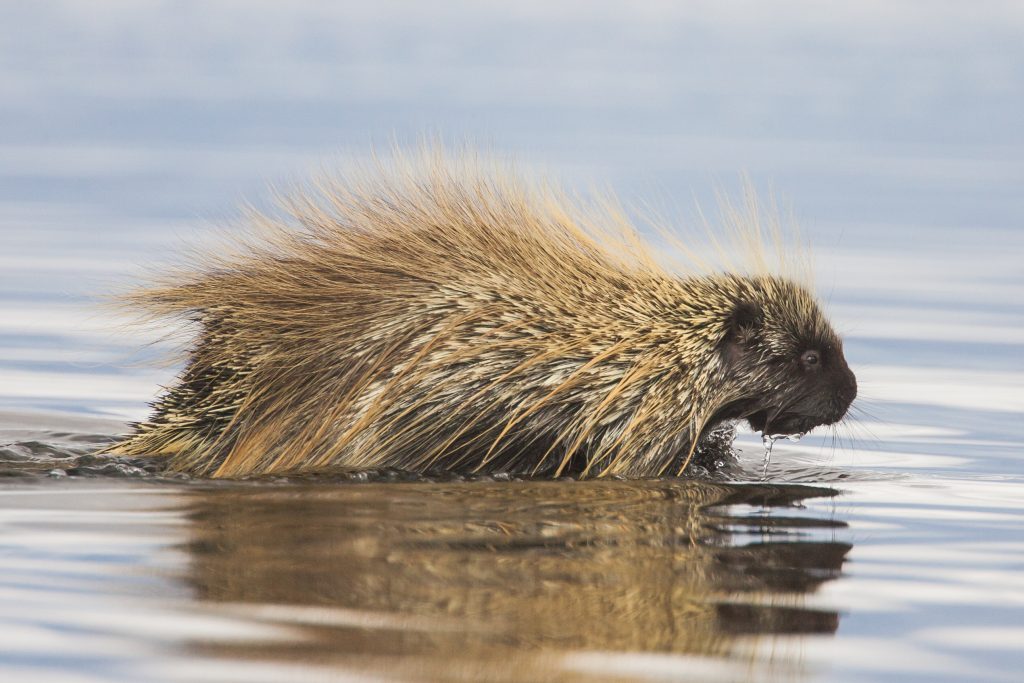
Then we found the porcupine. Near the bridge, in the road, struggling to breathe, bleeding from its hind leg. Likely a juvenile, he thought. He put alcohol on its wound. He kept it in the shed, in a cardboard box, and fed it lettuce, strawberries, saucers of sugar milk, and finally decided it needed to be held, like any living thing. It would heal only once it was held, he told me while eating dinner one night.
“You know that experiment with the baby monkeys? They got a bad choice. Two mothers. A cuddle from a soft monkey but no food. Or a wire monkey and dinner. They chose a cuddle, those poor guys. They’d rather starve.”
“It makes me nervous. You can’t hold a wild animal like that.”
But the animal needed a friend, so he put the antique teddy bear into the cardboard box with the recuperating animal, tucked the toy next to its sleeping body. The bear had no eyes or nose left, just a piece of dangling red yarn that had been its mouth. Once it had soothed a relative. Maybe it would soothe the porcupine? After an hour alone with the animal, the bear was annihilated. It had been filled with sawdust—dust and chips from trees that grew before this was America. The sawdust for some reason made me sadder than the ailing porcupine did. At the end, he tried to cuddle the porcupine wearing oven mitts and an orange life preserver, but it hissed and showed its teeth.
“Nothing lasts,” he said when it died. “Intervening makes it worse. I killed him. I made him sicker.”
We looked at the animal in the box. I knew the animal stood for someone else . . . his mother, or his old friend. I wasn’t totally interested in who, if I can be honest. I only wanted to bring him back from this dark place. “You gave him a death with dignity. You showed him love and he took it wherever he went.” You have to understand how unlike me it was to say such a thing. I cared about him, I realized. I didn’t want him to suffer. He wiped his eyes and seemed to feel better and I suggested we make some Jiffy Pop.
He buried the porcupine in the woods and wouldn’t tell me where. He was quiet all day. The next day he’d shout my name and I’d go to him and he’d look at me as if he had no idea why I was standing there.
“You called me.”
“I did?”
Shit, I thought. I understood he was not well. But what sort of not well? Old money not well. I was not smart back then about mental health matters. No one was. Interesting people struggled in interesting ways. I thought his behavior romantic, in doses, and so when the next day he was brighter again, I put my concerns away. He brought me cut flowers, a piece of mica in the shape of Idaho. In the afternoon, we sat in the chairs and watched bees and butterflies over the meadow.
“I keep feeling my parents are going to show up. Appear without warning.”
The phone in the house was not in working order, and this was before cell phones.
“Would that be so bad?”
“It wouldn’t be good.”
“I’d like to meet the vampires.”
I wondered if he’d be embarrassed by me. I was a divorced person, older, lacking his beauty. What would his parents see? But I wanted them to show up. I was curious about them too, of course, and hoped I could win them over, that they’d recognize how good I was for their son.
“They make me feel like an outsider. Like a freak.”
“My sister does that too.”
“They don’t know me at all,” he said. “They think they do, but they don’t.”
I told him about my passive-aggressive sister. How since childhood we’d always been so competitive. I told him about Christmas gifts she’d given over the years, gifts that seemed chosen to create a problem. A giant lazy Susan, the collected works of Agatha Christie. Gifts to highlight the smallness of my apartment.
They make me feel like an outsider. Like a freak.
“Once she had an ergonomic desk chair delivered to my office at work. Her husband sells them. A colleague of mine saw it and said, wow, holy shit, you really sprang for a nice chair, and I did some research and found out the chair cost fifteen hundred dollars.”
“This is the sister you want me to meet?”
“Not until Christmas.”
“I bet the chair was comfortable.”
It had been. So comfortable. But everything between us had become so warped, so stupidly warped, the chair felt like a big fuck-you, and I gave it to a colleague who had a bad back.
One day in July I was reading in the gingham chair when he came down from the attic holding an old book, a leather-bound diary. He’d been looking for this one and finally found it, he told me. The diary talked about Lewis Gordon, who’d lived here back in 1873. In the winters, Lewis used to take his white horse across the frozen sound to the mainland to do his shopping.
“It wasn’t uncommon back then to ride a horse across the water during the deepest freeze. But Lewis was crazy about this horse. Too attached, his sister said. It’s the sister’s diary. The horse’s name was Jasper. His sister wrote about what happened.” He shook it in his hand like a preacher. “One day the ice wasn’t as solid as they thought. They fell through, both of them, Lewis and the horse, out in the middle.”
“He died?”
“He should have. But he gets lucky. The wind carries his screams. People come to the rescue. Ropes and pulleys. Dangerous business, rescuing a man in the ice. Lots of deaths among rescuers in those days. Lewis wouldn’t accept help until they agreed to help the horse too. This pissed a lot of people off, but guess what happened in the end?”
He lit a cigarette. Took a drag. I waited.
He said, “They saved it.”
“The horse?”
“The horse! And Lewis. Both. She was furious, the sister who wrote it all down. He had a family to support. It was crazy back then, to die for a horse. But I tell you what, Susannah, I understand it. Animals are better than people.”
That was his final decree. I could hear his jaw clenching. I wanted to lighten the mood. I told him my old neighbor in midtown had a poodle that wore a real Chanel backpack. She herself used an old nylon Jansport. Fiona has much better taste than me, the neighbor would say. This was one of our last conversations. The next day I found his shoes, clothes, and Timex sitting on a flat rock near the water.
After a while, I walked into town. At the general store, an older woman sat behind the counter knitting a hat. She had an old-fashioned bouffant died hard black, hair that made the strangeness stranger. “You want some water, honey? You look affright.” I remember how hard it was to speak at first. “Honey, you need to make a call?” An old rotary dial phone, shiny and frightening, like a beetle. I didn’t want to touch it, had to gather my nerve. But I did. First, the police. Then New York City information. I received several phone numbers. The first number I tried, no one answered. The second was disconnected. When a woman picked up on the third, I said I was trying to reach Grace S.
“Speaking.”
I blamed her, the vampire. I thought contempt would make it easier to say. I told her my name. I was her son’s girlfriend and we’d been staying at their house in Maine and he’d gone swimming, or—I didn’t know, really, what to say. I hoped he might be lost. Or hiding. And yet I had a terrible feeling.
“Wait a minute. Edgar is not in Maine. I had dinner with him last night here in Manhattan. Edgar does not have a ‘girlfriend.’ He is married to Vivian, who is expecting a child. Who is this? Who are you?”
I said everything several times. “Give me your number,” the woman said, “I’ll call you back,” and I read her the number in the center of the dial. We hung up.
“Take a pack of tissues,” said the shopkeeper, thrusting her chin at a shelf. “Quite a day you’re having. I’ve been through heartbreak too.”
I opened a small pack of tissues, wiped my eyes, thanked her. A few minutes later the phone rang. Edgar on the other end, authentically.
A fisherman found the body two days later, in a cove around the bend. His real name was Adam DeLuca. An old friend of Edgar’s, friend of the S. family, son of their former housekeeper and for a while part of the crowd. I was invited to go to the morgue and see his body, but I declined. Naturally my grief was complicated. I felt I’d been had. Betrayed. I was angry and confused. The actual Edgar arrived the day after that. He wanted to see the body and the house and to make arrangements. He drove a Toyota. He wore a gray Lehigh T-shirt and a Yankees hat. A basic watch too—a Casio. He was the same age as my boyfriend but looked older, middle-aged in his carriage. Burly and comforting. He showed no surprise at my age, though he must have expected someone younger. He went by Ed. Only his mother called him Edgar.
“I’m not sure what to do,” he said, shyly. “Can I hug you?”
He wore a blue button-down and khaki pants, Nikes. He smelled like the men’s section of a department store. We drank the end of the whiskey in the chairs in the meadow. He loved the guy, he told me. For a period of time they were like brothers.
I said, “Things like this only happen in books!”
“They happen more than you might expect. People maintaining that they’re us. It’s not an uncommon phenomenon. Of course, most people are after money, and Adam wasn’t. He just wanted—” He pauses, doesn’t say. It wasn’t the first time Adam had squatted here. But never with someone else. “Never with a woman,” Ed said, his eyes moving to the clothesline where our underwear still hung.
Adam’s mother had been hired to be their city housekeeper when the boys were six. They had been close, Adam and Edgar, from this age onward. “But his mom was troubled.”
“Troubled how?”
“Addict, bad boyfriend, robbery. Sentenced to five years upstate, and Adam—” It’s hard to hear him being called Adam—”got removed from her custody when he was eleven.”
“Jesus.”
“It could have been worse. He got sent to live with an old aunt in Queens. Even then, he’d come here with us for the summers. Until he got a little strange.”
“What do you mean by strange?”
But of course I knew.
“My mom says schizoid, but she uses that as a catch-all for anyone crazy. Who knows. Maybe it was depression. Manic depression? He slipped off.”
Otherwise Adam’s stories checked out. He didn’t lie except colossally. He’d fed Cheerios to the groundhog and had a peculiar ability with animals and spent long days in the woods. Everyone liked having him around, until he got—whatever you want to call it.
“Look. It’s not my business, but clearly you shared something. He’s not a con man. I know Adam. No one tells their own story straight.”
“You’re awfully forgiving of the man who was impersonating you.”
“I feel bad for the guy.” Ed blinked. “He was only trying to impress you.”
It got dark. He would stay the night, we decided, sleep in the den. We went inside and ate baked beans and toast. He sat in the gingham chair but was too big for it. His knees came up too high. I had to remind myself it was his house. I remembered what his mother had said on the phone.
“You’re having a baby. Congratulations.”
He gave a wincing smile. “Viv’s better, finally. At first she could only eat oyster crackers.” He looked queasy. “She carried a plastic container in her purse to puke into.”
I felt that closeness to a body with money. The safety, the suspension. This time the money was real. When it was bedtime, he said, “I won’t kick you out. You’re a nice person, Susannah. And you cared about Adam, I can tell. If you want to stay until the end of summer, I’ll show you how to close up the house. It would be a favor, to be honest. You could stay until you go back to your job. Would you?”
I told him I’d be happy to take care of the property. How much did they pay the caretaker? Hurt gave me the courage.
“You do need a caretaker,” I said. “”What’s to stop another squatter from squatting?”
He put his big hand with its wedding ring to his heart. “I can see why he liked you.”
When he gave me a number, I doubled it.
I bet Adam would find it funny how much they paid me. I wanted to come the next summer too, but when I called Ed to ask he said they’d sold the property. He told me they’d made a big donation in Adam’s name to an organization that advocated for the mentally ill. I heard beeping and flapping behind him, the wheels of industry churning. I asked about the baby. He told me it was a boy—another Edgar, legit. The rich do that, deal out the same name like a winning hand of cards. I never ended up telling my sister about him, or anyone else. That was probably a defensive strategy. I kept the whole thing at bay very well. Not until now do I feel it acutely, and only because I happened to come to Maine with my niece for a long weekend.
My niece has had a hard go of it. Her own parents have turned pettier even than ours had been. My niece came to me when her father’s business failed and her parents moved out to the Nevada desert in search of a new plot. Now that she’s older, spending time with her feels like having a sister again. It’s curious. I had been looking forward to the trip, and Acadia was beautiful, but I couldn’t have predicted how much it would hurt to see that island. I had the urge to see that old house again, so on the way back to the airport we stopped there, in the rental car. More than twenty years have passed. The dirt road is paved now. The lovely old house is gone. Just: gone. Deleted. The woods have been razed. On the shorn land is a new house, enormous, a wraparound porch, a stone-edged swimming pool, a gazebo dripping wisteria.
It broke my heart but my niece was impressed. “You spent a summer here with a mysterious younger man? Not bad, Aunt Suze. This place is great. Is that a sauna over there? That cedar box?”
“It wasn’t like this. It was a creaky old house. Shingle style. Woods. Meadow.”
“This is so nice,” my niece said, putting her hand on the glass of the car window, making a face I knew well, the same expression my sister had.
I remembered our first interaction in the bookstore, Adam and me, the book for this same girl, who’d been so small then and was now grown up. I remembered my desire for a man with money, how for so many years that longing was the motor that carried me along. Sometimes I could not see straight for how badly I wanted it. I would fall for anything. I missed so much right in front of me, got caught on the wrong details. My niece turned and put her hand on my arm, as if sensing my grief, but only said, “You know what I’d really like, in my heart of hearts? A boyfriend with an inground pool.”
Read the original article here