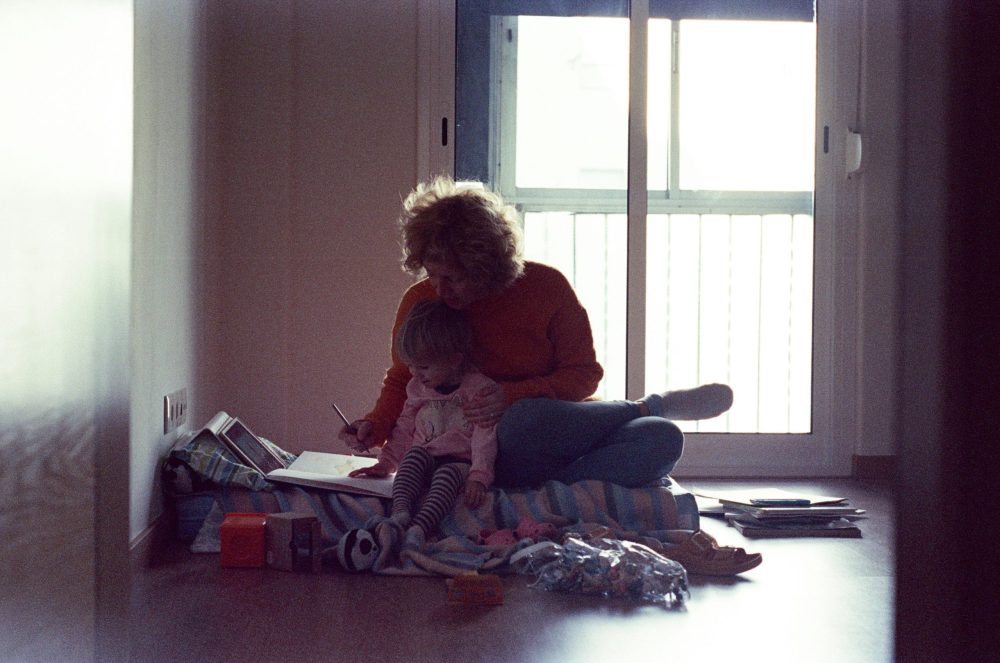
It’s 5:00 AM and I’m writing in a corner of our bedroom that I’ve cordoned off with a curtain. This is now my office. My old office became the baby’s room. Like many aspects of my postpartum life, my new space feels scotch-taped together. My desk, a thrifted school desk, is cute but so small that yesterday I elbowed my tea to the floor. I keep knocking my chair into teetering piles of books. My daughter’s baby blanket is spread across my lap.
In this space, I recently made final edits to the manuscript for my first book, She Was Wild Grass. As I edited, I was pleased by the textures and confidence of my language. I know my book is good. I am good. Yet I also feel a leaden anxiety pressing into my gut, a feeling that reverberates into my days and nights, making me pause while stirring the soup I cook for dinner and wake with my heart racing.
My book is nonfiction, all true, including its moments of violence and darkness. Material I needed to write through in order to move beyond it and turn toward beauty. To be the best mother I can be.
Now that I’m a mother, there are subjects in my book that I’d prefer not to discuss in detail with my daughter.
My anxiety eventually articulated itself as a question: What will my daughter think when she reads this?
What is a mother allowed to write?
I wrote most of my book before I was pregnant or even planning to have a child. I wrote it without knowing whether anyone would read it, and without concern about my audience.
But now that I’m a mother, there are subjects in my book that I’d prefer not to discuss in detail with my daughter. They are subjects I’d prefer she not read about at all in relation to me:
- doing drugs
- being hospitalized from alcohol poisoning
- temporarily separating from her father/my husband
- having sex with her father/my husband
- having sex at all
- masturbating
- getting raped
- experiencing loneliness as physical pain
I wouldn’t omit anything from my book. Yet as I sit at my desk and listen to my daughter breathe evenly over the baby monitor, deep in dreams, I’m snagged by shame, by the belief that instead of writing, I should be crafting her a protective bubble, like the kind that armors Glinda the Good in The Wizard of Oz. Or that I should be figuring out how to be Glinda the Good, pink and peaceful, archetypally maternal. Some part of me believes that as a mother I’m committing some sin of impropriety by writing the ugliest parts of my life. Maybe this has something to do with being raised Catholic. Or that there are no other writers in my family.
I worry that my daughter, or anyone in my family, without believing in the liberatory function of writing in the way I do, will view my book as simply spewing crude secrets. As if I wrote it for attention or for money. As if writing it wasn’t a deeply considered act—one that both enabled me to feel fully human and to speak truthfully about my experiences as a woman.
My mom once told me never to write about her. It was over the phone, after she learned from my sister that I’d written about something hurtful she’d said to me years earlier. I understand my mom’s desire to not have her life flattened on the page or to be spoken of in what she perceived to be a negative light. But also, I wasn’t criticizing her in my essay. I was writing about myself and my insecurities.
Over the phone, I told her I would never write about her, but I knew it was a lie. Maybe I wouldn’t write an entire book or even an essay about our relationship (as much as I want to), but as someone who mostly writes about my life, she’d need to show up here and there. Because she’s in my life. She’s the origin of my life. Even when I’m not writing about her, I’m writing about her. The same is now true of my daughter.
When I ask myself, What is a mother allowed to write?, I’m really asking myself, What do I allow myself to write? I am the director of my life. But my sense of myself has imploded since becoming a mother.
When I ask myself, What is a mother allowed to write?, I’m really asking myself, What do I allow myself to write?
Most days I don’t have the energy to write like I used to, and when I do it’s structured around my daughter’s sleep schedule. I rarely go out in the evenings anymore. I don’t have time for TV and I don’t drink. I’ve learned to quickly catch myself after tripping over a block, teething ring, ball, or shaker. I’ve accepted that I’ll usually show up 15 minutes late to any engagement because my daughter will need her diaper changed or for me to put out some small fire as I’m walking out the door.
Since giving birth, I instinctually reach for my husband’s button-down shirts to both cloak my leaking breasts and make them more accessible for my daughter to nurse. My body has held dozens of shapes in under a year. I can only tolerate soft pants. My clothes are usually crusted with baby spit-up or mashed banana. And sometimes with my own snot, when I can’t bother to find a tissue. It doesn’t feel good to be a walking garbage can. I’d like to buy new, comfortable clothes. But now that I only work piecemeal while staying home to care for my daughter, I have less money.
I’m trying to re-establish my “I” with what I have on hand: clothes that keep my body warm, batch soups with kale and beans, my desk in the corner of our bedroom. My writing.
While I’m still trying to reconfigure myself, motherhood has also imbued me with a sense of power and permission that I didn’t always feel as a daughter. I get to call the shots. I need to. I need to keep my daughter safe and teach her how to be a person.
Sometimes I think writing complicates this authority—I can make choices as an author and direct my narrative, but writers always lose control of their narrative once their writing is public. Other times I can feel my maternal authority shining throughout my creative process. I’ve done what I previously thought unfathomable—I birthed a child and kept her alive amid my own medical and mental crises. I now trust myself more.
I’m writing this now from my desk while continuously glancing at the baby monitor to check that my daughter is still sleeping, still safe. I’m writing this even though it terrifies me, even though some part of me worries I’m risking rupturing my closest relationships.
As a mother, what are my boundaries in writing? I’m still learning.
My mom lives a thousand miles away but calls me weekly. At the end of our phone call yesterday she told me, “By the way, I preordered your book!”
I sat up on the couch.
For years, she’d heard me talk about working on my book, and she’d celebrated with me when it was accepted for publication. Of course she’d be curious to read it. And I was grateful for her support. But, after a pause, I took a breath and told her, “You might not want to read it.”
She laughed nervously and said, “Oh.” Then she said, “Well, did it make you feel better to write it?” I cringed at her question, at what I perceived to be an oversimplification of my intellectual pursuit. But then I thought about it more. And I answered, truthfully, “Yes it did.”
In Motherhood and Its Ghosts, Iman Mersal writes about the impossibility of seeing one’s mother accurately in a photograph, and I think the same applies to any close relationship, depicted in any art form. “Is it not possible that the history and memories and details we share with [one’s mother] are a burden, functioning as a sheet or curtain that hides them from us?”
If my mom or daughter read my memoir, they’d likely only see me instead of the writer. They’d see me navigating difficulty and perhaps they’d want to fix things, or it’d hurt their feelings. Maybe they’d wonder why I couldn’t just write about being happy or even our happiness together.
My book is not for them, even if I wrote it out of love for them.
I worry that if my daughter read my work, it’d disrupt her ability to believe I’m a safe haven. I worry she’d judge me. I worry she’d be disgusted by me.
I also want my daughter to know me, truly. And I want her to know that even if people make mistakes or experience harm, they are still capable of greatness and worthy of love. She is allowed to be imperfect and I will always love her.
But what about boundaries? As a mother, what are my boundaries in writing? I’m still learning. Lucy Ives, on mentioning she experienced postpartum intrusive thoughts in an essay, pauses the narrative to say, “Speaking of boundaries, this is actually the limit of what can be written down. I can’t describe the things I thought to you.”
I won’t write about the harm my mother experienced as a child. I won’t write about my friend’s serious illness. I won’t write about the worst words exchanged between me and my husband. What can’t I tell you about my baby daughter? What would betray her privacy, her autonomy? I can’t say yet. But while the central inquiry of this essay, what is a mother allowed to write?, concerns my daughter, I actually write very little about her here. I want to protect her. And—this is an essay about me.
Women, and mothers in particular, are routinely punished for making art. Emily Van Duyne, in her essay “The Trouble-Making Mothers,” critiques the writer Caitlin Flanagan’s suggestion that Joan Didion’s daughter Quintana descended into addiction because of her mother’s devotion to writing. Duyne writes that Flanagan’s “illogic points to the ways we try writing mothers in absentia for their children’s perceived failings, or sufferings—they are always guilty, and their writing is always to blame.”
I don’t want to be punished as a mother. My identity as a mother is still so new and vulnerable. I’ve already beat myself up a thousand times for my imperfections, lapses in attention, and failure to completely protect my daughter from frustration, fear, anger, or sadness. I’ve also felt my personhood be obliterated by my attempts to be the perfect mother—cooking fussy meals on little sleep, sewing her gifts even though I mostly hate sewing, teaching her likely useless exercises to improve her motor and cognitive skills from some “baby genius” app—and I know that kind of martyrdom is unsustainable and unhealthy for me and my daughter.
I want to be a good mother and I want to be my own person. This desire makes me think of the moment in Duyne’s essay when she writes that Flanagan’s hostility toward Didion seems to stem from “rage at a woman who dared to make herself the center of her own story.” I’m trying to figure out how to be the center of my own story, and how to remain sovereign as a writer even as I consider the moral implications of writing about my family, including risking invading their privacy.
Writing, for women especially, can be dangerous—socially and physically. I think of the Brontë sisters with their pen names. I think of journalists who trek war zones to bear witness, like Shireen Abu Akleh from Palestine, murdered by an Israeli sniper; like Viktoriia Roshchyna from Ukraine, murdered in Russian custody. And I think of the strangers who have wished me harm in the comments sections of my essays. I’ve begrudgingly accepted their words as part and parcel of being a woman in the public sphere. But their menacing and violent comments doubly haunt me as a mother. I worry that anything I write will endanger my daughter’s safety.
Despite the risks, I need to write. Writing is what I do. It’s how I know myself. It’s how I try to understand my mother, and how I am beginning to try to understand my daughter.
I often turn to Bernadette Mayer for permission to entwine my creative life and motherhood. Mayer subverts the phrase I whispered to myself in the years before I had a child, Book before baby, as if their integration were impossible, as if motherhood occluded intelligence. In Mayer’s poems, her children and words spill into each other and blossom.
In “Abou,” she writes:
“it’s fine to have an audience
after having a family”
I interpret this to mean that I’m allowed to be the writer I was before I had a child. And with my book coming out, it means I may need to have uncomfortable conversations with my daughter and family down the road.
My identity as a mother is still so new and vulnerable. I’ve already beat myself up a thousand times for my imperfections.
Jane Lazarre, in her memoir The Mother Knot, takes Mayer’s permission to write and posits it as maternal responsibility. Amid her crazed first year of motherhood—in which her nerves are shot, she screams at her son and husband, and she resents being called “Jim’s wife” to her face—she begins writing devotedly in her journal. When she first starts an entry, her thoughts are tangled and stymied. But if she keeps writing, “a process began, a sort of translation of the tension into words.” Her nerves calm, she regains equilibrium. Identity intact, she is able to best parent her child.
In my office-corner my tea’s gone cold. The curtain emanates filmy grey light. It gets lighter earlier now as the year deepens into spring and inches toward my daughter’s first birthday. I often lose focus these mornings. I stop writing and read short novels. I peek past the curtain to watch my neighbor’s dog bound around their small backyard, ecstatic, bathed in dawn.
It’s taken me months to write this essay.
My husband wakes and changes our daughter every morning, then brings her to me to nurse. I hear her in the hallway, “Mamamamama,” calling for me. Claiming her own language.
We lie together in my bed and I nurse her, stroking her hair and her soft, plump cheek. When she finishes, she rolls sleepily away from me. Together, we look toward my empty desk, my books, and the bright sky beyond them. She asks, “Mama?” And we start a new conversation.
Read the original article here