This article is free to read. So is every article Electric Literature publishes. No limits, no paywalls—now or ever. Support from readers like you makes that possible.
We need to raise $60,000 to start off 2027 strong. Donate now to our end of year fundraiser to help ensure the future of free, accessible literature for all.
—————
While a part of me is always surprised when another Austen adaptation comes out, a different part of me—the part that prevails—wants to open the windows and shout Byron from the rooftops: “On with the dance! Let joy be unconfined.”
I suppose I was surprised that there would ever be another big-screen adaptation of Sense and Sensibility for a few reasons. I’ll begin with the reason that is potentially unfair, which is simply that Ang Lee’s 1995 adaptation was done so well I didn’t believe any other would stand up to it. (The 2008 BBC adaptation was solid but forgettable.)
Good adaptations can do that. Beyond being sufficiently powerful to be the “final word” on a work, they can start blending in dangerous and potent ways with the source material. Kate Winslet’s Marianne was Marianne Dashwood, just as Eleanor would always wear the face of Emma Thompson. The 1995 adaptation holds another point of significance for me: I admired the fact that Taiwanese filmmaker Ang Lee was brought on to direct an English period drama set in the late 18th century. Given my compulsion to write about characters and periods that don’t belong to my own time and cultural background, this felt especially important. Certainly, it speaks to the universality of Austen’s appeal, but knowing Lee had directed the film made me, to be frank, rather smug. At the time of my watching the movie, when I was very young and merely pretended to know a lot about Austen, some unspoken barrier seemed to have been lifted. The 1995 Sense and Sensibility movie was a truly great film on its own, a masterly adaptation of one of Austen’s most beloved works, and it was also directed by Ang Lee.
Oakley reminds us Austen deserves to be taken seriously. Very seriously. No light fare to be had here.
But none of this answers my original question of why Austen continues to be adapted again and again—and again. The cynical part of me finds it concerning, if not eyebrow-raising, that in our modern age, part of the continued appeal may be that we are still buying into the fantasy of uncomplicated happy endings, of simple love stories that treat love as an uncomplex and straightforward entity when it is anything but. Love is complicated (how can it not be?) because it is an amalgam of human quirks, of individual traumas and socio-economic backgrounds, of professions and different belief systems—the list can go on and on of all the factors that make a personality what it is. Still, many consider Austen to be light fare, ascribing her to the realm of the lovey-dovey and sentimental. It’s all about romance and love, isn’t it? So it has to be feel-good and happy. It’s all about stupid misunderstandings, but in the end, the guy gets the girl, right? Wrong.
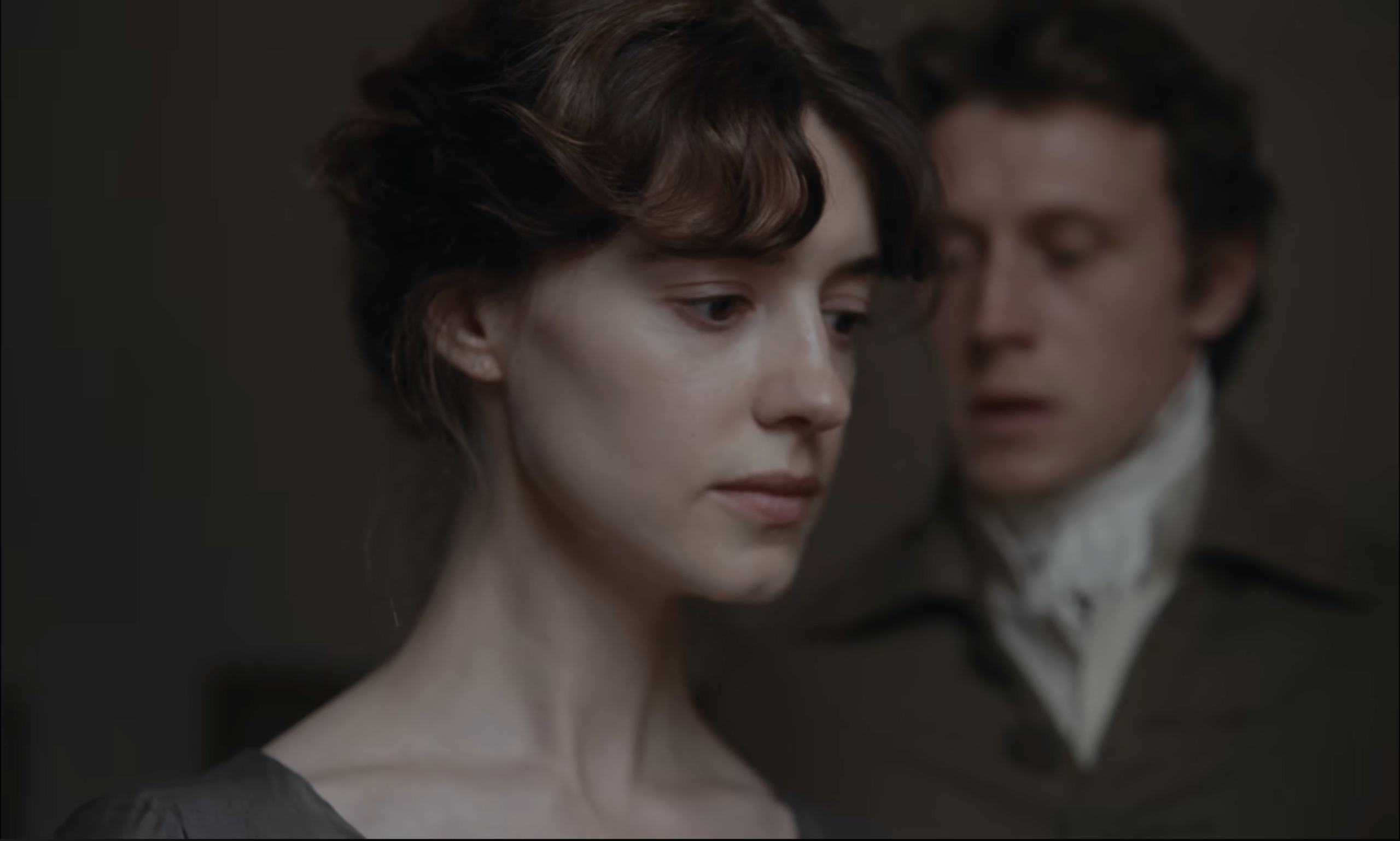
I thought of this when I watched Georgia Oakley’s Sense and Sensibility, starring Daisy Edgar -Jones and Esmé Creed-Miles as Eleanor and Marianne Dashwood. Oakley reminds us Austen deserves to be taken seriously. Very seriously. No light fare to be had here. From the get-go, everything feels an uphill battle for our lovely protagonists. The very first scene throws the viewer into a state of tension. Marianne lies in grass, watching a caterpillar crawl across her finger. It looks languid and pretty, the kind of scene one expects to lead an Austen film (rather like Keira Knightley’s Elizabeth Bennet taking a leisurely walk at the beginning of Pride and Prejudice while reading the final pages of a book). Appearances can be deceiving, however. Marianne is actually waiting for the mail coach that brings her father’s will. The scene of Marianne starting up from the grass when the coach appears and running towards it is interspersed with a beautiful visual of fallow deer running. Symbolically, this works well. The film often asks the question of who is really doing the hunting. Is it the men, who make offers of marriage? Or the women, endowed or, as is the unfortunate case with Eleanor and Marianne, not endowed with any significant fortune or estate? The Dashwood sisters are equipped with only their beauty and personal charms to find husbands. A much later scene of a heartbroken Marianne wandering the woods brings this point home. Her spirit subdued, she comes across a pack of hounds that run past, ignoring her. It’s an eerie and rather dark moment in the film that shows the extent to which Marianne’s passion and life force have literally been drained by the pursuit of love. Despite her vivacity and quick intelligence, she has never been the hunter or predator but always the quarry, the coveted hind.
The men of the film were so forgettable that I’m convinced cardboard cutouts would do just as well.
For everything that the film does right stylistically and visually, it also gets Austen really wrong. This isn’t only because the men of the film were so forgettable that I’m convinced cardboard cutouts would do just as well (as for Edgar-Jones and Creed-Miles, they were a delight to watch). But by taking the “Austen” out of the business of love and marriage, the adaptation seems to miss the point. In Oakley’s film, we see all the difficulties and challenges of love and marriage without being able to laugh at any of it. This makes things not only dreary but also uninteresting. Without humor, without lightness and wit, we have a very basic story of two sisters whose financially straitened circumstances render it a matter of both urgency and necessity to seek husbands. One sister (Eleanor) is more rational, more levelheaded, while the younger (Marianne) is outwardly more passionate. Time is of the essence. Youth and beauty won’t last forever. The clock is always ticking.
Oakley’s Sense and Sensibility is muted. Even when the sun is out, the film reminds me of cloudy weather: a lot of grays and dusky blues, a lot of dirt under one’s fingernails and sooty hands, and unkempt hair, and faces that look like they could do with a good soapy scrub. I hardly laughed at all. No particular lines hit home. Everything was finely executed; nothing, however, was memorable. No one was very funny, not even Fiona Shaw in the role of Mrs Jennings. Shaw is usually incredible, but this role wasn’t one of her finest, not by any stretch.
I acknowledge that it’s always easier to be critical, but this Austen adaptation made me genuinely miss Austen. Where was the wit? The cutting humor? Where was, in short, the comedy behind the horror, the hilarity behind the cold-bloodedness and mercenary nature of the marriage market that we already know and acknowledge to be perfectly awful? That is what makes Austen, after all, Austen. Austen isn’t a byword for love or for happy marriages. That isn’t why she has endured. If she endures, it is because she makes us laugh at situations that are stupid and ridiculous, where both women and men are forced to make the best of bizarre circumstances according to the dictates of a society that is at all times perilous. Everyone is risking penury; everyone is skirting the razor-sharp edge of social humiliation, AKA social death. Is it better to be a fool or to be poor is a question Austen throws at us time and again.
When the film was over, I breathed a sigh of relief (and was glad to use the restroom). Watching the movie had been less pleasurable than exhausting. My partner was already on his phone. He informed me that he’d sold a painting he found on a curb in his neighborhood a few hours before for nearly 40 dollars on Facebook Marketplace. “What?” I said. “You sold it that quickly? No way!” Truth be told, I was more impressed with his ability to make 40 dollars in no time at all than with the movie I’d just watched.
This Austen adaptation made me genuinely miss Austen. Where was the wit? The cutting humor?
Hours later, I shuffled to my bookshelf and, returning to the original text, found the novel to be more inspiringly revolutionary and rebellious than any part of the film, for all its contemporary touches. More than anything, I was struck by how very modern the novel feels. Yes, there are numerous references to terms specific to the historic period. But it is also incredibly nuanced. It captures so well the vagaries of human relations, the rapidly changing shades of nearly every character’s mind and thought process. Even the best of human nature is oftentimes contradictory and inconstant; that is what makes it human.
I’m one of the last people who has any right to say that an adaptation must stick to the source material. And I continue to believe an adaptation should have free rein; it should stand on its own. It shouldn’t rely on the viewer to come prepared or to possess any previous knowledge of the story and characters. But I think what Oakley’s adaptation lacks is a buoyancy, a lightness of foot. A sad situation, such as that the Dashwood sisters find themselves in, is always more poignant when it can also be funny, when it doesn’t draw so much attention to its tragic nature and the viewer ends up torn between whether to laugh or to feel pity. What Oakley’s Sense and Sensibility hammers home is a sense of the unromanticized chase. To Oakley’s credit, I think it’s useful to be reminded of why it isn’t wise—not always, at least—to romanticize love stories and depict them through rose-colored glasses. Eleanor’s frustration with Edward Ferrars during her last days at Norland is palpable. In one scene, she seems to be waiting for Edward to propose. Instead, he offers to see her out. Suppressing her upset, she gathers her drawing supplies and leaves. It’s impossible not to feel bad for Eleanor, and by extension, for any woman whose life becomes reduced to a perpetual waiting game. When will he propose? Will he ever propose? That is the question. That is indeed the crux of much of feminine existence. But that isn’t what makes Sense and Sensibility memorable. That isn’t really the reason why the work continues to resonate. Mostly, it’s Austen’s singular and scalpel-edged humor, the lines specific to characters that also ring so true about greed and buffoonery and marriage in general. It’s how resilient the two sisters become, how they find purpose and self-sufficiency in “merely” existing when no marriage proposals seem probable. What a novel idea, what a truly revolutionary and radical idea it is to live for oneself and to accept that there are many other forms of love than only the romantic.
It might have been unintentional on Oakley’s part, but her interpretation of Sense and Sensibility accomplished something else that I consider worthwhile to note. When I watched other adaptations, I always thought to myself how “fun” it would be to live as an Austen heroine, as, say, an Eleanor Dashwood or an Elizabeth Bennet or an Anne Elliot. I came away with no such feelings after finishing Oakley’s film. For all the problems and issues and worries that existence in any age brings, I was also reminded of how lucky I am. How liberating, I thought the next morning, after I’d had some time to mull over the film, to be unmarried, to have the lifestyle that I do, which, while far from affluent, is independent. I woke up next to my partner and after having breakfast on my own, went to work on his computer. For a break, we took a brief walk. Then we returned to his place, had sex and a filling lunch (scooped, toasted bagels from our favorite bagel place with plenty of lox, capers, and onions), after which time I left for home. On the bus, I listened to “Pet Sematary” by the Ramones (it was still Halloween season). I read more of Sense and Sensibility. I returned to my place and proceeded straight to the gym, and after a workout, I showered, cooked, had dinner by myself, and ended the day with more reading and writing before falling asleep in my own bed. The day felt filling. To be with my partner felt good; to be alone felt as good. I mention this because Oakley’s Sense and Sensibility seemed a reminder to take none of this for granted. It’s a blessing to chase one’s dreams instead of chasing husbands. It’s a blessing to depend upon oneself for financial security and happiness instead of upon another. No wonder when I left the cinema I felt so grateful for the fresh air, for the freedom of being released from the cavernous dark of the theatre. I was free to do as I wished, whenever I wished, and according to my own judgment. Austen, I think, would have approved.
In reflecting on the film, I can’t help but recall a line from Pride and Prejudice when Elizabeth Bennet says, “I hope I never ridicule what is wise or good. Follies and nonsense, whims and inconsistencies do divert me, I own, and I laugh at them whenever I can.” That’s all that was missing, really, from Oakley’s film—laughter—but what a miss it was.