The premise of Andrea Uptmor’s debut novel, The New People, is both gloriously simple and fraught with tension. Newlyweds Emma and Rachel move into a recently foreclosed house in a Midwestern campus town in 2008, but unbeknownst to them, the evicted former owners Charlotte and Dirk are still living in the attic in a form of illicit cohabitation known as phrogging. The contested space of the house—which Charlotte begins to sabotage in the hopes that “the new people” will leave—ultimately grounds the novel’s larger questions about the domestic infrastructure of marriage, homeownership, and parenthood, especially for people whose access to those social institutions has been restricted.
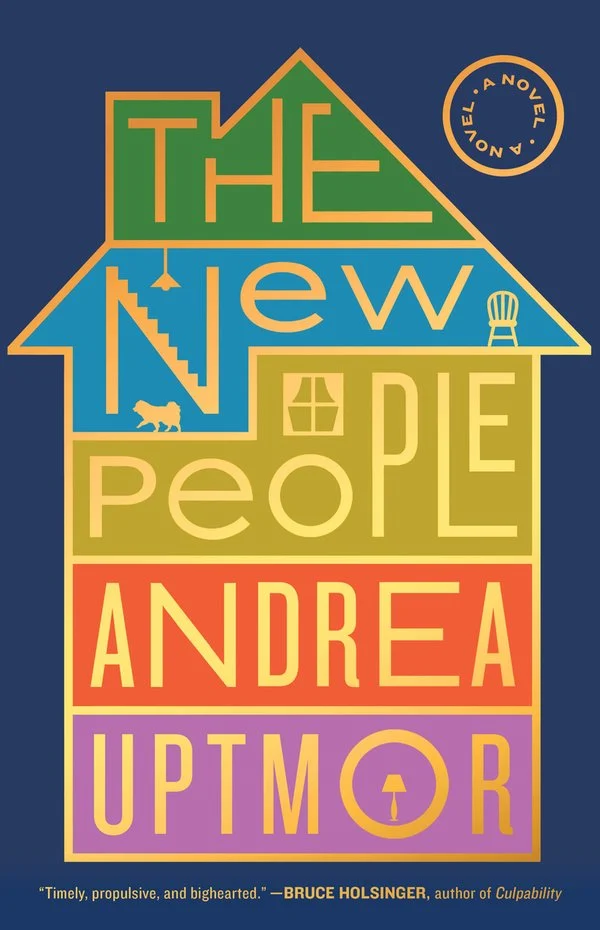
As a queer millennial who experienced the travails of trying to secure the legal protections of marriage well before the 2015 Obergefell v. Hodges ruling, I had no idea how much it would mean to me to encounter a story like this one. Uptmor’s insights into the pressures that both legal and social queerphobia exert on Emma and Rachel’s marriage is pitch-perfect, and I loved the unexpected way in which she intertwines their struggles with those of the much older straight couple. Her approach feels refreshingly nuanced and true to the lived complexities of navigating queer adulthood in a predominantly conservative community. The book frequently made me laugh, and even moved me to tears in public. I should also mention that it is built far more sturdily than the fictional house in question, with well-finished prose and an elegantly constructed plot. In short, it’s a novel I will be thrusting into the hands of queer and straight friends alike in the coming months.
In anticipation of the book’s release, Uptmor and I had a delightful conversation over Zoom this spring about living hauntings and contested domestic spaces, as well as the intersections of queer and economic issues that drew her to revisit 2008 with these particular characters.
Jules Fitz Gerald: I once heard Carmen Maria Machado speak about all stories being haunted house stories, in the sense that they’re haunted both by their writers and by their readers. If you think of yourself as a ghost, what prompted you to haunt this particular fictional house in Indiana?
Andrea Uptmor: This idea of illegally occupying somebody’s home has always been interesting to me. When my wife and I bought our first house in 2013 in South Minneapolis, it was in the middle of a huge rash of foreclosures in the neighborhood, and the day after we moved in, our neighbor was evicted due to foreclosure. Right after he left, a group of squatters moved in and occupied the house. Law enforcement was there all the time with their guns drawn, the windows were broken in, but they couldn’t get these people to leave. It was so fascinating to me, this idea that, for me, home ownership was about a mortgage, and for the people next door, it was about occupying a space. It wasn’t until I learned about phrogging, which is living in somebody’s house without their knowledge—sort of an actual living haunting—that I thought, oh, that’s the story. Because then you’ve got that automatic tension between the people who believe they own the house and the people who are occupying it.
The house becomes this microcosm of what’s happening in the country.
In terms of why Indiana, that’s a good question. I was living in Iowa at the time that I wrote this and was really feeling what Emma feels throughout the book—not quite belonging, being a woman married to a woman. Like Iowa, Indiana can be one of those on-the-fence places where you just never know, when someone’s cleaning your teeth at the dentist’s office, or giving you an Uber ride, whether they’re a safe person or not. I wanted to recreate that environment for Emma and [the] other characters where there’s this air of uncertainty, where you’re not always sure if people are being intentionally aggressive or bigoted or homophobic, or whether it’s being perceived through Emma’s conditioning.
JFG: I loved how you handled that in the book. I live very far from Indiana, in rural Oregon, but what you’re describing really resonates. Beyond the place, it was interesting as a reader to look back on that time period, especially as rights that once seemed like legal certainties–like marriage equality–are increasingly in question. What was it like for you to write 2008 from the vantage point of the present?
AU: I’m very nostalgic for 2008. I would love to go back right now and have eight years of Obama ahead of me. But it was a pretty grim time, economically speaking. Nearly 2.5 million homeowners lost their homes to foreclosure. There was high unemployment. People’s 401Ks were tanking. There was a huge recession. At the same time, there was this brief window in California where same sex marriage was legal . . . then Proposition Eight passed, and it was no longer legal. We look back on 2008 with this sense of nostalgia and hope now, but when you were living it in the moment, people were losing their jobs, their money, their marriages, their rights to marry. It felt like the domestic infrastructure of people’s lives was disappearing. And if I wanted to write a story where a post-retirement couple was willing to endure the discomfort and humiliation of phrogging in their own attic, 2008 is probably the most likely time that this could have actually happened. The house becomes this microcosm of what’s happening in the country. The people in the attic, Charlotte and Dirk, are dealing with money issues and with a child who [lives with] addiction and mental illness. And the people downstairs, Emma and Rachel, are navigating being a queer couple in a conservative area. They’re all in the same space, but they’re having these wildly different experiences. Yet when they’re placed together in a narrative, there’s a lot of overlap.
JFG: I really appreciated how the book is a portrait of these two different marriages at very different life stages. What led you to write Charlotte and Emma as dual narrators rather than, say, going back and forth between Emma and Rachel?
Quite a bit of the loss [in the book] is characters having to reconcile themselves to their lives going a different way than they’d expected.
AU: It’s fun to reflect on these things because a lot of times the writing is instinctive, or you just pick up a trail. Of the four main characters, if I was going to dedicate a couple years of my life to really thinking about them, Emma and Charlotte are the two I liked the most and wanted to spend the most time with. I started with Emma because her experience most closely aligns with mine, and I think that’s often a place where writers start. I had this idea in my head, like you said, of a portrait of these two marriages, but I originally thought of them as political or generational foils, where we’ve got the conservative folks in the attic, and the lesbians downstairs, and you know, what’s gonna happen? The nuance grew through the editing. As I wrote, I realized Charlotte is so much more complex than I had originally intended, and it’s reductionist to try to just boil her down. She’s obviously Republican, but that’s not really important to the story.
JFG: Yeah, I think of her as a secondary protagonist.
AU: Well, she’s the one who’s got more of an agenda. Like she’s got a drive. Dirk is a little bit of her opposite in that he’s willing to just wait for things to happen. In the first draft, though, Charlotte was a lot less active. I think naturally a character who spends most of a book in an attic becomes very self-reflective. She had a lot of internalized sequences, whereas Emma is out in the world, she’s going to work, she’s going to the clinic, she’s interacting with and meeting new people, and it’s hard to balance two protagonists who are energetically very different. So in revision, Charlotte grew more into a person who is driving the story on a certain level, and she’s actually making things happen. I hate it when writers say this, but it kind of surprised me as I was writing. If we’re going to pull one spouse from each pair, they are the two most tortured. And if I’m going to read a book or write a character, I’m really interested in the tortured ones, the ones who are suffering and who are contemplating what to do about it.
JFG: Same. I have to ask, too, with all literary allusions—like that delightful running joke between Emma and Rachel about having a Mrs. Dalloway day—who were the other books and authors lurking in the attic of your brain while you were writing?
AU: I think the writer who has probably influenced me the most and whom I adore the most is Tessa Hadley. I always tell people I would pay money to read Tessa Hadley’s grocery list. There’s just magic in the sentences. One thing that I admire about her and have picked up from her is her ability to layer psychology on the physical world, to blur the mental landscape with the physical landscape. There are parts of The New People where I can totally tell that I was reading a Tessa Hadley novel while I was writing, and I was trying so damn hard to sound like her. You should never do that because you’ll never—she’s that category of one.
Someone else I really love is Megha Majumdar, who wrote A Burning and A Guardian and a Thief. She writes these big stories where society is looming and impacting what’s happening on a level between two people. And yet the stories are so efficient. These are short novels that have these big, big worlds with huge consequences. She’s not afraid of a sad ending though, and I am—I can’t do it.
JFG: I’ll resist commenting on the ending of The New People, except to say that something I love so much about Emma is how her actions keep escalating. There’s this sense of watching the train wreck happening. I also really enjoyed that she’s a writer. It’s poignant that one of the big imbalances in her marriage with Rachel is that Emma has been writing this beautiful, quiet literary novel, trying to sell it for years, and then Rachel writes this bestselling science fiction novel. What was it like to write a character who is also a writer?
The novel is a perfect art form for shining a light on how these big systems that govern our lives, respond to something stressful.
AU: My agent would keep putting comments that said, “This is too inside baseball.” I have an MFA, which is really just a couple of years where you’re allowed to talk about writing 24 hours a day with people and you don’t have to excuse yourself. I still find it so fascinating and so interesting. Emma’s a writer, but she’s also dealing with something that a lot of creatives deal with, which is failure, this idea that when you’re creating a piece of art or a novel, most of the time, nobody has asked for it. That’s how I felt while I was writing this novel and kind of torturing myself over it like, is this going to be anything? Is this worth all the time and the tears? Nobody asked me to write this book and the world would be the same if I did or didn’t, and artists have to grapple with that all the time. Why do I keep going? What fuels me creatively? This is something that Emma doesn’t address directly because she spends so much time trying to look at anything but this creative failure. But it ties in with the rest of the book in the sense that everybody’s got some kind of invisible hope that’s dangling in front of them that keeps them going, that makes them want to want to get out of bed in the morning, and for a lot of creatives, the work is that.
JFG: There’s a lot of loss in the book, but quite a bit of that loss is more of characters having to reconcile themselves to their lives going in a different way—or motherhood looking a different way and marriage looking a different way—from what they’d hoped or expected. I know you were just talking about hope and the more sunny side of things, but I’m fascinated by your choice to make the house itself a compromised, dangerous space at a very literal level, with the shortcuts that were taken when the house was flipped and Charlotte’s later attempts at sabotage to try to get Emma and Rachel to leave. Am I reading too much into the metaphor to think of this as an interrogation of these domestic institutions or traditional frameworks around marriage and motherhood?
AU: I think in some ways big metaphors and big acts of symbolism in novels are the invention of the critics. I think the writer’s job is to bring up an implausible scenario and then create an authentic setting and authentic characters around it, so that what comes out is not symbolic but the natural human output of a society. So I appreciate that reading very much. The house failing on a structural level certainly was a critique of the way that the housing market crash happened in 2008. There was such a rush to get all these houses out. There were so many predatory lenders, and so many people who did not understand what they were signing up for. And that was the point. And obviously the people who flipped Rachel and Emma’s home can stand in for all the big bad players during that time. People did not have your security or your safety in mind when all of this was happening. It was just about lining people’s pockets.
I think the novel—not this novel in particular, but the novel in general—is a perfect art form for shining a light on how these big systems that govern our lives, the economy and political weather and the legal systems, how that plays out on a day-to-day level between two people who are talking, how they respond to something stressful. So I wouldn’t think of it naturally as symbolism, though a reader is definitely invited to think of it that way. That’s the great thing about the relationship between the writer and the reader, back to this question of haunting, is that the writer’s job is to build the house, and then move out, just get the hell out, and the reader comes in and the reader changes the lighting and moves in furniture, and that’s the most beautiful part of this whole process.
Read the original article here